
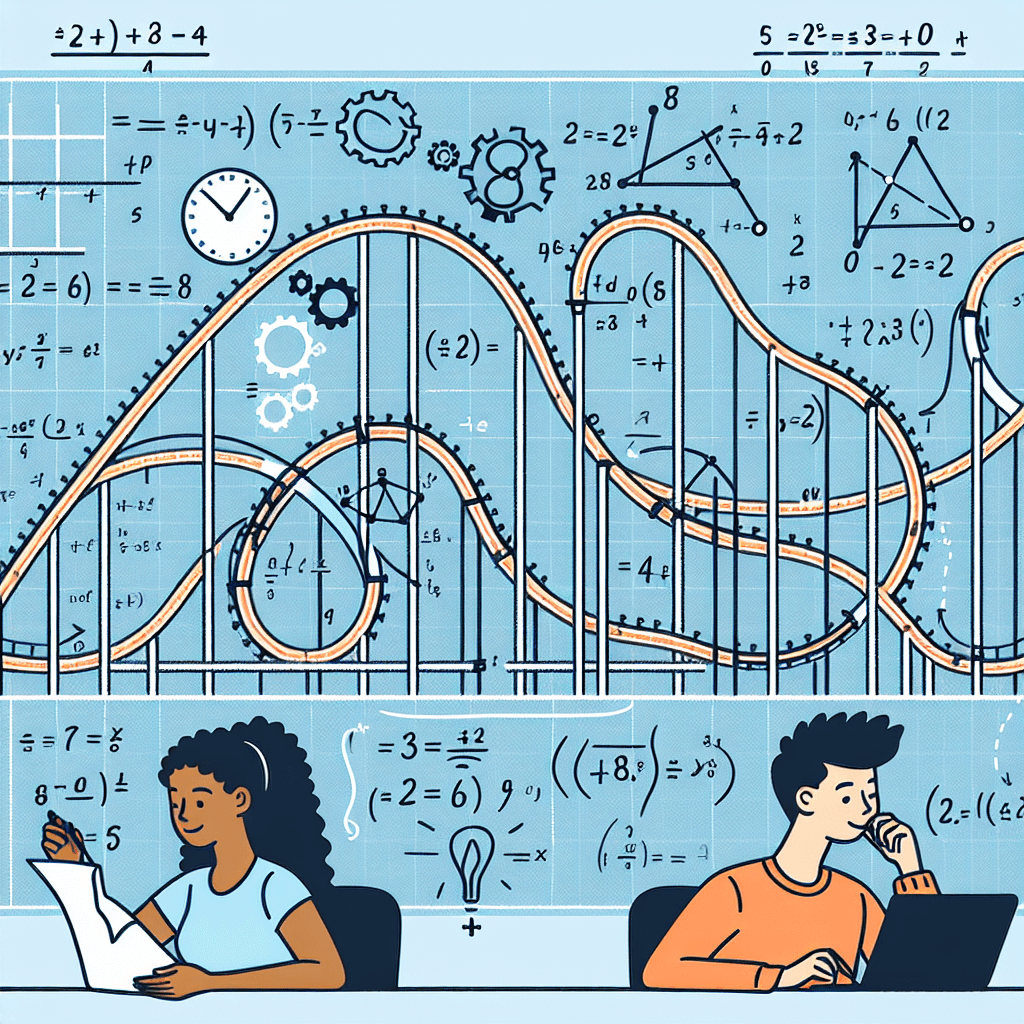
Design a Roller Coaster with Systems of Equations
Inquiry Framework
Question Framework
Driving Question
The overarching question that guides the entire project.How can we apply systems of equations to design a roller coaster that is safe, functional, and thrilling, while considering key components, safety limits, and real-world mathematical modeling?Essential Questions
Supporting questions that break down major concepts.- How do systems of equations apply in real-world situations such as designing a roller coaster?
- What are the key components of a roller coaster and how can mathematical equations represent these components?
- How can we use mathematical modeling to ensure the safety and functionality of a roller coaster design?
- What mathematical strategies can be used to optimize the design for speed and thrill while maintaining safety limits?
- How can different solutions to a system of equations influence the design and structure of a roller coaster?
Standards & Learning Goals
Learning Goals
By the end of this project, students will be able to:- Understand and apply systems of equations in real-world situations, particularly in the context of roller coaster design.
- Identify and represent key components of a roller coaster using mathematical equations.
- Use mathematical modeling to evaluate the safety and functionality of a roller coaster design.
- Analyze and optimize roller coaster designs for speed and thrill while maintaining safety limits through mathematical strategies.
- Explore how different solutions to a system of equations can influence the design and structure of a roller coaster.
- Develop problem-solving and critical-thinking skills through designing and evaluating mathematical models.
Common Core Standards
Next Generation Science Standards
Common Core Standards for Mathematical Practice
Entry Events
Events that will be used to introduce the project to studentsEquation Escape Room
Students enter a digital escape room where each puzzle requires solving systems of equations to progress. The final challenge: design the ultimate roller coaster that is both exhilarating and safe using their newfound knowledge, blending gamification with real-world problem-solving.Portfolio Activities
Portfolio Activities
These activities progressively build towards your learning goals, with each submission contributing to the student's final portfolio.Graphing the Coaster Path
This activity focuses on graphing the equations and inequalities developed previously to create an accurate representation of a roller coaster's path. Students will learn to use graphing tools to visualize their designs, ensuring that the ride meets both thrill and safety requirements.Steps
Here is some basic scaffolding to help students complete the activity.Final Product
What students will submit as the final product of the activityA graphically represented roller coaster path using equations and inequalities on a coordinate plane.Alignment
How this activity aligns with the learning objectives & standardsSupports CCSS.MATH.CONTENT.HSA.REI.C.6 by solving systems of equations approximately using graphs.Safety Constraints and Viability Analysis
Students will analyze their roller coaster designs based on safety constraints and determine the viability of their models. They will learn to apply system solutions meaningfully, evaluating if they meet both thrilling experience and safety standards.Steps
Here is some basic scaffolding to help students complete the activity.Final Product
What students will submit as the final product of the activityA viability report detailing which components of the roller coaster model meet safety standards and how others might be adjusted for improvement.Alignment
How this activity aligns with the learning objectives & standardsAligns with CCSS.MATH.CONTENT.HSA.CED.A.3 by ensuring students represent constraints through equations/inequalities, interpreting solutions in context.Design Optimization Challenge
With safety and functionality confirmed, students are now challenged to optimize their roller coaster designs for maximum thrill. They will use mathematical strategies and modeling to find the perfect balance between excitement and safety.Steps
Here is some basic scaffolding to help students complete the activity.Final Product
What students will submit as the final product of the activityAn optimized roller coaster design that balances thrill and safety, supported by mathematical strategies and models.Alignment
How this activity aligns with the learning objectives & standardsSupports CCSS.MATH.PRACTICE.MP4 by engaging students in modeling with mathematics and optimization techniques.Final Presentation and Reflection
Students will present their complete roller coaster designs, emphasizing the mathematical journey from conception to final optimization. They will reflect on how different solutions to systems of equations influenced their designs and the critical thinking skills developed throughout the project.Steps
Here is some basic scaffolding to help students complete the activity.Final Product
What students will submit as the final product of the activityA comprehensive presentation of roller coaster designs and a reflective piece on the mathematical and critical thinking skills applied.Alignment
How this activity aligns with the learning objectives & standardsAligns with NGSS.HS.ETS1-2 by having students design solutions to complex problems and with CCSS.MATH.PRACTICE.MP1 by developing perseverance in problem-solving.Rubric & Reflection
Portfolio Rubric
Grading criteria for assessing the overall project portfolioRoller Coaster Design & Analysis Rubric
Mathematical Understanding
Assessment of students' comprehension and application of mathematical concepts through systems of equations in the design process.Conceptual Application
Evaluate how well students apply mathematical concepts such as systems of equations to model real-world scenarios.
Exemplary
4 PointsDemonstrates sophisticated application of systems of equations in a real-world context, with innovative solutions.
Proficient
3 PointsDemonstrates thorough application of systems of equations, providing appropriate solutions.
Developing
2 PointsShows limited application of systems of equations, with some errors present.
Beginning
1 PointsStruggles to apply systems of equations in developing solutions.
Mathematical Precision
The accuracy and detail of the mathematical work presented, such as calculations and graphing.
Exemplary
4 PointsDisplays meticulous precision in mathematical reasoning and graphing, with no errors.
Proficient
3 PointsShows accurate and precise mathematical reasoning with few errors.
Developing
2 PointsExhibits some accuracy in mathematical reasoning, with several errors.
Beginning
1 PointsDisplays minimal accuracy, with frequent errors in reasoning and graphing.
Safety and Functionality Analysis
Evaluation of how well students identify and incorporate safety and functionality constraints in roller coaster design.Constraint Identification
Ability to identify and represent safety and functionality constraints using equations and inequalities.
Exemplary
4 PointsExpertly identifies and represents all relevant constraints, with innovative use of equations and inequalities.
Proficient
3 PointsCorrectly identifies and represents key constraints with equations and inequalities.
Developing
2 PointsIdentifies and represents some constraints, but incomplete or inaccurate at times.
Beginning
1 PointsStruggles to identify or represent constraints accurately.
Solution Viability and Analysis
Analyze the viability of design solutions concerning identified constraints and propose improvements.
Exemplary
4 PointsProvides a comprehensive and innovative analysis of design solutions, exceeding safety standards.
Proficient
3 PointsDelivers effective analysis of design, meeting safety standards with logical improvements.
Developing
2 PointsPresents basic analysis of design solutions, with errors or omissions in meeting standards.
Beginning
1 PointsMinimal analysis with significant errors in understanding safety standards.
Creative and Critical Thinking
Evaluation of the creativity and problem-solving skills demonstrated in designing a functional and thrilling roller coaster.Creativity and Innovation
The ability to innovate and create unique designs that represent systems of equations realistically and creatively.
Exemplary
4 PointsDesigns an exceptionally creative roller coaster, showcasing advanced innovation in mathematical concepts.
Proficient
3 PointsIllustrates creativity and innovation in roller coaster design, using mathematical concepts well.
Developing
2 PointsShows some creativity in design, with room for increased innovation and sophistication.
Beginning
1 PointsMinimal creativity and innovation in design, struggling to apply concepts creatively.
Problem Solving and Adaptability
Assessment of how well students address challenges and adapt their designs in response to feedback.
Exemplary
4 PointsDemonstrates outstanding problem-solving skills, adapting designs creatively with thorough consideration of feedback.
Proficient
3 PointsShows good problem-solving abilities, effectively adapting designs following feedback.
Developing
2 PointsEngages with problem-solving to a limited extent, with inconsistent adaptation strategies.
Beginning
1 PointsStruggles with problem-solving and adapting designs effectively.
Presentation and Reflection
Assessment of the clarity and depth of students' presentations and reflections on their learning experience.Presentation Clarity and Organization
The clarity, organization, and professionalism of the presentation, including the communication of mathematical processes.
Exemplary
4 PointsPresents with exceptional clarity and organization, communicating mathematical processes effectively and professionally.
Proficient
3 PointsProvides a clear and organized presentation with effective communication of processes.
Developing
2 PointsOffers a presentation with some clarity issues, lacking in organization occasionally.
Beginning
1 PointsPresentation lacks clarity and organization, struggling to communicate ideas effectively.
Reflective Insight
Depth of reflection on the learning process, including understanding of mathematical modeling and critical thinking development.
Exemplary
4 PointsProvides profound reflective insights, thoroughly analyzing the learning journey and growth in critical thinking.
Proficient
3 PointsOffers effective reflection, demonstrating awareness of learning growth and critical thinking development.
Developing
2 PointsReflects on learning with limited insight or depth, touching on growth sporadically.
Beginning
1 PointsProvides superficial reflection with minimal engagement in analyzing learning experiences.