
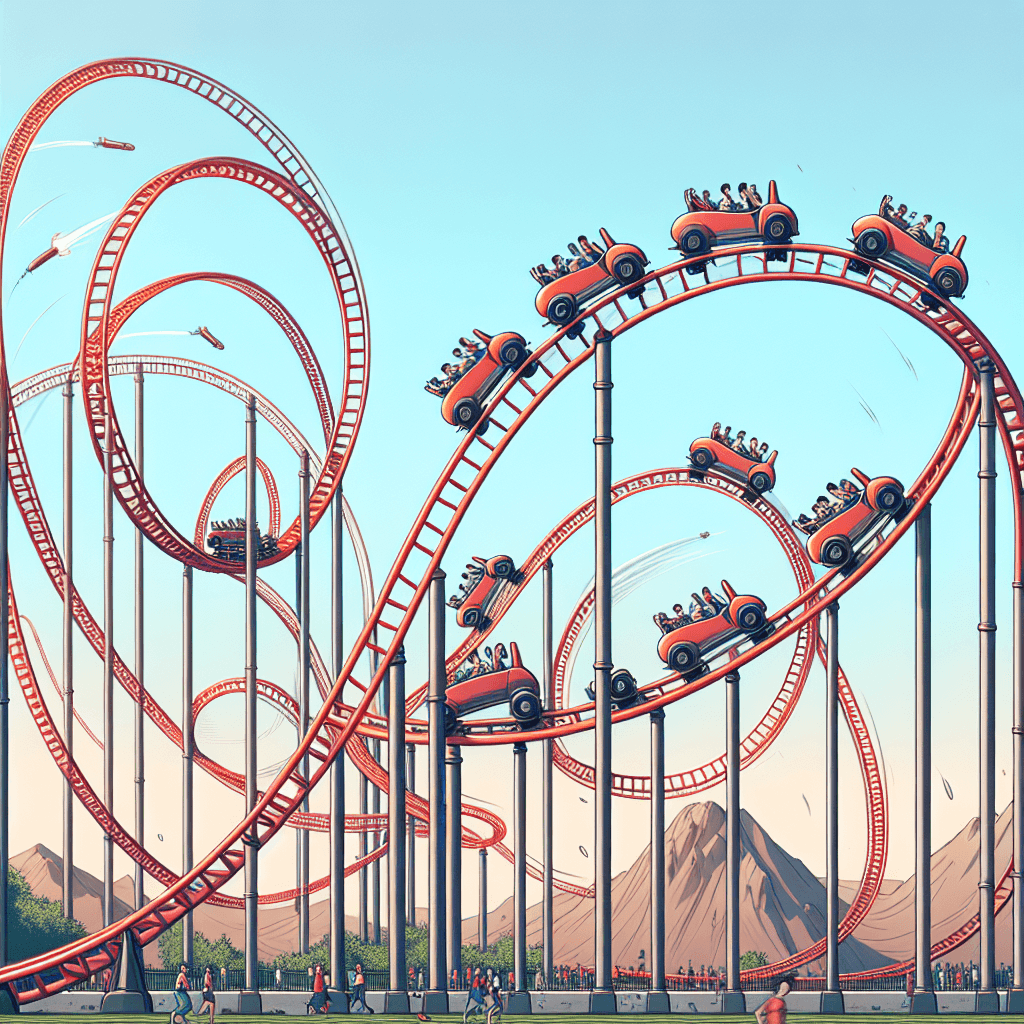
Design a Thrilling Roller Coaster Using Newton's Laws
Inquiry Framework
Question Framework
Driving Question
The overarching question that guides the entire project.How can we apply Newton's Laws of Motion to design a safe and thrilling model roller coaster that demonstrates the interaction of energy, force, and motion?Essential Questions
Supporting questions that break down major concepts.- What are Newton's three laws of motion, and how do they apply to everyday experiences?
- How can we measure and demonstrate the effects of forces on moving objects?
- In what ways can understanding the principles of physics help in designing a roller coaster?
- What safety considerations must be taken into account when designing a roller coaster?
- How do energy, force, and motion interact on a roller coaster track?
Standards & Learning Goals
Learning Goals
By the end of this project, students will be able to:- Students will understand and explain Newton's three laws of motion and their application to real-world scenarios, specifically roller coasters.
- Students will design and create a model roller coaster that effectively utilizes and demonstrates the concepts of force, energy, and motion.
- Students will investigate and analyze the interaction of balanced and unbalanced forces on their roller coaster model.
- Students will evaluate the safety implications of their roller coaster designs, applying principles of physics.
- Students will interpret and present data on how mass, speed, and kinetic energy interact on their model roller coaster.
Next Generation Science Standards
Entry Events
Events that will be used to introduce the project to studentsDesign-a-Coaster App Challenge
Introduce the project with a mobile app challenge where students use an app to design their own roller coaster, aiming to maintain safety while maximizing thrills. They can present their initial designs and challenge each other on understanding of physics involved, setting the stage for in-depth study.Portfolio Activities
Portfolio Activities
These activities progressively build towards your learning goals, with each submission contributing to the student's final portfolio.Conceptual Coaster Design
In this initial activity, students will learn about Newton's three laws of motion and their application to roller coasters. They will research and analyze how these laws ensure both thrill and safety in roller coaster design. This foundational understanding is crucial for crafting their model coaster later in the project.Steps
Here is some basic scaffolding to help students complete the activity.Final Product
What students will submit as the final product of the activityA group presentation highlighting the relationship between Newton's laws and various elements of roller coaster design, supported by real-world examples.Alignment
How this activity aligns with the learning objectives & standardsAligns with MS-PS2-1 by applying Newton’s Third Law to design a solution using understanding of motion and forces.Forces and Motion Investigation
Students will conduct experiments to understand the effects of balanced and unbalanced forces on motion using simple materials. This will help them grasp core physical interactions that will be vital when building their roller coaster models.Steps
Here is some basic scaffolding to help students complete the activity.Final Product
What students will submit as the final product of the activityA detailed lab report containing observations, data collected, and conclusions drawn on the effects of balanced and unbalanced forces.Alignment
How this activity aligns with the learning objectives & standardsAligns with MS-PS2-2 by planning an investigation providing evidence of the effects of forces on motion.Energy Dynamics Workshop
In this activity, students explore the principles of kinetic energy and its relationship to mass and speed using their roller coaster designs. They will also begin to interpret and graphically represent the data they collect during test runs.Steps
Here is some basic scaffolding to help students complete the activity.Final Product
What students will submit as the final product of the activityGraphs and data analysis presentations on how mass, speed, and kinetic energy relate to their roller coaster models.Alignment
How this activity aligns with the learning objectives & standardsAligns with MS-PS3-1 by constructing and interpreting graphical data of energy relationships.Coaster Safety & Evaluation
Students will finalize their roller coaster designs by evaluating and implementing safety features based on their understanding of physics principles. They will then present their models, explaining the interplay between design, safety, and physical concepts.Steps
Here is some basic scaffolding to help students complete the activity.Final Product
What students will submit as the final product of the activityA presentation or demonstration of a safe roller coaster prototype, complete with safety features and an explanation of underlying physics concepts.Alignment
How this activity aligns with the learning objectives & standardsCombines elements from all three standards by creating a physical model informed by an understanding of motion, forces, and energy dynamics.Rubric & Reflection
Portfolio Rubric
Grading criteria for assessing the overall project portfolioRoller Coaster Physics Assessment Rubric
Understanding of Newton's Laws
Assessment of students' knowledge and application of Newton's Laws of Motion in the context of roller coaster physics.Comprehension of Newton's Laws
Evaluate students' understanding of Newton's three laws of motion, focusing on their application in roller coaster design.
Exemplary
4 PointsDemonstrates comprehensive understanding of Newton's three laws and provides exceptional examples of their application in roller coaster physics.
Proficient
3 PointsShows thorough understanding of Newton's laws with clear examples of application in roller coaster physics.
Developing
2 PointsDisplays basic understanding of Newton's laws with some relevant examples.
Beginning
1 PointsExhibits minimal understanding of Newton's laws with ineffective examples.
Application to Roller Coaster Design
Evaluate how well students can apply Newton's laws to innovate and problem-solve in roller coaster design.
Exemplary
4 PointsApplies Newton's laws creatively and effectively in roller coaster design, demonstrating innovation and problem-solving skills.
Proficient
3 PointsApplies Newton's laws effectively in roller coaster design, with demonstrated problem-solving skills.
Developing
2 PointsApplies Newton's laws with basic problem-solving in roller coaster design, showing limited creativity.
Beginning
1 PointsShows minimal application of Newton's laws in roller coaster design, struggling with creativity and problem-solving.
Scientific Inquiry and Analytical Skills
Assessment of students' ability to conduct experiments, analyze data, and communicate findings effectively.Experimental Design and Execution
Evaluate students' ability to appropriately design and conduct scientific experiments related to balanced and unbalanced forces.
Exemplary
4 PointsDesigns and conducts experiments meticulously with exceptional attention to scientific method, controls, and accuracy.
Proficient
3 PointsDesigns and executes experiments with attention to control and scientific method.
Developing
2 PointsDesigns basic experiments with some oversight of scientific method or controls.
Beginning
1 PointsShows minimal competence in designing and conducting experiments effectively.
Data Analysis and Interpretation
Evaluate students' ability to analyze and interpret data related to energy dynamics and force interactions.
Exemplary
4 PointsAnalyzes data comprehensively and interprets it effectively, providing insightful conclusions and supporting evidence.
Proficient
3 PointsAccurately analyzes and interprets data with sound conclusions.
Developing
2 PointsProvides basic analysis and interpretation of data with some useful conclusions.
Beginning
1 PointsShows minimal ability in analyzing and interpreting data, providing weak conclusions.
Safety and Design Integration
Assessment of students' ability to integrate safety considerations into roller coaster design using principles of physics.Safety Measures and Justification
Evaluate students' integration of safety features and understanding of their physics-based justifications in roller coaster models.
Exemplary
4 PointsIncorporates comprehensive safety measures with highly informed physics reasoning in their coaster design.
Proficient
3 PointsIncorporates sufficient safety measures with clear physics justifications.
Developing
2 PointsIncorporates basic safety measures with limited justification based on physics.
Beginning
1 PointsShows minimal integration of safety features with weak physics justification.