
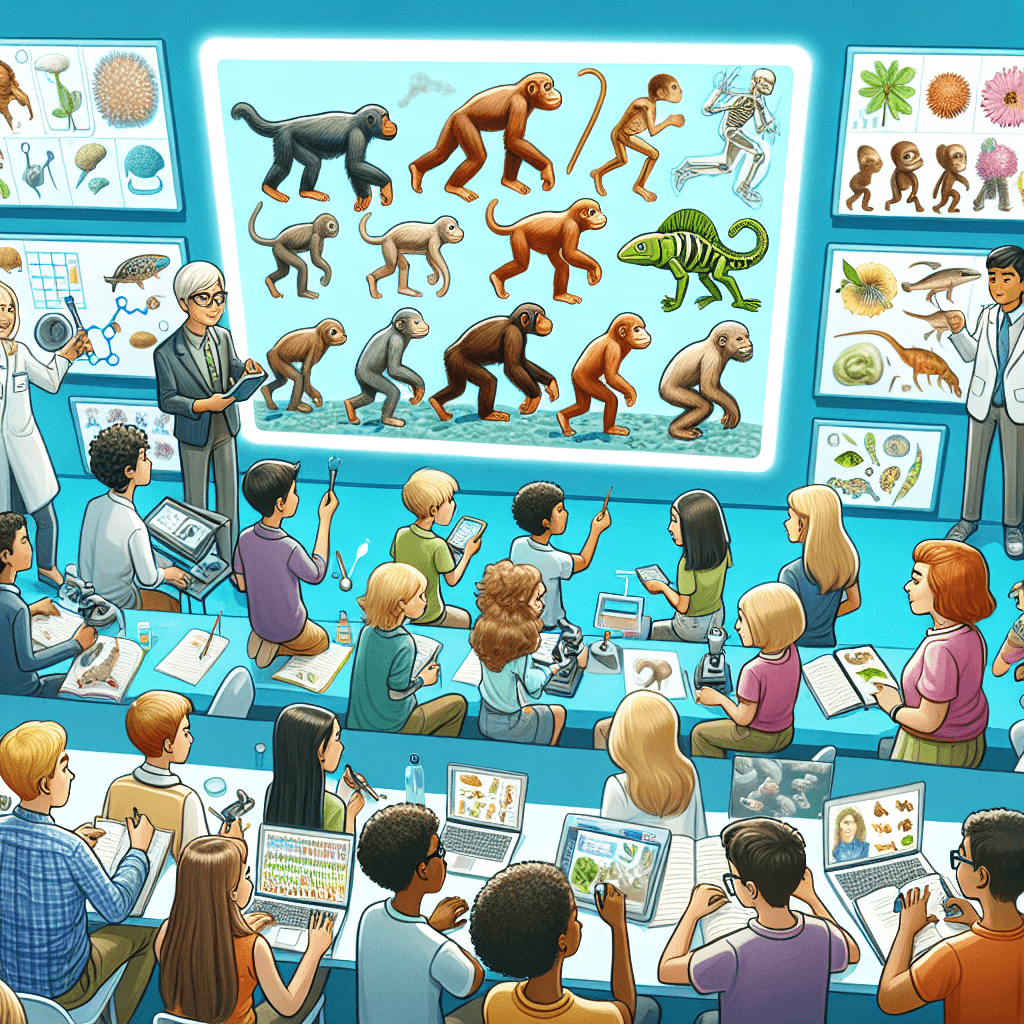
Design an Interactive Evolution Simulation
Inquiry Framework
Question Framework
Driving Question
The overarching question that guides the entire project.How can we design an interactive simulation to demonstrate the processes and effects of natural selection and mutations on a species within changing environments over time?Essential Questions
Supporting questions that break down major concepts.- How does natural selection influence evolution in a population?
- What are the key mechanisms and factors that drive natural selection?
- How can we simulate the process of evolution through natural selection using technology?
- What role do mutations play in the evolution of species?
- How do environmental changes affect evolutionary processes and outcomes?
Standards & Learning Goals
Learning Goals
By the end of this project, students will be able to:- Develop an interactive simulation that accurately represents natural selection and mutation effects on species.
- Analyze how mutations and natural selection lead to changes in species over time.
- Explain the role of environmental factors in driving evolutionary changes and natural selection processes.
- Construct evidence-based explanations for the processes of evolution, focusing on natural selection.
- Evaluate and communicate scientific evidence of evolution and adaptation of species in varying environments.
Next Generation Science Standards
Entry Events
Events that will be used to introduce the project to studentsCase Study Revolve
Begin with a mystery creature survival scenario. Students receive briefs on various creatures that could thrive or go extinct under current climate changes. They research and present how natural selection might affect each organism's future evolution, integrating their findings into the simulation.Portfolio Activities
Portfolio Activities
These activities progressively build towards your learning goals, with each submission contributing to the student's final portfolio.Creature Profile Creator
Students create detailed profiles of various creatures, analyzing their traits and predicting how these traits might impact their survival in different climates.Steps
Here is some basic scaffolding to help students complete the activity.Final Product
What students will submit as the final product of the activityA profile and presentation illustrating potential evolutionary paths and survival strategies of a selected organism.Alignment
How this activity aligns with the learning objectives & standardsThis activity aligns with HS-LS4-1 (Communicating scientific information) by requiring students to present empirical evidence supporting evolutionary predictions.Natural Selection Blueprint
Students draft blueprints that simulate the processes of natural selection, identifying key factors that influence the adaptation of populations.Steps
Here is some basic scaffolding to help students complete the activity.Final Product
What students will submit as the final product of the activityA detailed blueprint and basic model illustrating natural selection influences.Alignment
How this activity aligns with the learning objectives & standardsAligns with HS-LS4-4 (Constructing explanations for adaptations) through building models of natural selection scenarios.Mutation Impact Investigator
In this activity, students explore mutation effects in species over time, analyzing how genetic variations contribute to evolution.Steps
Here is some basic scaffolding to help students complete the activity.Final Product
What students will submit as the final product of the activityA comprehensive report and presentation on the evolutionary impact of a specific mutation.Alignment
How this activity aligns with the learning objectives & standardsSupports HS-LS4-2 (Constructing explanations based on evidence) by analyzing genetic variation and its evolutionary effects.Environmental Change Analyst
Students evaluate environmental changes and their potential impacts on species evolution, predicting future scenarios.Steps
Here is some basic scaffolding to help students complete the activity.Final Product
What students will submit as the final product of the activityAn analytical report and presentation predicting future evolutionary outcomes due to environmental changes.Alignment
How this activity aligns with the learning objectives & standardsThis task meets HS-LS4-5 (Evaluating evidence) by predicting species' evolutionary responses to environmental changes.Interactive Simulation Designer
Students design and develop an interactive simulation to demonstrate natural selection processes, showcasing adaptations and species evolution over time.Steps
Here is some basic scaffolding to help students complete the activity.Final Product
What students will submit as the final product of the activityA fully functional interactive simulation that demonstrates key natural selection and evolutionary processes.Alignment
How this activity aligns with the learning objectives & standardsThis comprehensive project synthesizes HS-LS4-1 through HS-LS4-5 by developing a digital representation of evolution, enabling analysis and communication of scientific concepts.Rubric & Reflection
Portfolio Rubric
Grading criteria for assessing the overall project portfolioInteractive Evolution Simulation Evaluation Rubric
Understanding of Evolutionary Concepts
Assessment of student's understanding of key evolutionary concepts such as natural selection, mutations, and environmental effects on species.Comprehension of Natural Selection
Evaluates student's understanding of natural selection processes and their application in evolutionary contexts.
Exemplary
4 PointsDemonstrates an in-depth and sophisticated understanding of natural selection, illustrating robust application of concepts in diverse contexts.
Proficient
3 PointsShows thorough understanding and ability to accurately apply natural selection concepts in standard contexts.
Developing
2 PointsExhibits basic understanding with inconsistent application of natural selection concepts, requiring guidance.
Beginning
1 PointsDisplays initial understanding but struggles significantly to apply natural selection concepts.
Integration of Mutation Effects
Measures student's ability to analyze and apply mutation effects in evolutionary scenarios.
Exemplary
4 PointsAnalyzes and integrates mutation effects expertly within evolutionary explanations, showing innovation and depth.
Proficient
3 PointsEffectively analyzes mutation effects and applies them reasonably in evolutionary explanations.
Developing
2 PointsAnalyzes mutation effects with some inaccuracies and limited depth.
Beginning
1 PointsStruggles to understand mutation effects and how they integrate into evolutionary scenarios.
Simulation Design and Execution
Evaluation of the student's ability to design, develop, and present the simulation that demonstrates evolutionary processes.Design and Functionality
Assesses the creativity, complexity, and functionality of the designed simulation to depict natural selection and evolutionary processes.
Exemplary
4 PointsSimulation is exceptionally creative, highly functional, and comprehensively represents evolutionary processes with nuanced details.
Proficient
3 PointsSimulation is creative and functional, representing key evolutionary processes effectively.
Developing
2 PointsSimulation shows basic design and functionality, with some representation of evolutionary processes.
Beginning
1 PointsSimulation is simplistic or poorly designed, lacking clear representation of evolutionary processes.
Use of Technology
Evaluates the effective use of technology in creating a dynamic and educational simulation environment.
Exemplary
4 PointsUses technology innovatively to enhance educational value, with seamless integration of multimedia and interactive elements.
Proficient
3 PointsEmploys technology effectively to create a coherent and functional educational simulation.
Developing
2 PointsUses technology with some effectiveness, though integration and educational impact are limited.
Beginning
1 PointsStruggles to use technology effectively in simulation creation, resulting in limited interactivity and educational value.
Communication and Collaboration
Assessment of student's ability to communicate scientific concepts and collaborate effectively during the project.Presentation Skills
Assesses clarity, organization, and scientific accuracy in presenting simulation and research findings.
Exemplary
4 PointsPresents findings with exceptional clarity, organization, and scientific accuracy, engaging the audience expertly.
Proficient
3 PointsPresents findings clearly and accurately with good organizational structure.
Developing
2 PointsPresents with basic organization and clarity; some inaccuracies present.
Beginning
1 PointsPresentation lacks clarity and organization, with significant scientific inaccuracies.
Collaborative Effort
Evaluates how well the student works within a team setting to achieve project goals.
Exemplary
4 PointsDemonstrates leadership and facilitates effective team collaboration, contributing significantly to team goals.
Proficient
3 PointsContributes positively to team efforts, working effectively with others.
Developing
2 PointsEngages in team work with limited effectiveness, requiring some support.
Beginning
1 PointsStruggles to collaborate with team, needing significant guidance and support to contribute.