
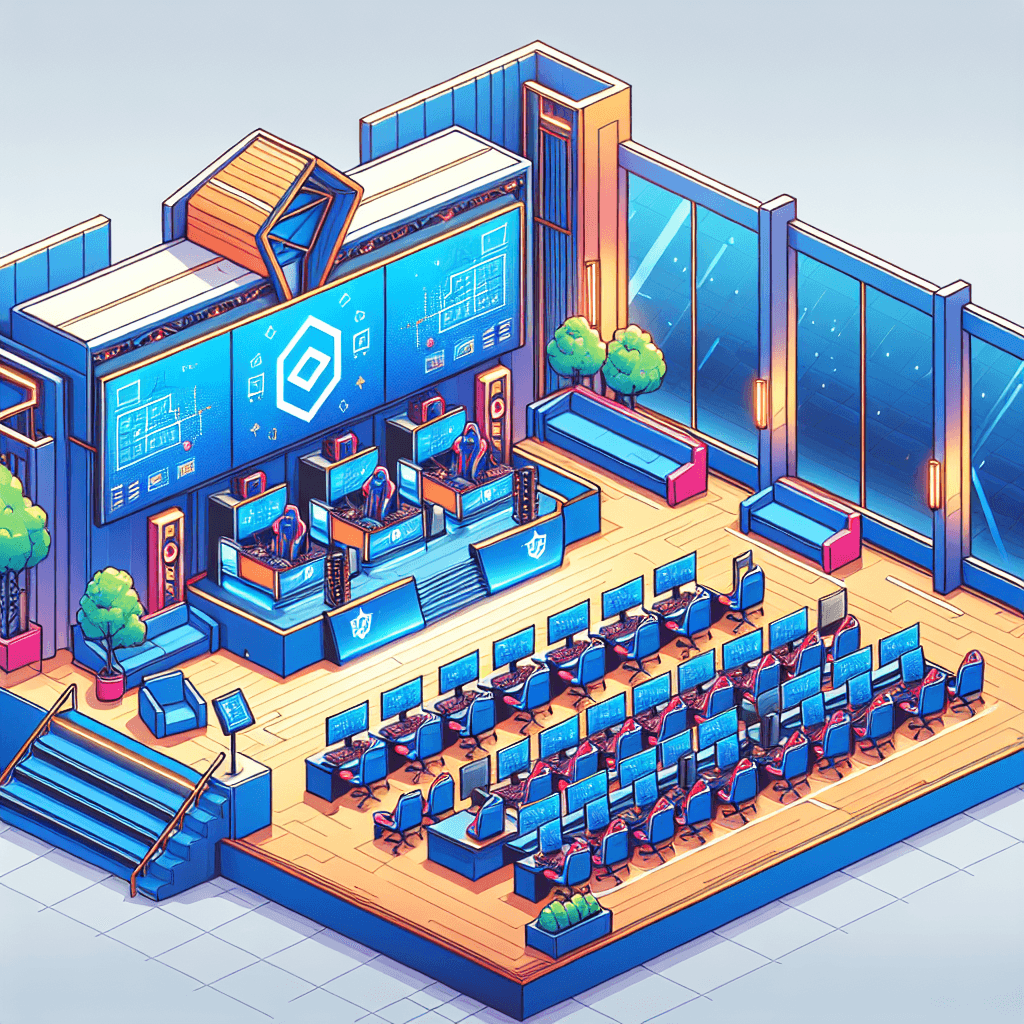
Design and Build a Virtual ESPORTS Arena
Inquiry Framework
Question Framework
Driving Question
The overarching question that guides the entire project.How can we design and build a state-of-the-art ESPORTS arena that incorporates essential components, integrates advanced technology, and optimizes both player and audience experience while ensuring effective teamwork and communication?Essential Questions
Supporting questions that break down major concepts.- What are the essential components of an ESPORTS arena, and how do they function together?
- How can we use mathematical concepts to design and create a functional ESPORTS arena?
- What technological requirements are necessary for a successful ESPORTS experience?
- How do computer networks and hardware influence the performance and experience in an ESPORTS arena?
- What roles do teamwork and communication play in the setup and operation of an ESPORTS event?
Standards & Learning Goals
Learning Goals
By the end of this project, students will be able to:- Design and model an ESPORTS arena that incorporates essential components and advanced technology.
- Apply mathematical concepts such as the Pythagorean Theorem and linear equations in the planning and layout of an ESPORTS arena.
- Understand and fulfill technological requirements needed for a successful ESPORTS event including network and hardware specifications.
- Demonstrate teamwork and communication skills by collaborating in groups to conceptualize and execute the project.
Common Core Mathematics
ISTE Standards for Students
Next Generation Science Standards
Entry Events
Events that will be used to introduce the project to studentsEsports Industry Panel Discussion
Organize a panel discussion with esports professionals, including players, organizers, and coaches, to discuss the unique challenges and creative possibilities in esports arena design. This real-world insight offers students a chance to ask questions and draw inspiration for their projects.Virtual Reality Arena Tour
Kick off the project with a virtual reality tour of existing esports arenas around the world. Students can explore their design, technology setup, and crowd engagement strategies, igniting ideas for their own creations. This immersive experience not only captures attention but also provides a comprehensive view of what's possible in designing an esports arena.Design Your Ultimate Gaming Setup
Host a workshop where students can design their ultimate gaming setup, considering factors like ergonomics, technology, and aesthetics. This hands-on activity leads directly into broader discussions about space design and technical requirements of an esports arena.Live Esports Match Viewing
Invite students to watch a live esports match, either online or in person, to experience the energy and dynamics within a professional arena. Observing crowd interactions, player setups, and event management live encourages students to think critically about incorporating these elements into their arena design.Community Challenge: Design an Arena for Our School
Challenge students to design a concept for an esports arena tailored specifically for their school community, addressing local interests and needs. This activity not only grounds the project in their immediate experience but also opens avenues for creative problem-solving tied to their surroundings.Portfolio Activities
Portfolio Activities
These activities progressively build towards your learning goals, with each submission contributing to the student's final portfolio.Dream Arena Blueprint
Students will start their esports arena project by researching and planning the design of their arena using a blueprint. This involves using coordinate planes and geometry to understand spatial relationships and area coverage. It also integrates technology standards by utilizing design software.Steps
Here is some basic scaffolding to help students complete the activity.Final Product
What students will submit as the final product of the activityA detailed digital blueprint of the esports arena, showcasing spatial awareness and mathematical elements.Alignment
How this activity aligns with the learning objectives & standardsAligns with CCSS.MATH.CONTENT.8.G.B.9, NGSS.ET1.B, and ISTE.NETS.S.4 by applying the Pythagorean Theorem and engaging in digital design.Capacity Calculator Challenge
Students will engage in a mathematical modeling exercise to predict audience capacity in their esports arena using linear equations. This activity helps students understand and solve real-world problems by incorporating algebraic thinking components.Steps
Here is some basic scaffolding to help students complete the activity.Final Product
What students will submit as the final product of the activityA comprehensive report detailing the calculation process and final audience capacity estimate, supported by algebraic equations.Alignment
How this activity aligns with the learning objectives & standardsAligns with CCSS.MATH.CONTENT.8.EE.C.7.b by solving linear equations and ISTE.NETS.S.4 by utilizing digital tools to present findings.Tech Specs Architect
In this activity, students will identify and incorporate technological needs and components into their esports arena design. Understanding network infrastructure, computing power, lighting, and sound technology forms a crucial part of ensuring a successful esports environment.Steps
Here is some basic scaffolding to help students complete the activity.Final Product
What students will submit as the final product of the activityAn upgraded arena blueprint integrated with all required technological components for optimal performance.Alignment
How this activity aligns with the learning objectives & standardsAligns with ISTE.NETS.S.4 and NGSS.ET1.B, focusing on technology research, design, and collaborative problem-solving.Teamwork Dynamics Workshop
This activity emphasizes the importance of collaborative teamwork and effective communication in the setup and operation of an esports arena. Students will work in mock teams to simulate project tasks and roles.Steps
Here is some basic scaffolding to help students complete the activity.Final Product
What students will submit as the final product of the activityA collaborative reflection journal where students document teamwork experiences, challenges, and improvements.Alignment
How this activity aligns with the learning objectives & standardsAligns with ISTE.NETS.S.4, fostering skills in collaboration using technology tools and effective communication.Rubric & Reflection
Portfolio Rubric
Grading criteria for assessing the overall project portfolioESPOrts Arena Design Project Rubric
Mathematical Application
Evaluates how effectively students apply mathematical concepts such as the Pythagorean Theorem and linear equations in designing and planning the ESPOrts arena.Pythagorean Theorem Usage
Assesses the student's ability to correctly apply the Pythagorean Theorem in the arena's layout calculation tasks.
Exemplary
4 PointsStudent applies the Pythagorean Theorem in complex problems without errors, demonstrating advanced spatial reasoning and accuracy.
Proficient
3 PointsStudent applies the Pythagorean Theorem accurately in most scenarios, showing clear understanding and correct calculations.
Developing
2 PointsStudent attempts to use the Pythagorean Theorem but with minor errors; understanding of concepts is basic but present.
Beginning
1 PointsStudent struggles with applying the Pythagorean Theorem correctly, demonstrating a need for further instruction in basic geometric applications.
Linear Equation Modeling
Evaluates the student's ability to create and solve linear equations to address real-world scenarios in the arena design.
Exemplary
4 PointsStudent creates intricate linear models and performs flawless calculations, demonstrating an exceptional grasp of algebraic modeling.
Proficient
3 PointsStudent constructs valid linear equations and solves them with accuracy, reflecting a solid understanding of algebra.
Developing
2 PointsStudent shows partial success in forming and solving linear equations; calculations may contain errors.
Beginning
1 PointsStudent finds difficulty in creating or solving linear equations, indicating a need for further basic instruction.
Technological Integration
Measures the ability to research, identify, and integrate appropriate technologies within the arena design, ensuring optimal performance and innovation.Technology Research and Application
Assesses the student's ability to research and incorporate cutting-edge technological components into the arena blueprint effectively.
Exemplary
4 PointsStudent demonstrates in-depth research and innovative integration of technology components, enhancing arena functionality beyond standard practices.
Proficient
3 PointsStudent effectively researches and integrates necessary technology components, meeting project objectives and design goals.
Developing
2 PointsStudent shows basic research skills with partial integration of technology, missing some components for optimized function.
Beginning
1 PointsStudent has difficulty identifying or integrating appropriate technology, requiring additional guidance and instruction.
Collaboration and Communication
Evaluates the student's ability to work effectively within a team, emphasizing roles, responsibilities, and communication skills during the project.Teamwork Dynamics
Assesses the effectiveness of student collaboration, role fulfillment, and communication during the project.
Exemplary
4 PointsStudent consistently takes initiative, contributes innovative ideas, and facilitates effective communication, exceeding expected teamwork standards.
Proficient
3 PointsStudent engages in teamwork effectively, fulfills roles, and communicates clearly to meet project goals.
Developing
2 PointsStudent shows basic participation with inconsistent role fulfillment and communication; teamwork is progressing.
Beginning
1 PointsStudent struggles with teamwork, requiring support to participate and communicate effectively in the project setting.