
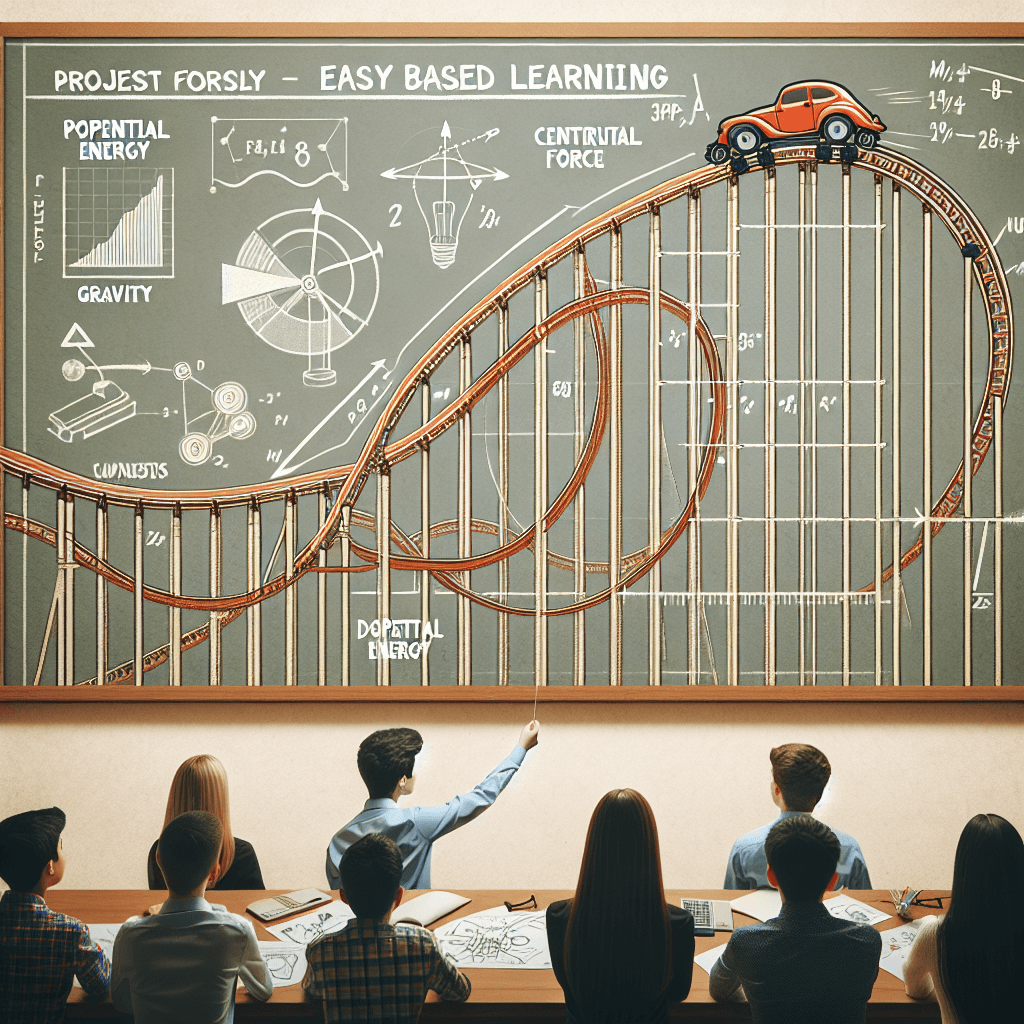
Design and Calculate Forces of a Roller Coaster
Inquiry Framework
Question Framework
Driving Question
The overarching question that guides the entire project.How can we apply mathematics and physics to design a roller coaster that balances thrills with safety, by accurately calculating and analyzing the forces involved throughout its track using Free Body Diagrams (FBDs)?Essential Questions
Supporting questions that break down major concepts.- What is a Free Body Diagram (FBD) and how is it used in analyzing forces?
- How do forces interact on a roller coaster at different points in its track?
- What mathematical principles are used to calculate the forces in a roller coaster design?
- How do engineers ensure safety and comfort in roller coaster design through physics and mathematics?
- What role do gravity, friction, and tension play in the motion of a roller coaster?
- How can we use mathematical models to predict the behavior of a roller coaster?
- In what ways do real-world constraints affect the design and functionality of a roller coaster?
Standards & Learning Goals
Learning Goals
By the end of this project, students will be able to:- Students will understand and apply the principles of Free Body Diagrams (FBDs) to analyze forces acting on a roller coaster.
- Students will calculate forces such as gravity, friction, and tension at different points on a roller coaster using mathematical principles.
- Students will develop skills in mathematical modeling to predict roller coaster behavior.
- Students will explore the design process of engineering to balance thrill and safety in roller coaster construction.
- Students will apply problem-solving strategies to address real-world constraints in roller coaster design.
Pearson EdExcel Mechanics
Next Generation Science Standards
Common Core Standards
Entry Events
Events that will be used to introduce the project to studentsForces in Action: Live Demo
A dynamic physics demonstration shows everyday objects experiencing forces akin to those on a roller coaster. Seeing these forces in action piqued curiosity and frames the critical role of physics in designing real-world structures like roller coasters.Portfolio Activities
Portfolio Activities
These activities progressively build towards your learning goals, with each submission contributing to the student's final portfolio.FBD Fundamentals Workshop
In this activity, students will explore the basics of Free Body Diagrams (FBDs), learning how to represent forces acting on an object, specifically focusing on roller coasters. This foundational understanding is crucial to analyzing forces and building towards complex calculations later in the project.Steps
Here is some basic scaffolding to help students complete the activity.Final Product
What students will submit as the final product of the activityA collection of student-drawn Free Body Diagrams illustrating various forces on different sections of a roller coaster.Alignment
How this activity aligns with the learning objectives & standardsAligns with D1: Understand and use FBDs to solve mechanics problems involving forces.Vector Voyage Expedition
Students dive into the world of vectors, using them to represent forces and motions experienced by roller coasters. They will learn how vectors are integral to understanding forces and will practice calculating vector components necessary for accurate FBDs.Steps
Here is some basic scaffolding to help students complete the activity.Final Product
What students will submit as the final product of the activityA portfolio of vector problems solved, demonstrating students' ability to apply vectors to represent forces and motion.Alignment
How this activity aligns with the learning objectives & standardsAligns with M1: Use of vectors to represent forces and motion in mechanics.Newton's Motion Masterclass
This activity deepens students' understanding of Newton's Second Law and its application in roller coaster physics. They will engage in problem-solving activities to calculate net forces and understand how acceleration affects motion.Steps
Here is some basic scaffolding to help students complete the activity.Final Product
What students will submit as the final product of the activityA set of complex problems and solutions demonstrating the application of Newton’s Second Law in roller coaster dynamics.Alignment
How this activity aligns with the learning objectives & standardsAligns with NGSS-HS-PS2-1: Analyze data to support Newton’s second law's relationship among net force, mass, and acceleration.Rate of Change Rally
In this activity, students will explore and calculate rates of change in the context of forces on a roller coaster. They will learn how these rate changes relate to acceleration and velocity, deepening their understanding of motion dynamics.Steps
Here is some basic scaffolding to help students complete the activity.Final Product
What students will submit as the final product of the activityAn analysis report containing rate of change calculations and interpretations corresponding to roller coaster motion.Alignment
How this activity aligns with the learning objectives & standardsAligns with CCSS.MATH.CONTENT.HSF.IF.B.6: Calculate and interpret average rates of change, estimating from graphs.Safety and Thrill Balancing Act
In the final project activity, students will synthesize their knowledge to design a roller coaster that balances safety and thrill. They will use FBDs, vectors, and principles of physics to ensure their design can handle the calculated forces safely.Steps
Here is some basic scaffolding to help students complete the activity.Final Product
What students will submit as the final product of the activityA detailed roller coaster design, supplemented with FBDs and force calculations, demonstrating the application of physics principles to ensure a safe yet thrilling ride.Alignment
How this activity aligns with the learning objectives & standardsAligns with M1, D1, NGSS-HS-PS2-1, and CCSS.MATH.CONTENT.HSF.IF.B.6: Integrates use of vectors, FBDs, Newton's laws, and rate of change calculations to engineer a roller coaster design.Rubric & Reflection
Portfolio Rubric
Grading criteria for assessing the overall project portfolioRoller Coaster Physics: Mastery Rubric
Understanding of Free Body Diagrams (FBDs)
Assessment of the student's ability to accurately create and interpret FBDs, representing forces on roller coaster components.Accuracy of FBDs
Measures how precisely students represent forces on a roller coaster using FBDs, including correct notation and identification of forces.
Exemplary
4 PointsCreates highly detailed and accurate FBDs showing all relevant forces with correct labels and notation.
Proficient
3 PointsCreates accurate FBDs, showing most relevant forces with correct labels and notation.
Developing
2 PointsCreates FBDs with some correct forces and labels, but several errors or omissions are present.
Beginning
1 PointsCreates FBDs with minimal correct forces and numerous errors or omissions.
Interpretation Skills
Evaluates the student's ability to interpret forces and predict resulting motion from FBDs.
Exemplary
4 PointsInterprets FBDs flawlessly, accurately predicting the motion based on the forces depicted.
Proficient
3 PointsInterprets FBDs reliably, with mostly accurate predictions of motion based on depicted forces.
Developing
2 PointsShows emerging skills in interpreting FBDs, with some correct predictions and several errors.
Beginning
1 PointsStruggles to interpret FBDs, with predictions lacking accuracy and understanding.
Application of Vectors
Assessment of student proficiency in using vectors to represent forces and calculate net forces in a roller coaster context.Vector Representation
Assesses the accuracy in representing forces as vectors and solving vector problems related to roller coaster mechanics.
Exemplary
4 PointsUses vectors precisely and accurately to represent and solve force-related problems, ensuring complete and correct solutions.
Proficient
3 PointsEffectively uses vectors to represent forces and solve problems with mostly correct solutions.
Developing
2 PointsShows a basic ability to use vectors for force representation, with some correct solutions but frequent mistakes.
Beginning
1 PointsExhibits difficulty in correctly using vectors, often misrepresenting forces and solving problems inaccurately.
Vector Calculation
Evaluates the ability to calculate net forces using vector principles applied to roller coaster mechanics.
Exemplary
4 PointsCalculates net forces accurately using vectors, demonstrating complete understanding of vector addition and components.
Proficient
3 PointsCalculates net forces with vectors effectively, with few minor computational errors.
Developing
2 PointsPerforms vector calculations with emerging competence, but makes noticeable computation errors.
Beginning
1 PointsStruggles with vector calculations, frequently making significant errors in net force determination.
Understanding of Newton’s Laws
Evaluation of the student's ability to apply Newton’s Second Law to analyze motion and forces on a roller coaster.Application of Newton’s Second Law
Assesses the ability to utilize Newton's Second Law in calculating and understanding forces and motion.
Exemplary
4 PointsApplies Newton’s Second Law adeptly to calculate forces and motion, providing complete, accurate results and insights.
Proficient
3 PointsApplies Newton’s Second Law effectively, with mostly accurate calculations and insights.
Developing
2 PointsDemonstrates basic application of Newton’s Second Law with some correct calculations and insights, but frequent errors.
Beginning
1 PointsStruggles to apply Newton’s Second Law correctly, resulting in inaccurate calculations and insights.
Rate of Change Understanding and Application
Examines the student's competence in using mathematical concepts to interpret and predict rates of change in forces on a roller coaster.Interpretation of Rates of Change
Evaluates the skill in calculating and interpreting change in velocity and acceleration using mathematics.
Exemplary
4 PointsInterprets and calculates rates of change with precision, providing comprehensive analyses connecting calculations to physical forces.
Proficient
3 PointsCalculates and interprets rates of change accurately, though minor analytical connections may be lacking.
Developing
2 PointsShows basic ability to calculate and interpret rates of change, but struggling with consistent accuracy and connections.
Beginning
1 PointsStruggles to calculate and interpret rates of change accurately, showing limited understanding and connections.
Design Application and Safety Considerations
Assessment of students' ability to apply learned concepts to design a safe yet thrilling roller coaster, utilizing forces correctly.Design Precision and Innovation
Measures the creativity and precision in the roller coaster design considering safety and thrill factors.
Exemplary
4 PointsDesigns an innovative and precise roller coaster with well-balanced safety and thrill using accurate applications of physics.
Proficient
3 PointsDesigns an effective roller coaster with a good balance of safety and thrill using physics applications with minor errors.
Developing
2 PointsShows emerging ability in designing a safe and thrilling roller coaster but with notable inaccuracies in applying physics.
Beginning
1 PointsStruggles to create a practical roller coaster design, lacking balance in safety and thrill and inaccurate application of physics.