
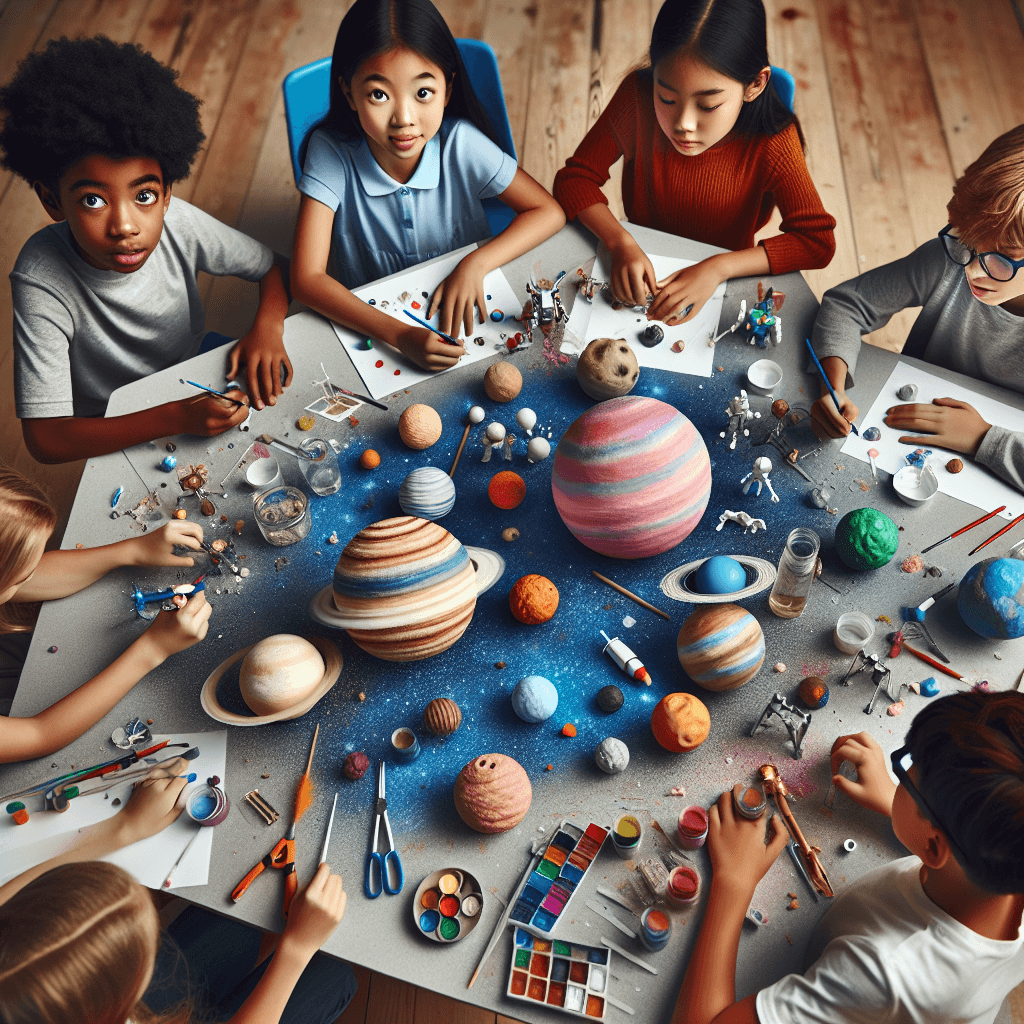
Design Your Own Solar System Planet
Inquiry Framework
Question Framework
Driving Question
The overarching question that guides the entire project.How can you design a unique planet that could support life, taking into consideration its rotation, position in the solar system, and interactions with celestial bodies?Essential Questions
Supporting questions that break down major concepts.- What characteristics would your planet need to sustain life?
- How does the rotation of your planet affect the length of its day and night?
- How do the position and movements of your planet impact its seasons and climate?
- In what ways does the size and order of your planet within its solar system affect its environment and potential for supporting life?
- How can the visible appearance of moons or other celestial bodies from your planet provide insights into the dynamics of your solar system?
Standards & Learning Goals
Learning Goals
By the end of this project, students will be able to:- Understand the fundamental movements of celestial bodies, including Earth's rotation, and how these affect the day/night cycle.
- Identify and explain the role of Earth's position in the solar system and its effects on seasons and climate.
- Design a planet with consideration of scientific principles related to rotation, position, and celestial interactions.
- Analyze the impact of a planet's physical and environmental characteristics on its ability to support life.
- Integrate artistic and scientific concepts to create a visual and descriptive presentation of a designed planet.
- Utilize data to predict patterns and changes in the celestial environment and analyze the observable appearance of moons or other celestial bodies.
Earth and Space Standards
Earth’s Movement Readiness Standards
Supporting Standards
Solar System Supporting Standards
Entry Events
Events that will be used to introduce the project to studentsAstronaut's Rescue Mission Simulation
Engage students with an interactive simulation where they must create the design for a new planet to serve as a refuge for stranded astronauts. They will need to consider aspects such as day/night cycles, temperatures, and living conditions based on data readings they 'receive' about the planetary conditions from the spacecraft. This event connects to real-world space exploration scenarios, prompting students to think critically and creatively.Portfolio Activities
Portfolio Activities
These activities progressively build towards your learning goals, with each submission contributing to the student's final portfolio.Planet Design Sketch and Concept
Students will start the project by sketching a rough concept of their planet, naming it creatively, and describing its key characteristics and symbolism. This activity blends art and science, asking students to consider scientific principals like rotation while encouraging imaginative planetary features.Steps
Here is some basic scaffolding to help students complete the activity.Final Product
What students will submit as the final product of the activityInitial sketch and description of a uniquely designed planet.Alignment
How this activity aligns with the learning objectives & standardsAligns with standard 5.9 as it focuses on recognizing celestial patterns and simulating their effects on a designed environment.Day/Night Cycle Simulator
Students will simulate the rotation of their planet, creating models and diagrams that demonstrate the day/night cycle to understand rotation effects.Steps
Here is some basic scaffolding to help students complete the activity.Final Product
What students will submit as the final product of the activityA model and diagram showing the rotation and day/night cycle of the designed planet.Alignment
How this activity aligns with the learning objectives & standardsFulfills 5.9(A) by demonstrating rotation and explaining its effects on day and night cycles.Celestial Position Impact Analysis
Students will analyze how their planet’s position in the solar system affects its seasons, temperature, and climate and present their findings in a report.Steps
Here is some basic scaffolding to help students complete the activity.Final Product
What students will submit as the final product of the activityAn analytical report detailing the impact of solar system positioning on the designed planet’s climate and seasons.Alignment
How this activity aligns with the learning objectives & standardsSupports standard 4.9(A) by collecting and analyzing data regarding climate affected by planetary positioning.Observational Moon Mapping
In this activity, students will imagine and create a visual representation of the observable moon(s) from their planet and identify how it orbits and the effects it has on their planet's environmental and celestial patterns.Steps
Here is some basic scaffolding to help students complete the activity.Final Product
What students will submit as the final product of the activityA creative presentation or illustrated report on the moon(s) visible from the designed planet, including their orbits and effects.Alignment
How this activity aligns with the learning objectives & standardsAligned with standard 4.9(B) by focusing on collecting information to predict changes in celestial patterns.Planetary Order and Environmental Impact Study
Students will create a comprehensive study of where their planet is positioned in relation to others within their solar system, and analyze how this order influences potential life-supporting properties.Steps
Here is some basic scaffolding to help students complete the activity.Final Product
What students will submit as the final product of the activityA detailed research report on the environmental impact of the planet’s order within a hypothetical solar system.Alignment
How this activity aligns with the learning objectives & standardsSupports standard 3.9(B) by identifying planetary order and analyzing environmental and life-support effects."Rubric & Reflection
Portfolio Rubric
Grading criteria for assessing the overall project portfolioPlanet Design and Celestial Interaction Rubric
Scientific Understanding and Application
Evaluating the depth of scientific knowledge applied in the design and understanding of celestial interactions.Celestial Mechanics Understanding
Knowledge and application of how celestial movements affect planet characteristics (rotation, seasons, shadow patterns, etc.).
Exemplary
4 PointsDemonstrates a sophisticated and nuanced understanding of celestial mechanics, effectively applying this knowledge to the design of a planet that participates in complex interactions affecting its climate and habitability.
Proficient
3 PointsShows thorough understanding and application of celestial mechanics in designing a planet, with appropriate connections to its climate and habitability considerations.
Developing
2 PointsDemonstrates a basic understanding of celestial mechanics, but with limited application in designing a planet with minor insights into interactions affecting climate.
Beginning
1 PointsShows minimal understanding of celestial mechanics with struggles in applying this knowledge to planet design, lacking insights into climate or interactions.
Data Analysis and Interpretation
Skills in collecting, analyzing, and interpreting data related to celestial observations and planetary impacts.
Exemplary
4 PointsExhibits exceptional skill in data collection, analysis, and interpretation, providing insightful and accurate conclusions about planetary characteristics and their implications.
Proficient
3 PointsDemonstrates strong skills in data collection and analysis, leading to well-reasoned interpretations and conclusions about planetary characteristics.
Developing
2 PointsShows basic skills in data collection and analysis, with some accurate but incomplete interpretations and conclusions.
Beginning
1 PointsStruggles with data collection and analysis, providing minimal interpretation and inaccurate conclusions regarding planetary characteristics.
Artistic and Creative Expression
Assessment of creativity and artistic skills in visualizing and presenting a designed planet.Planetary Design Creativity
Creativity and originality in the conceptualization and presentation of a planet's characteristics and environment.
Exemplary
4 PointsDemonstrates exceptional creativity, producing uniquely imaginative and original planetary designs that effectively integrate scientific principles in an innovative manner.
Proficient
3 PointsShows clear creativity and originality in designing a planet with effective integration of scientific principles, though minor opportunities for additional originality exist.
Developing
2 PointsExhibits some creativity in planetary design with limited originality and partial integration of scientific principles.
Beginning
1 PointsShows minimal creativity, lacking originality and struggling to integrate scientific principles in planetary design.
Communication and Presentation
Evaluating clarity and effectiveness in presenting scientific and artistic findings.Clarity and Coherence of Presentation
Clarity, structure, and coherence in writing and presenting ideas related to the planet design and its scientific basis.
Exemplary
4 PointsPresents ideas with exceptional clarity and coherence, using well-structured arguments and detailed explanations that brilliantly convey scientific and artistic concepts.
Proficient
3 PointsExhibits clear and coherent presentation of ideas with structured arguments that effectively convey the relationship between scientific principles and artistic design.
Developing
2 PointsShows basic coherence in presentation, with some structure in arguments but lacking detailed explanations or full clarity.
Beginning
1 PointsStruggles with clarity and coherence in presentation, with unstructured arguments and lack of detail in explaining concepts.