
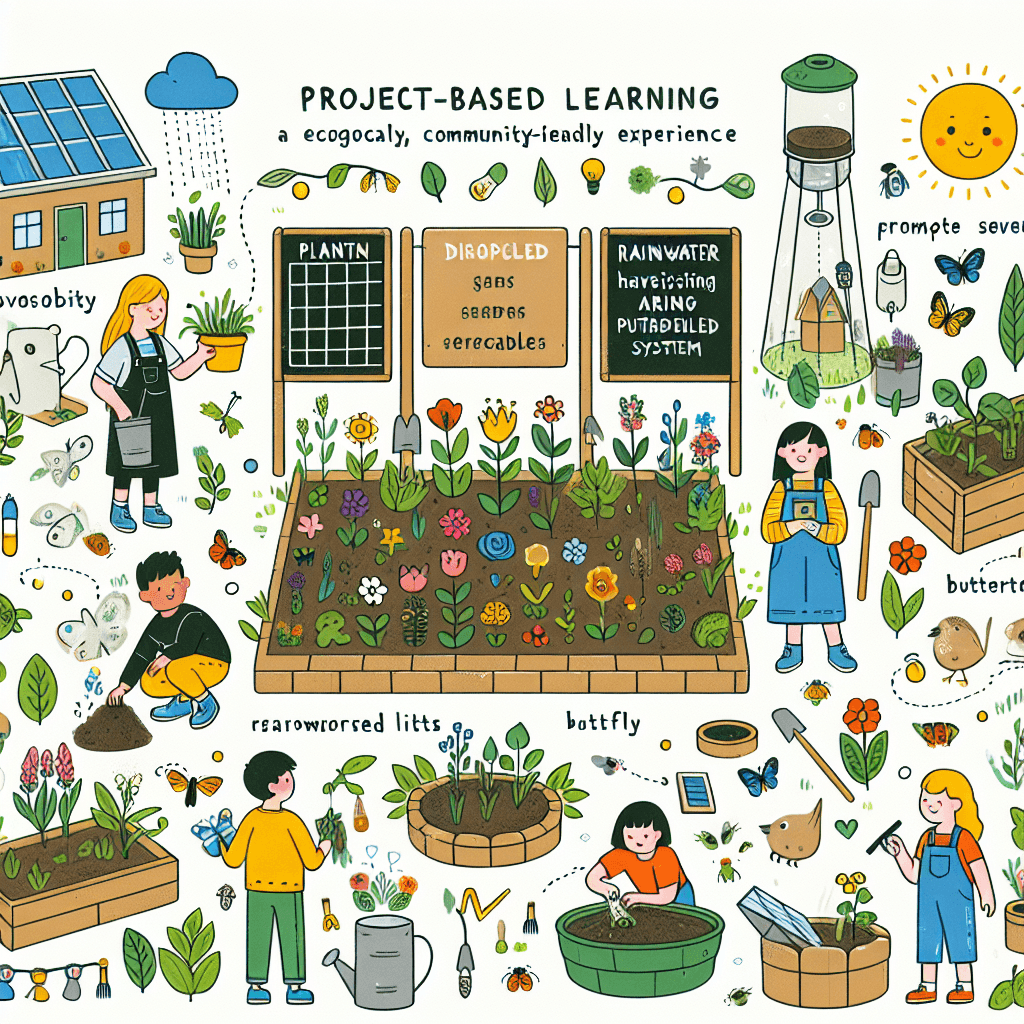
Designing a Community and Eco-Friendly School Garden
Inquiry Framework
Question Framework
Driving Question
The overarching question that guides the entire project.How can we, as landscape architects, design a new school garden that enhances both the community and the ecosystem while utilizing our knowledge of math, science, and effective communication?Essential Questions
Supporting questions that break down major concepts.- What are the roles and responsibilities of a landscape architect?
- How can school gardens benefit local communities and ecosystems?
- What plants and garden designs are best suited for the school environment?
- How do you calculate the area and perimeter of various garden layouts?
- What is the impact of different plants on soil quality and biodiversity?
- How can you effectively communicate and present your garden design ideas?
Standards & Learning Goals
Learning Goals
By the end of this project, students will be able to:- Students will understand the roles and responsibilities of a landscape architect.
- Students will analyze how school gardens benefit local communities and ecosystems.
- Students will research and identify plants and garden designs suitable for a school environment.
- Students will apply mathematical concepts to calculate the area and perimeter of various garden layouts.
- Students will investigate the impact of different plants on soil quality and biodiversity.
- Students will develop skills to effectively communicate and present their garden design ideas.
Common Core Standards
Next Generation Science Standards
Entry Events
Events that will be used to introduce the project to studentsVirtual Reality Eco-Tour
Students put on virtual reality headsets and are transported to some of the world's most innovative eco-gardens. They can explore various landscapes and note features that enhance both community involvement and ecological sustainability. This inspires students to think critically about how they can implement similar features in their school garden project.Portfolio Activities
Portfolio Activities
These activities progressively build towards your learning goals, with each submission contributing to the student's final portfolio.Landscape Architect Research Adventure
In this activity, students will explore the roles and responsibilities of a landscape architect, understanding how they contribute to both community and environmental enhancement.Steps
Here is some basic scaffolding to help students complete the activity.Final Product
What students will submit as the final product of the activityA reflection paper outlining the insights gathered about landscape architects and their relevance to the school garden project.Alignment
How this activity aligns with the learning objectives & standardsAligns with CCSS.ELA-LITERACY.W.6.2 as it requires students to organize and write an informative text.Garden Geometry Challenge
Students will apply mathematical concepts to calculate the area and perimeter of proposed garden layouts, essential for planning their design.Steps
Here is some basic scaffolding to help students complete the activity.Final Product
What students will submit as the final product of the activityAnnotated sketches with calculated area and perimeter measurements.Alignment
How this activity aligns with the learning objectives & standardsCovers CCSS.MATH.CONTENT.6.G.A.1 by engaging students in real-world geometry problems.Ecosystem Impact Investigator
In this activity, students will research and understand how various plants and garden designs impact ecosystems positively and negatively.Steps
Here is some basic scaffolding to help students complete the activity.Final Product
What students will submit as the final product of the activityA comprehensive report analyzing the plant selections and their ecological impact.Alignment
How this activity aligns with the learning objectives & standardsMeets NGSS.MS-LS2-1 by analyzing how plant resource availability affects ecosystems.Rubric & Reflection
Portfolio Rubric
Grading criteria for assessing the overall project portfolioSchool Garden Design Portfolio Assessment
Landscape Architecture Understanding
Assessment of students' exploration and articulation of the roles and responsibilities of a landscape architect.Research Quality
Evaluation of the depth and relevance of research conducted about landscape architecture roles and responsibilities.
Exemplary
4 PointsResearch demonstrates a comprehensive and nuanced understanding of landscape architecture roles, with extensive details and insightful connections to the school garden project.
Proficient
3 PointsResearch is thorough and well-documented, showing a clear understanding of landscape architecture roles with several connections to the project.
Developing
2 PointsResearch shows basic understanding with limited connections to the school garden project; some roles may be superficially addressed.
Beginning
1 PointsResearch is minimal, lacks depth, and shows little understanding of landscape architecture roles.
Reflection Insight
Quality of reflection on how landscape architecture roles apply to the school garden project.
Exemplary
4 PointsReflection provides deep insights into how landscape architecture roles are applied, with innovative ideas for the garden project.
Proficient
3 PointsReflection offers thoughtful insights into role applications with practical ideas for the garden project.
Developing
2 PointsReflection offers basic insights with some ideas for the project; lacks depth.
Beginning
1 PointsReflection lacks meaningful insights or connections to the project.
Mathematical Application
Assessment of students' abilities to apply mathematical concepts in designing garden layouts, focusing on geometry and measurement.Geometry Calculations
Accuracy and reasoning in calculating the area and perimeter of various garden shapes.
Exemplary
4 PointsDemonstrates exceptional accuracy and detailed reasoning in area and perimeter calculations, with error-free annotations.
Proficient
3 PointsCalculations are accurate and well-reasoned, with most annotations correct.
Developing
2 PointsCalculations show some accuracy but may have minor errors or reasoning issues.
Beginning
1 PointsCalculations are mostly inaccurate, with little reasoning or correct annotations.
Layout Design Creativity
Creativity and effectiveness of garden layout designs.
Exemplary
4 PointsLayout designs are highly creative and optimized for space, functionality, and aesthetics.
Proficient
3 PointsLayout designs are creative and functional, effectively using space.
Developing
2 PointsDesigns show some creativity but may lack space optimization or balance.
Beginning
1 PointsDesigns lack creativity and are inefficient in space utilization.
Ecosystem Understanding and Analysis
Evaluation of students' understanding of ecosystem impacts through plant research and analysis.Research and Analysis Quality
Depth of plant research and quality of analysis on ecosystem impacts.
Exemplary
4 PointsResearch and analysis are comprehensive with a strong understanding of plant impacts on ecosystems, including detailed justifications for plant selection.
Proficient
3 PointsResearch and analysis are thorough, with a good understanding of plant impacts and justified selections.
Developing
2 PointsResearch and analysis are basic, showing limited understanding and justifications.
Beginning
1 PointsResearch is minimal with a poor understanding of plant impacts and no justifications.
Recommendation Clarity
Clarity and justification of plant selection recommendations.
Exemplary
4 PointsRecommendations for plant selections are clear, well-justified, and rooted in research, with a strong link to ecosystem benefits.
Proficient
3 PointsRecommendations are clear and justified, with good links to ecosystem benefits.
Developing
2 PointsRecommendations are present but may lack clarity or strong justification.
Beginning
1 PointsRecommendations are unclear and unjustified, with weak links to benefits.