
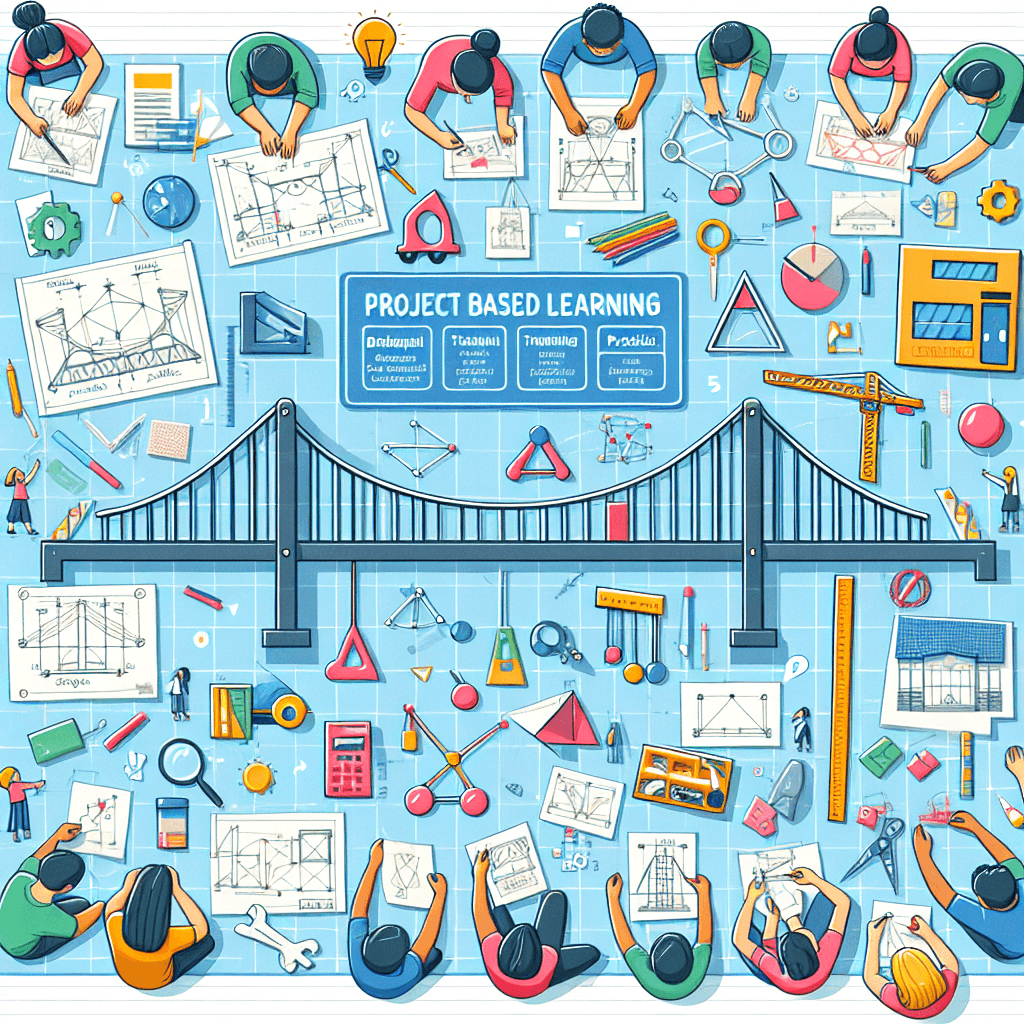
Designing Bridges: Geometry and Physics in Action
Inquiry Framework
Question Framework
Driving Question
The overarching question that guides the entire project.How can we, as young engineers, design and build a functional bridge incorporating the principles of geometry and physics, while utilizing technology and understanding its impact on STEM careers and real-world applications in civil engineering?Essential Questions
Supporting questions that break down major concepts.- How do the principles of geometry apply to bridge design?
- What role does physics play in ensuring the stability and safety of bridges?
- How can technology be used to enhance bridge design and construction?
- In what ways does bridge engineering connect to STEM careers?
- What are the real-world applications of mathematical concepts in civil engineering?
Standards & Learning Goals
Learning Goals
By the end of this project, students will be able to:- Students will understand and apply principles of geometry, such as the Pythagorean Theorem, in real-world bridge design.
- Students will apply physics concepts, particularly forces and motion, to assess and ensure the stability of bridge structures.
- Learners will utilize technology tools to design, simulate, and evaluate bridge models.
- Students will explore connections to STEM careers by understanding the role of civil engineering and related fields in real-world applications.
- Learners will develop research, critical thinking, and problem-solving skills through iterative design processes.
NGSS
Common Core Standards for Mathematics
Entry Events
Events that will be used to introduce the project to studentsCommunity Connection Challenge
Challenge students to design a bridge model that connects two 'distant' communities within the school (e.g., art and science rooms). This project involves understanding geometry and physics, while also encouraging students to think creatively about collaboration and resource-sharing benefits.Bridge Collapse Mystery
Present students with the mystery of a fictional bridge collapse in the local area. Task them with investigating the causes using physics and geometry principles, exploring tools like simulation software to model potential weaknesses and solutions as they develop their construction skills.Portfolio Activities
Portfolio Activities
These activities progressively build towards your learning goals, with each submission contributing to the student's final portfolio.Geometry Pioneers: Triangle Explorers
In this activity, students dive into the geometry underlying bridge design by exploring the Pythagorean Theorem. They will use various triangles to understand how the theorem applies to calculating dimensions and ensuring structural integrity in bridge designs.Steps
Here is some basic scaffolding to help students complete the activity.Final Product
What students will submit as the final product of the activityStudents will create their own right-angled triangles using various materials and demonstrate correct application of the Pythagorean Theorem to their calculations, creating a geometric basis for their bridge designs.Alignment
How this activity aligns with the learning objectives & standardsAligns with CCSS.MATH.CONTENT.8.G.B.6 as it involves the explanation and application of the Pythagorean Theorem.Force Focus: Motion in Bridges
This activity allows students to explore the effects of forces and motion on bridge stability. They will apply Newton's Third Law of Motion to understand how different bridge designs can withstand forces, such as weight and wind, in real-world settings.Steps
Here is some basic scaffolding to help students complete the activity.Final Product
What students will submit as the final product of the activityStudents will submit a report analyzing a bridge model, highlighting how they applied Newton's Third Law and identifying design elements that influence stability.Alignment
How this activity aligns with the learning objectives & standardsCorresponds to NGSS.MS-PS2-1 by applying Newton's Third Law to the design and analysis of bridges.STEM Career Quest: Bridge to the Future
In this research activity, students connect their learning to real-world careers by exploring civil engineering and related STEM careers. They will research famous engineers, analyze their contributions, and reflect on how these careers impact society.Steps
Here is some basic scaffolding to help students complete the activity.Final Product
What students will submit as the final product of the activityA research project presented creatively that demonstrates the link between learned principles and their application in STEM careers, focusing on the societal benefits and individual contributions.Alignment
How this activity aligns with the learning objectives & standardsConnects to real-world applications and STEM career exploration components, enriching students' understanding of engineering's societal implications.Rubric & Reflection
Portfolio Rubric
Grading criteria for assessing the overall project portfolioBridge Building Design and Analysis Rubric
Understanding of Geometry Principles
Assesses students' grasp of geometric concepts, particularly the Pythagorean Theorem, in bridge design.Application of Pythagorean Theorem
Evaluates how well students apply the Pythagorean Theorem for calculating dimensions in bridge design.
Exemplary
4 PointsDemonstrates an exceptional understanding and can accurately apply the Pythagorean Theorem to complex bridge designs with no errors.
Proficient
3 PointsShows a thorough understanding and correctly applies the Pythagorean Theorem to multiple bridge designs.
Developing
2 PointsApplies the Pythagorean Theorem with minor errors in simpler bridge designs.
Beginning
1 PointsStruggles to apply the Pythagorean Theorem accurately, resulting in major inaccuracies.
Triangle Construction
Measures students' ability to construct and use triangles effectively in bridge models.
Exemplary
4 PointsConstructs accurate and precise right triangles using various materials, innovatively demonstrating geometric applications.
Proficient
3 PointsSuccessfully constructs accurate right triangles using provided materials, with minimal errors.
Developing
2 PointsConstructs triangles with some inaccuracies, indicating need for further instruction.
Beginning
1 PointsProduces poorly constructed triangles, lacking in accuracy and precision.
Physics Principles in Bridge Design
Evaluates the application of physical science concepts, particularly Newton's Third Law of Motion, in analyzing bridge stability.Newton's Third Law Application
Assesses students' ability to apply Newton's Third Law to evaluate and enhance bridge stability.
Exemplary
4 PointsApplies Newton's Third Law expertly to analyze and optimize bridge designs under various force conditions.
Proficient
3 PointsCorrectly applies Newton's Third Law to assess basic stability factors in given bridge models.
Developing
2 PointsApplies Newton's Third Law with some conceptual errors, limiting analysis depth.
Beginning
1 PointsDisplays significant misunderstandings in applying Newton's Third Law, affecting stability assessments.
Technology and Tools Integration
Focuses on students' ability to use technology strategically in bridge modeling and simulation processes.Simulation Software Use
Evaluates proficiency in using simulation tools to model and test bridge designs.
Exemplary
4 PointsUses simulation software skillfully to create detailed, accurate models and tests their effectiveness under various conditions with insightful analysis.
Proficient
3 PointsEffectively uses simulation software to model and test bridge designs, identifying most potential issues.
Developing
2 PointsUtilizes simulation software but with limited and occasionally flawed insights into model performance.
Beginning
1 PointsStruggles significantly with using simulation tools, leading to incomplete or inaccurate modeling.
STEM Career Connections and Research
Assesses students' exploration and understanding of STEM careers related to bridge engineering and their real-world impact.Research Project Quality
Measures the depth and creativity of the students' research projects on civil engineering careers.
Exemplary
4 PointsDelivers a thoroughly researched and creatively presented project, demonstrating deep understanding of STEM careers and their societal impact.
Proficient
3 PointsProduces a well-researched and clearly presented project, showing an adequate understanding of relevant STEM fields.
Developing
2 PointsPresents a project with basic research and limited creative insights, showing emerging understanding of STEM careers.
Beginning
1 PointsProvides insufficient research and lacks engagement, indicating minimal understanding of career impact.