
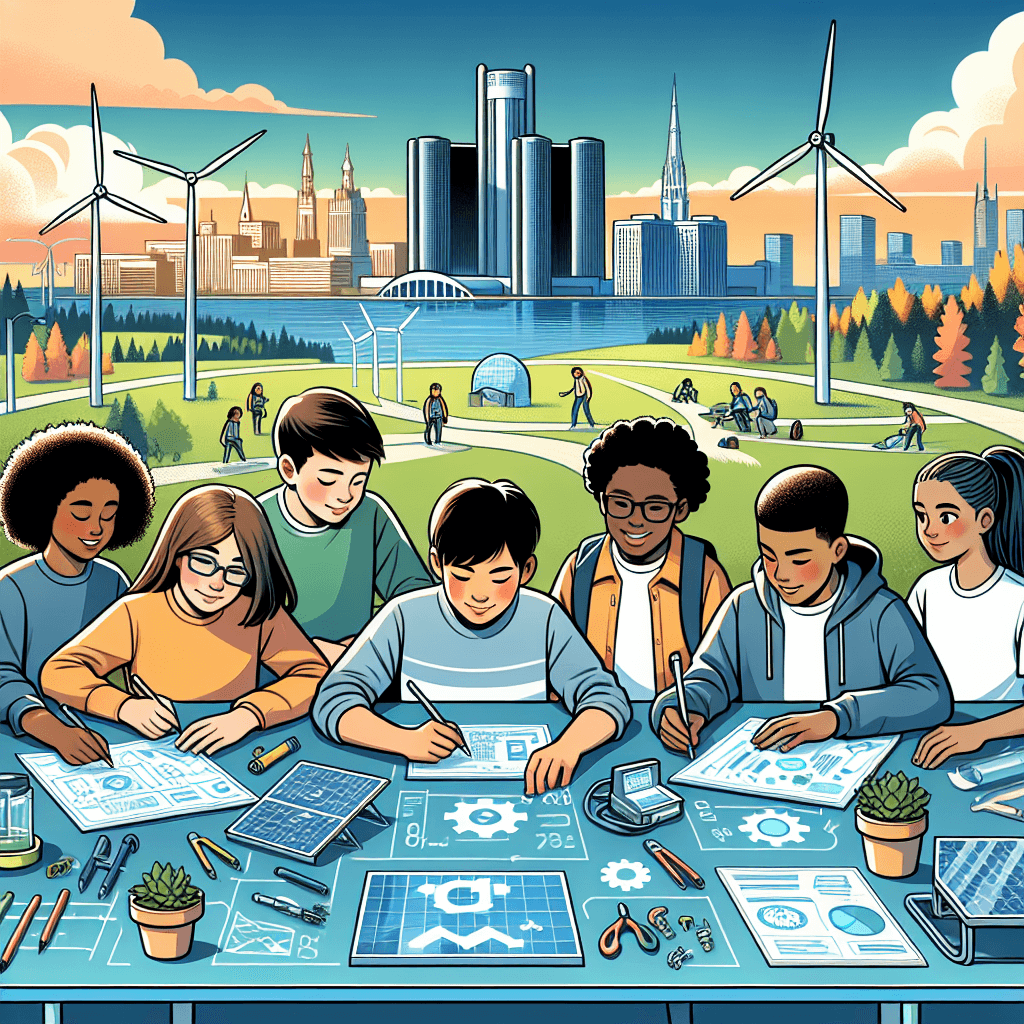
Designing Future Tech for Michigan's Energy Sustainability
Inquiry Framework
Question Framework
Driving Question
The overarching question that guides the entire project.How can we design innovative technology solutions to address the specific energy needs and challenges of Michigan, considering the environmental, social, and economic factors influencing renewable energy development?Essential Questions
Supporting questions that break down major concepts.- What are the current renewable energy technologies being used in Michigan and how do they benefit the environment?
- How can new technology be developed to enhance Michigan's energy sustainability?
- What are the challenges and limitations of current renewable energy solutions in Michigan?
- How do environmental, social, and economic factors influence the development and implementation of renewable energy technologies in Michigan?
- How can we design future technology to address the specific energy needs and challenges faced by Michigan?
- What role do innovation and technology play in shaping a sustainable energy future for Michigan?
Standards & Learning Goals
Learning Goals
By the end of this project, students will be able to:- Students will understand the current renewable energy technologies used in Michigan and their environmental benefits.
- Students will identify and evaluate challenges and limitations of current energy solutions in Michigan.
- Students will develop innovative technological solutions to enhance Michigan's energy sustainability.
- Students will analyze how environmental, social, and economic factors influence renewable energy technologies.
- Students will gain insights into the role of innovation in shaping a sustainable future for Michigan's energy grid.
NGSS
Common Core
Entry Events
Events that will be used to introduce the project to studentsEnergy Crisis Escape Room
Engage students with a themed escape room challenge centered on solving an energy crisis in Michigan. They must use critical thinking and problem-solving skills related to renewable energies to 'escape,' stimulating interest in designing viable future-tech solutions.Portfolio Activities
Portfolio Activities
These activities progressively build towards your learning goals, with each submission contributing to the student's final portfolio.Renewable Energy Tech Explorer
In this initial activity, students will research and explore various renewable energy technologies currently used in Michigan. The aim is to understand their environmental benefits and how they contribute to energy sustainability. Students will analyze these technologies from both a technical and societal perspective.Steps
Here is some basic scaffolding to help students complete the activity.Final Product
What students will submit as the final product of the activityA group presentation detailing the renewable energy technologies in Michigan, along with their pros and cons.Alignment
How this activity aligns with the learning objectives & standardsAligns with Exploring renewable energy technology, focusing on benefits, directly supporting MS-ESS3-3.Energy Solutions Inventor
Building on their research, students brainstorm innovative technological solutions to enhance Michigan's energy sustainability. This activity encourages creativity and critical thinking as they define and develop new solutions considering environmental, social, and economic factors.Steps
Here is some basic scaffolding to help students complete the activity.Final Product
What students will submit as the final product of the activityA comprehensive proposal for an innovative renewable energy technology tailored for Michigan's needs.Alignment
How this activity aligns with the learning objectives & standardsDirectly supports 7-ETS1-1, focusing on criteria and constraints of technology design.Impact Investigator
In this activity, students analyze how their proposed solutions will affect Michigan's energy landscape. They evaluate how environmental, social, and economic factors influence their technology's implementation and potential success.Steps
Here is some basic scaffolding to help students complete the activity.Final Product
What students will submit as the final product of the activityA detailed report analyzing the potential impacts of their proposed energy solution on Michigan.Alignment
How this activity aligns with the learning objectives & standardsSupports 7-ESS3-4 by evaluating human and environmental impacts on consumption and sustainability.Innovative Tech Showcase
Students finalize their projects by developing a presentation that highlights their innovative energy technology solutions. This activity emphasizes communication and persuasion skills to advocate for their technology's adoption.Steps
Here is some basic scaffolding to help students complete the activity.Final Product
What students will submit as the final product of the activityA final presentation advocating for their innovative energy technology tailored for Michigan.Alignment
How this activity aligns with the learning objectives & standardsEngages communication skills, supporting MS-PS3-4 by emphasizing scientific principles and their application to real-world solutions.Rubric & Reflection
Portfolio Rubric
Grading criteria for assessing the overall project portfolioTech for Tomorrow: Energy Sustainability Portfolio Rubric
Research and Understanding
Assessment of the depth of research into current renewable energy technologies and understanding of their benefits and drawbacks in Michigan.Research Depth
Evaluation of the thoroughness of the research conducted on renewable energy technologies in Michigan.
Exemplary
4 PointsConducts comprehensive and detailed research, showcasing an in-depth understanding of multiple renewable energy technologies and their impacts on Michigan.
Proficient
3 PointsConducts detailed research covering key renewable energy technologies and their impacts on Michigan with minor gaps.
Developing
2 PointsConducts basic research with limited detail on renewable energy technologies and impacts, covering some essential points.
Beginning
1 PointsConducts minimal research with significant gaps in understanding renewable energy technologies and their impacts.
Understanding and Analysis
Measures the understanding and analysis of the societal and environmental implications of current technologies.
Exemplary
4 PointsProvides a sophisticated analysis of societal and environmental implications, demonstrating thorough understanding and insightful connections.
Proficient
3 PointsOffers a clear analysis of societal and environmental implications with good understanding and logical connections.
Developing
2 PointsOffers a basic analysis of societal and environmental implications with some understanding and obvious connections.
Beginning
1 PointsPresents a minimal analysis of societal and environmental implications with minimal understanding and few connections.
Innovation and Creativity
Assess student creativity and innovation in designing new renewable energy technology solutions for Michigan's specific challenges.Creativity and Innovation
The originality and inventiveness of proposed technological solutions.
Exemplary
4 PointsDemonstrates exceptional creativity with unique and innovative ideas that effectively address Michigan's energy challenges.
Proficient
3 PointsDemonstrates good creativity with original ideas that adequately address Michigan's energy challenges.
Developing
2 PointsShows some creativity with conventional ideas that partially address Michigan's energy challenges.
Beginning
1 PointsShows minimal creativity with standard ideas that only slightly address Michigan's energy challenges.
Application of Scientific Principles
Evaluation of the application of scientific principles to the design process and final proposals.
Exemplary
4 PointsApplies scientific principles expertly in the design process, demonstrating thorough integration into final proposals.
Proficient
3 PointsApplies scientific principles effectively, showing good integration into final proposals.
Developing
2 PointsApplies scientific principles occasionally, showing partial integration into final proposals.
Beginning
1 PointsRarely applies scientific principles, with minimal integration into final proposals.
Critical Thinking and Reflection
Evaluation of students' critical thinking and reflection on their proposed solutions' potential impacts.Critical Analysis of Impacts
Analysis of the proposed technology's impact on Michigan's environment, society, and economy.
Exemplary
4 PointsProvides a detailed and insightful analysis, considering multiple perspectives and potential impacts comprehensively.
Proficient
3 PointsProvides a clear analysis, considering the key impacts from various perspectives.
Developing
2 PointsProvides a basic analysis, considering some impacts from a few perspectives.
Beginning
1 PointsProvides minimal analysis, considering limited impacts from narrow perspectives.
Communication and Presentation
Assessment of students' ability to communicate and present their solutions effectively.Presentation Clarity and Persuasiveness
Clarity and persuasiveness in presenting technological solutions to an audience.
Exemplary
4 PointsCommunicates ideas with exceptional clarity and persuasiveness, thoroughly engaging the audience.
Proficient
3 PointsCommunicates ideas clearly and persuasively, adequately engaging the audience.
Developing
2 PointsCommunicates ideas with some clarity and persuasive elements, partially engaging the audience.
Beginning
1 PointsCommunicates ideas unclearly with limited persuasive effort, resulting in minimal audience engagement.