
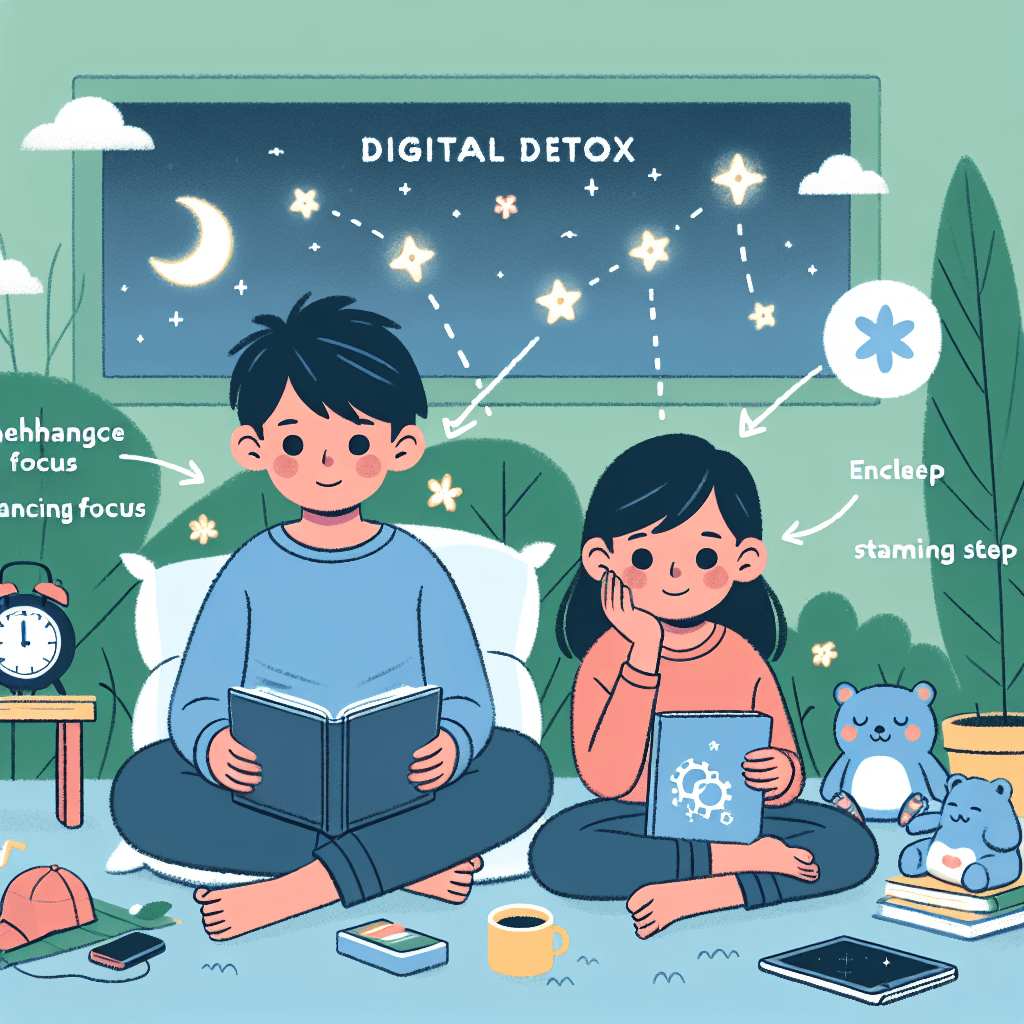
Digital Detox: Enhance Focus & Sleep
Inquiry Framework
Question Framework
Driving Question
The overarching question that guides the entire project.How can we measure and understand the biological and chemical effects of screen time on teenage mental health, focus, and sleep, and what creative strategies can we develop to initiate a digital detox?Essential Questions
Supporting questions that break down major concepts.- What are the biological effects of screen time on the human body, particularly in teenagers?
- How do chemicals produced by screen use affect mental health and sleep?
- What environmental factors contribute to screen time habits and how can they be mitigated?
- In what ways does art convey the impact of screen usage on mental and physical health?
- How can scientific methods be applied to measure screen time's impact on focus and sleep quality?
- Why is digital detox important for maintaining mental and physical health?
- What practical strategies can individuals implement to reduce screen time and improve quality of life?
Standards & Learning Goals
Learning Goals
By the end of this project, students will be able to:- Students will investigate the biological impact of screen time on teenagers' mental health and sleep.
- Students will develop a chemical understanding of compounds released during extended screen time and their effects.
- Students will evaluate and propose strategies using environmental science concepts to mitigate screen time habits.
- Students will apply scientific methodologies to measure screen time's effect on focus and sleep quality.
- Students will use artistic expression to convey the impacts of screen usage on mental and physical health.
- Students will explore and articulate practical digital detox strategies to enhance overall well-being.
Next Generation Science Standards
Common Core Standards for Mathematics
National Health Standards
Entry Events
Events that will be used to introduce the project to studentsDigital Fast Challenge
Kick off with a 'Digital Fast Challenge' where students are asked to voluntarily give up all screens for 24 hours and document their experiences. This immersive experience will provide a direct connection to how screen-time impacts mental health, focus, and sleep, sparking curiosity about the science behind these effects.Portfolio Activities
Portfolio Activities
These activities progressively build towards your learning goals, with each submission contributing to the student's final portfolio.Digital Experience Journal
Students will document their experiences during a 24-hour digital fast, reflecting on how the absence of screens affected their mental state, focus, and sleep. This activity intends to ground students in real-world experiences, providing personal insights for further exploration and understanding of digital influence on health.Steps
Here is some basic scaffolding to help students complete the activity.Final Product
What students will submit as the final product of the activityA personalized journal reflecting on the impact of screen abstinence on mental health, focus, and sleep.Alignment
How this activity aligns with the learning objectives & standardsAligns with HealthEd-Analyze Influences by helping students understand personal and external influences on their digital habits.Chemical Detective: Understanding the Screen-Induced Chemistry
Students will explore and model the chemical changes in the brain induced by prolonged screen use. They will research the biochemical pathways affected by screen time and illustrate how these changes can impact mental health and sleep.Steps
Here is some basic scaffolding to help students complete the activity.Final Product
What students will submit as the final product of the activityA comprehensive model and report on the chemical effects of screens, demonstrating understanding of biochemical principles.Alignment
How this activity aligns with the learning objectives & standardsAddresses HS-PS1-4 by modeling the energy changes from chemical reactions related to screen time.Biological Response Analysis: Screening Focus and Sleep
Through this activity, students will conduct an investigation into how screen time biologically affects the human body's ability to focus and sleep. By comparing pre- and post-screen time conditions, students will learn about homeostasis and feedback mechanisms.Steps
Here is some basic scaffolding to help students complete the activity.Final Product
What students will submit as the final product of the activityA detailed report on physiological changes during screen exposure, highlighting the disruptions in homeostasis.Alignment
How this activity aligns with the learning objectives & standardsMeets HS-LS1-3 by demonstrating how feedback mechanisms maintain homeostasis.Environmental Impact Reflection: Bridging Nature and Digital
Students will evaluate the environmental factors that contribute to screen time habits and the broader implications for mental health. They will propose adjustments incorporating environmental science concepts to mitigate these habits.Steps
Here is some basic scaffolding to help students complete the activity.Final Product
What students will submit as the final product of the activityA thoughtful proposal and campaign on modifying environmental factors to improve screen time habits.Alignment
How this activity aligns with the learning objectives & standardsSupports HS-ESS3-4 by evaluating human impact on natural systems and mental health.Artistic Expression: The Screen's Tale
In this creative activity, students will use art to express the effects of screen time on mental and physical health. By conveying emotions and experiences visually, they can promote awareness and inspire others to consider digital detox strategies.Steps
Here is some basic scaffolding to help students complete the activity.Final Product
What students will submit as the final product of the activityAn expressive art project depicting screen time impacts, accompanied by a narrative explanation.Alignment
How this activity aligns with the learning objectives & standardsLinks to HealthEd-Analyze Influences and artistic exploration of health behaviors.Strategic Detox Plan: Crafting a Future Path
Students will synthesize their findings and creative expressions to develop a comprehensive digital detox plan personally applicable and potentially beneficial to peers.Steps
Here is some basic scaffolding to help students complete the activity.Final Product
What students will submit as the final product of the activityA practical and personalized digital detox plan, emphasizing enhanced well-being.Alignment
How this activity aligns with the learning objectives & standardsAligns with HealthEd-Analyze Influences by implementing understanding into personal health behavior strategies.Rubric & Reflection
Portfolio Rubric
Grading criteria for assessing the overall project portfolioDigital Detox Portfolio Rubric
Scientific Inquiry and Analysis
Evaluation of students’ ability to conduct investigations, analyze data, and apply scientific methods related to screen time effects.Investigation Design
Assessment of students’ proficiency in designing and conducting experiments to investigate screen time effects.
Exemplary
4 PointsDesigns thorough and innovative investigations that comprehensively explore screen time's effects on health.
Proficient
3 PointsDesigns effective investigations addressing core questions about screen time's impact.
Developing
2 PointsDesigns basic investigations with partial exploration of screen time effects.
Beginning
1 PointsDesigns incomplete or flawed investigations with minimal exploration.
Data Analysis
Evaluation of students' ability to interpret and analyze data collected during investigations.
Exemplary
4 PointsAnalyzes and interprets data with exceptional insight, drawing well-supported conclusions.
Proficient
3 PointsAnalyzes data and derives logical, evidence-based conclusions.
Developing
2 PointsInterprets data with some inconsistencies in logic or conclusion accuracy.
Beginning
1 PointsStruggles to interpret data or draw valid conclusions.
Creative and Artistic Expression
Assessment of creativity in conveying the impact of screen time through the arts.Artistic Representation
Evaluation of how well students express the impact of screen time creatively and meaningfully through art.
Exemplary
4 PointsCreates highly original and emotionally impactful interpretations of screen time's effects, showing clear intent and message.
Proficient
3 PointsProduces meaningful and thoughtful artistic representations that convey screen time’s effects.
Developing
2 PointsCreates representations with some clarity in intent and message but lacks originality.
Beginning
1 PointsProduces artwork with unclear or undeveloped interpretations of screen time effects.
Personal Reflection and Practical Application
Evaluation of students’ ability to reflect on their experiences and apply insights to develop practical solutions.Reflective Writing
Assessment of students’ depth of reflection and personal insight about screen time impacts.
Exemplary
4 PointsProvides profound personal reflections with insightful connections to broader implications.
Proficient
3 PointsOffers honest reflections with clear connections to personal and general implications.
Developing
2 PointsShares basic reflections with limited connections and insight.
Beginning
1 PointsProvides superficial or unsupported reflections lacking depth.
Practical Solutions and Plans
Evaluation of students' ability to develop and propose actionable strategies based on learned content.
Exemplary
4 PointsDevelops comprehensive, innovative digital detox strategies that are extensively researched and feasible.
Proficient
3 PointsProposes well-researched and practical digital detox strategies applicable to many.
Developing
2 PointsProposes basic strategies that may lack thorough research or feasibility.
Beginning
1 PointsOffers vague or impractical strategies with little basis in research.