
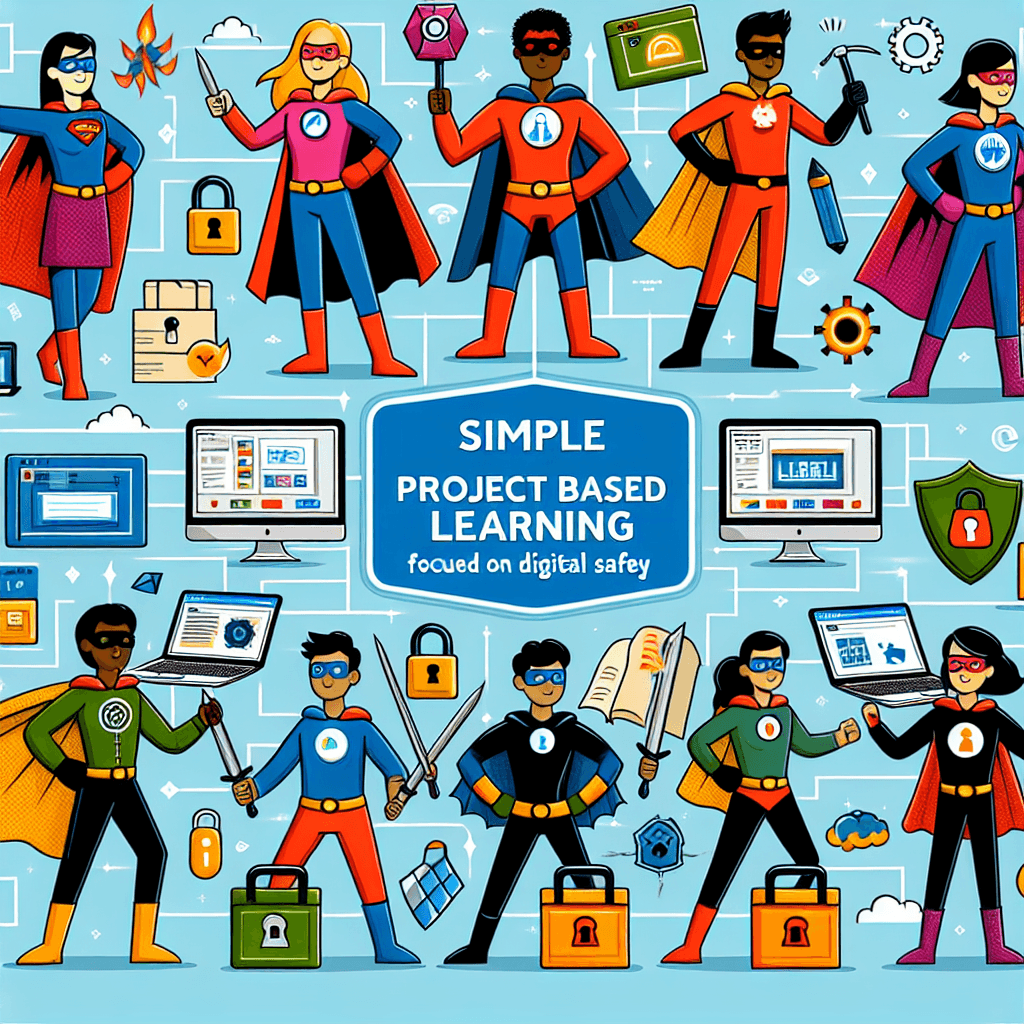
Digital Safety Superheroes
Inquiry Framework
Question Framework
Driving Question
The overarching question that guides the entire project.How can we create a comprehensive Digital Citizenship Pledge that ensures the protection of personal information, promotes responsible online behavior, and addresses the challenges of cyber threats?Essential Questions
Supporting questions that break down major concepts.- What is information and cyber security, and why is it important?
- How can I protect my personal information and privacy online?
- What are the basic principles of digital citizenship?
- Why is it important to be a responsible digital citizen?
- How do cyber threats affect individuals and organizations?
- What strategies can be used to identify and prevent cyber attacks?
- How can collaboration and communication online be both positive and negative?
- What are the ethical considerations of internet use?
Standards & Learning Goals
Learning Goals
By the end of this project, students will be able to:- Understand the importance of information and cyber security and how it affects individuals and organizations.
- Identify strategies to protect personal information and privacy online.
- Develop a Digital Citizenship Pledge that addresses responsible online behavior and cyber threat mitigation.
- Investigate the impact of cyber threats on individuals and organizations.
- Explore ethical considerations in digital communication and information sharing.
- Learn to collaborate and communicate effectively and responsibly in online environments.
ISTE Standards for Students
Common Core Standards
Next Generation Science Standards
Entry Events
Events that will be used to introduce the project to studentsThe Phishing Attack Simulation
Conduct a simulation where students receive fake 'phishy' emails and must identify which are safe or dangerous. This hands-on exploration of phishing attacks not only captures attention but also enlightens them on critical thinking needed for their Digital Citizenship Pledge. It connects to their everyday experiences of receiving emails and messages.Hacker's Hideout Escape Room
Turn the classroom into an escape room where students have to solve cyber security challenges to "escape" from a simulated hacker scenario. Each challenge solved will provide a key idea or principle to include in their Digital Citizenship Pledge. The game-like setting ties together problem-solving with practical application of technology concepts.Portfolio Activities
Portfolio Activities
These activities progressively build towards your learning goals, with each submission contributing to the student's final portfolio.Phishing Detective
Students engage in a simulation exercise to detect phishing emails. This activity aims to build critical thinking and enhance awareness about safe versus unsafe digital communication as part of their Digital Citizenship Pledge.Steps
Here is some basic scaffolding to help students complete the activity.Final Product
What students will submit as the final product of the activityA class-generated list of tips and red flags for identifying phishing emails.Alignment
How this activity aligns with the learning objectives & standardsAligns with ISTE-2A as students learn to keep personal information safe and recognize cyber threats.Escape Room: Cyber Security Challenge
Students participate in a classroom-based escape room activity where they solve a series of cyber security puzzles. Each challenge teaches them a principle of digital citizenship, guiding them toward creating their Digital Citizenship Pledge.Steps
Here is some basic scaffolding to help students complete the activity.Final Product
What students will submit as the final product of the activityA set of cyber security challenges completed and a list of digital citizenship principles discovered from the activity.Alignment
How this activity aligns with the learning objectives & standardsSupports NGSS-3-5-ETS1-1 by helping students define problems and consider criteria for successful solutions, as well as ISTE-2A for recognizing safe online practices.Digital Citizenship Research Quest
Students embark on a research project to investigate digital citizenship concepts, drawing information from various sources. This helps them gather the content needed for their Digital Citizenship Pledge.Steps
Here is some basic scaffolding to help students complete the activity.Final Product
What students will submit as the final product of the activityA comprehensive research portfolio with summarized findings and a bibliography.Alignment
How this activity aligns with the learning objectives & standardsMeets CCSS.ELA-LITERACY.W.5.8 by focusing on information gathering and summarizing from various sources.Cyber Ethics Debate
Students engage in a debate about ethical considerations in digital communication. This activity encourages critical thinking about internet use, supporting their Digital Citizenship Pledge development.Steps
Here is some basic scaffolding to help students complete the activity.Final Product
What students will submit as the final product of the activityRecordings or written summaries of debates with reflections on ethical considerations discussed.Alignment
How this activity aligns with the learning objectives & standardsAligns with ISTE-2A for understanding privacy and security, and ISTE-6D for presenting tailored content to audiences.Rubric & Reflection
Portfolio Rubric
Grading criteria for assessing the overall project portfolioDigital Citizenship and Cyber Security Evaluation Rubric
Understanding of Digital Citizenship Concepts
Assesses students' knowledge of digital citizenship principles, cyber security issues, and their importance.Knowledge of Cyber Security Principles
Evaluates students' understanding of fundamental cyber security concepts such as phishing, privacy, and online safety.
Exemplary
4 PointsShows sophisticated understanding of cyber security issues and principles, explaining them comprehensively with effective examples.
Proficient
3 PointsDisplays thorough understanding of basic cyber security principles, with relevant examples.
Developing
2 PointsShows emerging understanding with some correct identification of cyber security principles.
Beginning
1 PointsMinimal understanding of cyber security concepts, with possible misconceptions.
Impact of Cyber Threats
Assesses the understanding of the effects of cyber threats on individuals and organizations.
Exemplary
4 PointsProvides comprehensive analysis of cyber threat impacts, connecting real-world scenarios and solutions.
Proficient
3 PointsClearly explains the impact of at least two significant cyber threats.
Developing
2 PointsIdentifies some impacts of cyber threats, but with limited depth.
Beginning
1 PointsHas difficulty identifying cyber threats and their impacts.
Research and Information Gathering
Evaluates how effectively students gather, evaluate, and integrate research to support their work.Research Skills
Assess students' ability to gather, summarize, and paraphrase information from multiple sources.
Exemplary
4 PointsEfficiently gathers and synthesizes information from diverse sources, offering well-organized summaries.
Proficient
3 PointsGathers relevant information and creates understandable summaries from multiple sources.
Developing
2 PointsAttempts to gather information with incomplete or unclear summaries.
Beginning
1 PointsStruggles to gather relevant information and create cohesive summaries.
Collaborative Work and Communication
Assesses students' ability to work collaboratively and communicate effectively within group activities and presentations.Collaboration Skills
Assesses participation and contribution to group activities.
Exemplary
4 PointsLeads group effectively, promoting inclusive collaboration and shared goals.
Proficient
3 PointsContributes actively and cooperatively towards group objectives.
Developing
2 PointsParticipates in collaboration but with limited initiative or engagement.
Beginning
1 PointsMinimal contribution to group tasks; relies heavily on peers for direction.
Communication Skills
Evaluates how well students can articulate ideas and findings through written and verbal communication.
Exemplary
4 PointsCommunicates ideas clearly and persuasively in both writing and speaking, with effective use of tone and style.
Proficient
3 PointsCommunicates clearly in writing and speaking, using appropriate tone and vocabulary.
Developing
2 PointsCommunicates ideas with some clarity; may lack coherence or appropriateness in tone.
Beginning
1 PointsStruggles to effectively communicate ideas in writing and speaking.
Creative and Critical Thinking
Evaluates the students' ability to think critically and creatively when developing their Digital Citizenship Pledge.Problem Solving and Innovation
Assesses the capacity for critical thinking and creative problem solving in designing the Digital Citizenship Pledge.
Exemplary
4 PointsInnovatively solves complex problems, demonstrating deep critical thinking and original ideas.
Proficient
3 PointsEffectively solves problems and demonstrates logical reasoning and creativity.
Developing
2 PointsDemonstrates basic problem-solving skills, with partial logic and creativity.
Beginning
1 PointsStruggles to engage in critical or creative problem-solving processes.