
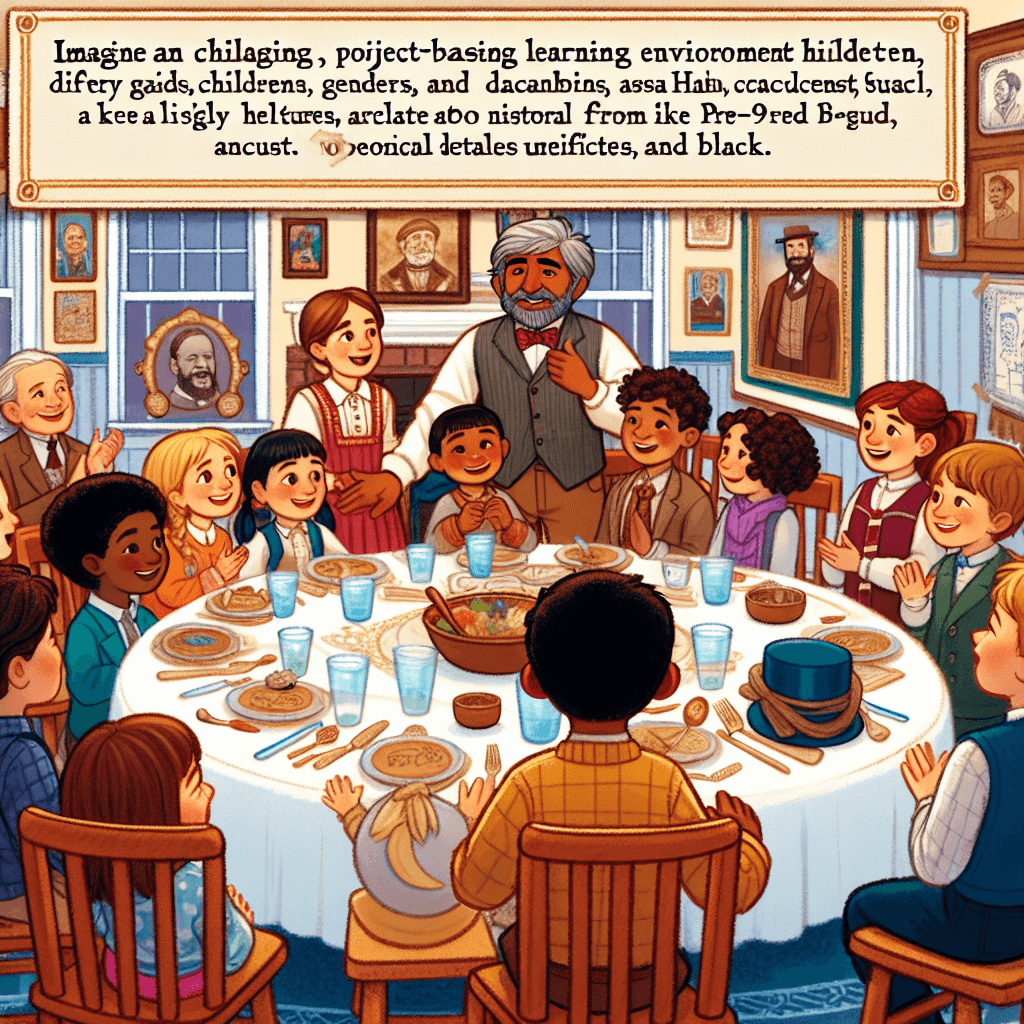
Dinner Party with a Historical Figure: A PBL Project
Inquiry Framework
Question Framework
Driving Question
The overarching question that guides the entire project.How can we plan a historical dinner party, using math, research, and persuasive writing to create an engaging and informative experience?Essential Questions
Supporting questions that break down major concepts.- How can we use math to plan a dinner party within a budget?
- How can we use primary and secondary sources to develop interview questions?
- How can we use persuasive writing to create an invitation and menu?
Standards & Learning Goals
Learning Goals
By the end of this project, students will be able to:- Students will be able to research a historical figure using primary and secondary sources.
- Students will be able to develop interview questions based on their research.
- Students will be able to plan a dinner party within a budget.
- Students will be able to write persuasively to create an invitation and menu.
- Students will be able to integrate math, research, and writing skills to create an engaging and informative experience.
- Students will demonstrate an understanding of the historical figure's life and times through their dinner party plan and interview questions.
- Students will apply budgeting and resource allocation skills in a real-world context.
- Students will develop critical thinking skills through the research and interview process.
- Students will enhance their communication and collaboration skills through group work and presentation of their dinner party plan.
- Students will strengthen their problem-solving abilities by addressing challenges related to budget constraints and resource management.
- Students will build their research and information literacy skills by evaluating and synthesizing information from various sources.
- Students will refine their organizational and planning skills by managing the various tasks and deadlines associated with the project.
- Students will cultivate their curiosity and lifelong learning skills by exploring new topics and engaging in inquiry-based learning.
- Students will strengthen their ability to work independently and collaboratively by managing their time, resources, and responsibilities effectively.
- Students will develop their ability to adapt to changing circumstances and unexpected challenges by adjusting their plans and strategies as needed.
- Students will strengthen their ability to reflect on their learning and identify areas for improvement by evaluating their own work and seeking feedback from others.
Entry Events
Events that will be used to introduce the project to studentsDinner Party Budget Challenge
Present students with a 'Dinner Party Budget Challenge': Give each student a limited amount of play money and a sample menu with prices. Challenge them to create the most appealing and balanced dinner menu possible within budget. This immediately connects to the math aspect of the project and sparks discussions about cost, value, and dietary considerations for their historical guest.Historical Figure Mystery Dinner
Host a 'Historical Figure Mystery Dinner': Students arrive to find the classroom transformed into a dinner party setting, but one historical figure is 'missing.' Clues related to their accomplishments, time period, and personality are scattered around the room. Students must analyze the clues to deduce the missing guest and understand who they will be planning a dinner party for and interviewing.Portfolio Activities
Portfolio Activities
These activities progressively build towards your learning goals, with each submission contributing to the student's final portfolio.Historical Figure Deep Dive
Students will immerse themselves in the life and times of their chosen historical figure. They will use a variety of resources to gather information about their figure's background, accomplishments, and impact on society.Steps
Here is some basic scaffolding to help students complete the activity.Final Product
What students will submit as the final product of the activityA detailed research report, including a timeline of key events, a summary of accomplishments, and a character profile. This report will serve as the foundation for the dinner party plan and interview questions.Alignment
How this activity aligns with the learning objectives & standardsAddresses learning goals related to research, question development, and historical understanding. Aligns with Social Studies standards by requiring in-depth study of a historical figure. Connects to English Language Arts through the development of interview questions.Question Quest: Interviewing the Past
Students will craft insightful and relevant interview questions for their chosen historical figure. These questions should demonstrate a deep understanding of the figure's life and accomplishments.Steps
Here is some basic scaffolding to help students complete the activity.Final Product
What students will submit as the final product of the activityA list of 10-15 interview questions that are thoughtful, open-ended, and designed to elicit meaningful responses from the historical figure.Alignment
How this activity aligns with the learning objectives & standardsAddresses learning goals related to interview question development and historical understanding. Aligns with English Language Arts standards by focusing on effective question formulation and research skills.Dinner Party Planner Extraordinaire
Students will plan a historical dinner party within a budget. They will create a menu, design invitations, and allocate resources effectively to create a memorable event.Steps
Here is some basic scaffolding to help students complete the activity.Final Product
What students will submit as the final product of the activityA complete dinner party plan, including a menu with prices, an invitation design, and a budget breakdown. This plan will demonstrate students' ability to integrate math, writing, and research skills in a practical context.Alignment
How this activity aligns with the learning objectives & standardsAddresses learning goals related to budgeting, resource allocation, and persuasive writing. Aligns with Math standards by requiring students to work within a budget and calculate costs. Connects to English Language Arts through the creation of a menu and invitation.Rubric & Reflection
Portfolio Rubric
Grading criteria for assessing the overall project portfolioHistorical Dinner Party Project Rubric
Research and Historical Accuracy
Assesses the depth and breadth of the student's research into their chosen historical figure.Historical Accuracy and Depth
Accuracy and depth of research on the historical figure's life, accomplishments, and impact.
Exemplary
4 PointsDemonstrates comprehensive and insightful research, including accurate details about the historical figure's life, accomplishments, and impact, going beyond basic information.
Proficient
3 PointsDemonstrates thorough research, including accurate details about the historical figure's life, accomplishments, and impact.
Developing
2 PointsShows emerging understanding through basic research, including some details about the historical figure's life, accomplishments, and impact.
Beginning
1 PointsShows initial understanding through limited research, including few details about the historical figure's life, accomplishments, and impact.
Organization and Clarity
Organization and clarity of the research report, including timeline, summary of accomplishments, and character profile.
Exemplary
4 PointsPresents a well-organized and exceptionally clear research report with a detailed timeline, comprehensive summary of accomplishments, and insightful character profile.
Proficient
3 PointsPresents a well-organized and clear research report with a detailed timeline, summary of accomplishments, and character profile.
Developing
2 PointsPresents a somewhat organized research report with a basic timeline, summary of accomplishments, and character profile.
Beginning
1 PointsPresents a poorly organized research report with a minimal timeline, summary of accomplishments, and character profile.
Source Quality and Citation
Quality and variety of sources used (primary and secondary), with proper citations.
Exemplary
4 PointsUses a wide range of high-quality primary and secondary sources, cited meticulously and appropriately, demonstrating exceptional research skills.
Proficient
3 PointsUses a variety of primary and secondary sources, cited appropriately, demonstrating solid research skills.
Developing
2 PointsUses some primary and secondary sources, with some citations, demonstrating basic research skills.
Beginning
1 PointsUses few sources, with minimal or incorrect citations, demonstrating limited research skills.
Interview Question Development
Evaluates the quality and structure of the interview questions developed by the student.Question Relevance and Insight
Relevance and insightfulness of interview questions.
Exemplary
4 PointsCrafts highly relevant and exceptionally insightful interview questions that demonstrate a deep understanding of the historical figure's motivations, challenges, and perspectives.
Proficient
3 PointsCrafts relevant and insightful interview questions that demonstrate a good understanding of the historical figure's motivations, challenges, and perspectives.
Developing
2 PointsCrafts somewhat relevant interview questions that show some understanding of the historical figure's motivations, challenges, or perspectives.
Beginning
1 PointsCrafts interview questions that are largely irrelevant or superficial, showing little understanding of the historical figure's motivations, challenges, or perspectives.
Question Clarity and Conciseness
Clarity and conciseness of interview questions.
Exemplary
4 PointsPresents exceptionally clear and concise interview questions that are easily understood and focused.
Proficient
3 PointsPresents clear and concise interview questions that are easily understood and focused.
Developing
2 PointsPresents interview questions that are generally clear but may lack conciseness or focus.
Beginning
1 PointsPresents interview questions that are unclear, rambling, or difficult to understand.
Question Organization and Flow
Organization and logical flow of interview questions.
Exemplary
4 PointsOrganizes interview questions into an exceptionally logical and engaging flow that builds naturally and effectively explores the historical figure's life and experiences.
Proficient
3 PointsOrganizes interview questions into a logical flow that effectively explores the historical figure's life and experiences.
Developing
2 PointsOrganizes interview questions with some logical flow, but the connection between questions may be weak.
Beginning
1 PointsPresents interview questions in a random or illogical order, making it difficult to follow the interview's purpose.
Dinner Party Planning
Assesses the student's ability to plan a historical dinner party within a budget, including menu creation, invitation design, and resource allocation.Menu Authenticity
Authenticity and appropriateness of the menu to the historical figure's time period and culture.
Exemplary
4 PointsCreates a menu that is exceptionally authentic and appropriate to the historical figure's time period and culture, demonstrating a deep understanding of historical dining customs and food availability.
Proficient
3 PointsCreates a menu that is authentic and appropriate to the historical figure's time period and culture, demonstrating a good understanding of historical dining customs and food availability.
Developing
2 PointsCreates a menu that is somewhat authentic to the historical figure's time period and culture, but may include some anachronistic or inappropriate items.
Beginning
1 PointsCreates a menu that is largely inauthentic or inappropriate to the historical figure's time period and culture, showing little understanding of historical dining customs or food availability.
Budget Accuracy and Feasibility
Accuracy and feasibility of the budget, including realistic pricing and resource allocation.
Exemplary
4 PointsDevelops an exceptionally accurate and feasible budget with realistic pricing and optimal resource allocation, demonstrating advanced budgeting skills and attention to detail.
Proficient
3 PointsDevelops an accurate and feasible budget with realistic pricing and good resource allocation, demonstrating solid budgeting skills.
Developing
2 PointsDevelops a budget that is somewhat accurate but may have some unrealistic pricing or resource allocation issues.
Beginning
1 PointsDevelops a budget that is inaccurate or infeasible, with unrealistic pricing and poor resource allocation.
Invitation Creativity and Persuasiveness
Creativity and persuasiveness of the invitation design and wording.
Exemplary
4 PointsDesigns an exceptionally creative and persuasive invitation that effectively entices guests to attend the dinner party and reflects the historical figure's personality and era.
Proficient
3 PointsDesigns a creative and persuasive invitation that effectively entices guests to attend the dinner party and reflects the historical figure's personality and era.
Developing
2 PointsDesigns an invitation that is somewhat creative or persuasive but may lack visual appeal or relevant details.
Beginning
1 PointsDesigns an invitation that is uninspired and lacks persuasive elements or relevant details.