
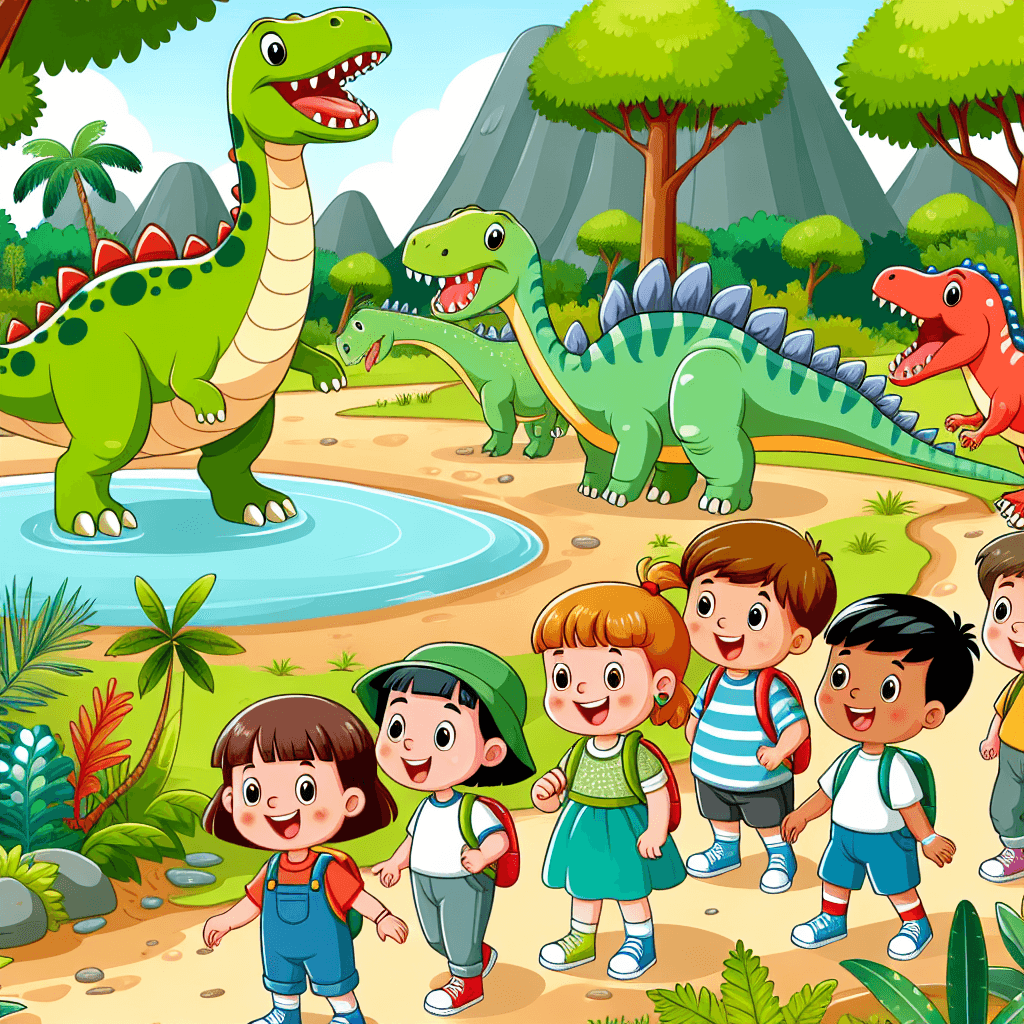
Dinosaur Zoo: A Kindergarten PBL Adventure
Inquiry Framework
Question Framework
Driving Question
The overarching question that guides the entire project.How can we create a dinosaur zoo that reflects what we know about where dinosaurs lived, what they ate, and how they can be grouped?Essential Questions
Supporting questions that break down major concepts.- What did dinosaurs eat?
- How can we group dinosaurs?
- Where did dinosaurs live?
Standards & Learning Goals
Learning Goals
By the end of this project, students will be able to:- Students will be able to explain where dinosaurs lived.
- Students will be able to explain what dinosaurs ate.
- Students will be able to group dinosaurs.
- Students will be able to use their knowledge to create a realistic dinosaur zoo.
- Students will be able to improve their communication skills through collaborative work and presentations of their zoo exhibits.
Entry Events
Events that will be used to introduce the project to studentsThe Mystery Egg
A mysterious egg is discovered in the classroom, sparking curiosity about what kind of creature might hatch and whether it could be a dinosaur. Students investigate clues, make predictions, and begin their journey into the world of dinosaurs to prepare for the egg's potential arrival.Portfolio Activities
Portfolio Activities
These activities progressively build towards your learning goals, with each submission contributing to the student's final portfolio.Dinosaur Habitat Illustration and Writing
Students will learn about different dinosaur habitats and create an illustration with a written description.Steps
Here is some basic scaffolding to help students complete the activity.Final Product
What students will submit as the final product of the activityAn illustration of a dinosaur in its habitat with a written description.Alignment
How this activity aligns with the learning objectives & standardsLearning Goal: Students will be able to explain where dinosaurs lived.Dinosaur Diet Detectives
Students will categorize dinosaurs based on their diet (herbivore, carnivore, omnivore).Steps
Here is some basic scaffolding to help students complete the activity.Final Product
What students will submit as the final product of the activityA poster classifying dinosaurs by their diet with pictures and labels.Alignment
How this activity aligns with the learning objectives & standardsLearning Goal: Students will be able to explain what dinosaurs ate.Dinosaur Grouping
Students will group dinosaurs based on physical characteristics.Steps
Here is some basic scaffolding to help students complete the activity.Final Product
What students will submit as the final product of the activityA chart organizing dinosaurs by size, shape, and other features.Alignment
How this activity aligns with the learning objectives & standardsLearning Goal: Students will be able to group dinosaurs.Dinosaur Zoo Designer
Students will plan and design their own dinosaur zoo exhibit, incorporating what they have learned about dinosaur habitats, diets, and groupings.Steps
Here is some basic scaffolding to help students complete the activity.Final Product
What students will submit as the final product of the activityA blueprint and model of a dinosaur zoo exhibit, including a description of the dinosaurs, their habitats, and diets.Alignment
How this activity aligns with the learning objectives & standardsLearning Goal: Students will be able to use their knowledge to create a realistic dinosaur zoo.Dinosaur Zoo Presentation
Students will present their dinosaur zoo exhibits to the class, explaining their design choices and what they have learned about dinosaurs.Steps
Here is some basic scaffolding to help students complete the activity.Final Product
What students will submit as the final product of the activityA presentation of their dinosaur zoo exhibit to the class.Alignment
How this activity aligns with the learning objectives & standardsLearning Goal: Students will be able to improve their communication skills through collaborative work and presentations of their zoo exhibits.Rubric & Reflection
Portfolio Rubric
Grading criteria for assessing the overall project portfolioDinosaur Habitat Illustration Rubric
Dinosaur Habitat Representation
This category assesses the student's ability to accurately represent a dinosaur's habitat through illustration and provide a coherent written description.Habitat Accuracy
Accuracy of dinosaur habitat representation and factual details in the written description.
Beginning
1 PointsHabitat is inaccurately represented and/or factual details in the description are incorrect or missing.
Developing
2 PointsHabitat is somewhat represented, but with some inaccuracies or omissions in factual details.
Proficient
3 PointsHabitat is accurately represented with correct factual details in the description.
Exemplary
4 PointsHabitat is exceptionally accurately represented, and the description includes detailed and accurate factual details, demonstrating a deep understanding.
Illustration Quality
Clarity and detail of the illustration, including relevant elements of the habitat.
Beginning
1 PointsIllustration is unclear, lacks detail, and does not represent the dinosaur's habitat effectively.
Developing
2 PointsIllustration shows some elements of the habitat, but lacks detail and clarity.
Proficient
3 PointsIllustration is clear, includes relevant details, and effectively represents the dinosaur's habitat.
Exemplary
4 PointsIllustration is exceptionally detailed and clear, creatively and accurately representing the dinosaur's habitat with relevant and well-executed elements.
Description Organization
Organization and coherence of the written description, demonstrating understanding of habitat.
Beginning
1 PointsDescription is disorganized, difficult to understand, and does not clearly relate to the habitat.
Developing
2 PointsDescription shows some organization, but lacks coherence and clarity in relating to the habitat.
Proficient
3 PointsDescription is well-organized, clear, and coherently explains the dinosaur's habitat.
Exemplary
4 PointsDescription is exceptionally well-organized, clearly and engagingly explaining the dinosaur's habitat with insightful details and a strong sense of understanding.