
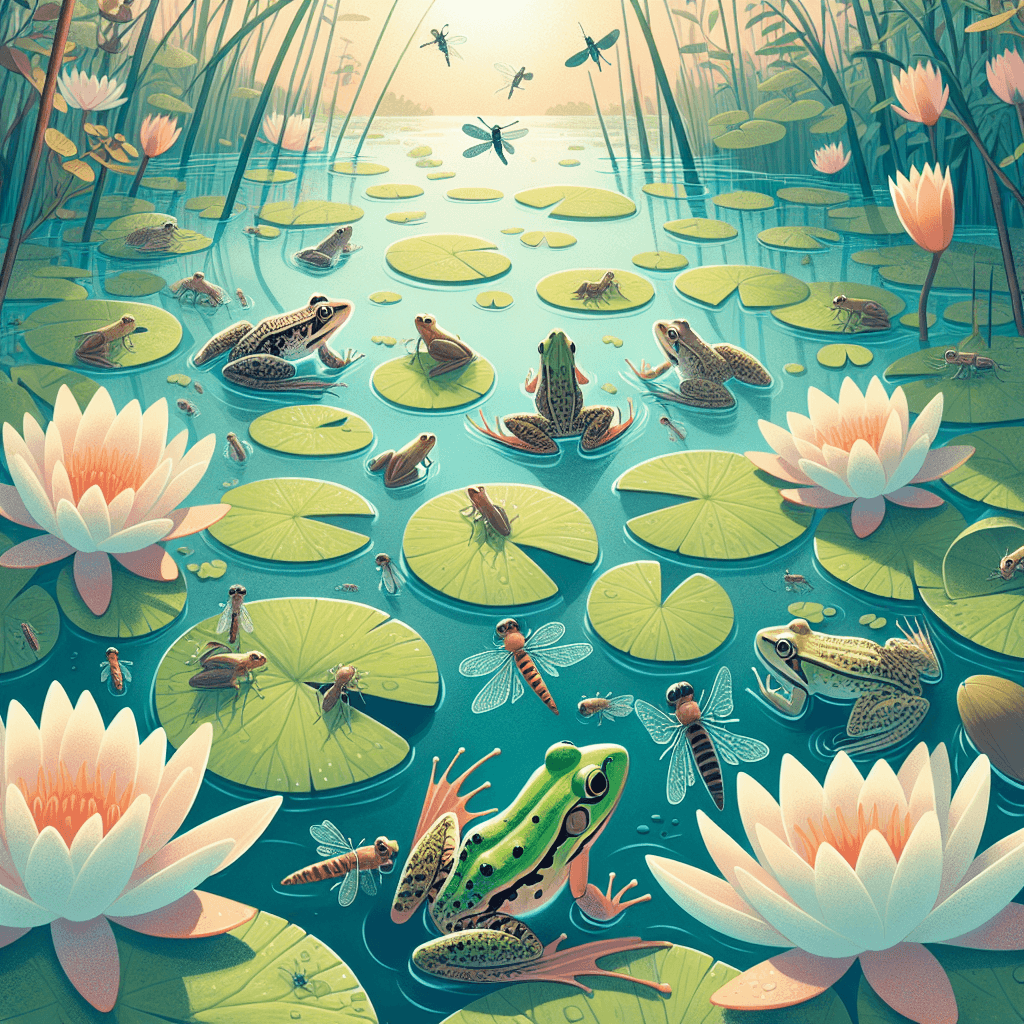
Disappearing Frogs: A Pond Ecosystem Exploration
Inquiry Framework
Question Framework
Driving Question
The overarching question that guides the entire project.How can we, as young scientists, investigate why frogs are disappearing from our local pond ecosystem and what solutions can we propose to help protect them?Essential Questions
Supporting questions that break down major concepts.- What are the key components of a pond ecosystem?
- How do frogs contribute to the ecosystem of a pond?
- What are some reasons frogs might be disappearing from pond ecosystems?
- How do environmental changes affect the organisms in a pond?
- What can we do to help protect frog populations in ponds?
Standards & Learning Goals
Learning Goals
By the end of this project, students will be able to:- Identify and describe the key components of a pond ecosystem.
- Understand the role of frogs in the ecosystem of a pond.
- Investigate possible reasons for the decline in frog populations.
- Explore the impacts of environmental changes on pond ecosystems.
- Propose solutions to help protect frog populations in local ponds.
NGSS
Entry Events
Events that will be used to introduce the project to studentsPond Biome Mystery
Transform the classroom into a mysterious pond environment overnight. Upon entering, students find frog sounds playing, strange footprints on the floor, and a 'Sherlock Holmes' style investigation kit at their desks. Students are then tasked with solving the mystery of disappearing frogs using clues scattered around the classroom, simulating real-world scientific inquiry.Portfolio Activities
Portfolio Activities
These activities progressively build towards your learning goals, with each submission contributing to the student's final portfolio.Frog Guardian Project
Students brainstorm and design solutions to help protect frog populations in their local pond ecosystem. They create a proposal outlining their solutions and explaining how they would benefit the frogs and the pond environment.Steps
Here is some basic scaffolding to help students complete the activity.Final Product
What students will submit as the final product of the activityA proposal outlining solutions to protect frog populations.Alignment
How this activity aligns with the learning objectives & standardsAligns with NGSS 2-ESS2-1 and learning goals related to exploring human interventions.Rubric & Reflection
Portfolio Rubric
Grading criteria for assessing the overall project portfolioFrog Guardian Project Rubric
Solutions and Impact
This category assesses the student's ability to identify problems facing frog populations, design effective solutions, and explain the benefits of those solutions.Problem Identification
The proposal clearly identifies specific and relevant threats to frog populations in the pond ecosystem.
Exemplary
4 PointsIdentifies specific, accurate, and relevant threats, demonstrating a deep understanding of factors impacting frog populations.
Proficient
3 PointsIdentifies relevant threats to frog populations with reasonable accuracy and understanding.
Developing
2 PointsIdentifies some threats to frog populations, but with limited accuracy or relevance.
Beginning
1 PointsStruggles to identify relevant threats to frog populations or provides inaccurate information.
Solution Design
The proposal offers practical and effective solutions to protect frog populations and improve the pond ecosystem.
Exemplary
4 PointsPresents innovative, highly practical, and effective solutions that address identified threats comprehensively.
Proficient
3 PointsPresents practical and effective solutions that address identified threats appropriately.
Developing
2 PointsPresents some solutions, but they are not always practical, effective, or clearly aligned with identified threats.
Beginning
1 PointsStruggles to present solutions that are practical, effective, or aligned with identified threats.
Explanation of Benefits
The proposal clearly explains how the proposed solutions would benefit the frogs and the overall pond environment, demonstrating a clear understanding of ecological relationships.
Exemplary
4 PointsProvides a detailed and insightful explanation of the benefits, demonstrating a sophisticated understanding of ecological relationships and potential impacts.
Proficient
3 PointsProvides a clear and coherent explanation of the benefits, demonstrating a solid understanding of ecological relationships and potential impacts.
Developing
2 PointsProvides a basic explanation of the benefits, but may lack detail or demonstrate a limited understanding of ecological relationships.
Beginning
1 PointsStruggles to explain the benefits of the solutions or demonstrates a lack of understanding of ecological relationships.
Presentation and Creativity
This category focuses on the quality of communication, organization, and creative thinking demonstrated in the proposal.Clarity and Organization
The proposal is clearly written, well-organized, and uses appropriate scientific vocabulary related to pond ecosystems and frog conservation.
Exemplary
4 PointsPresents information in a highly clear, concise, and engaging manner, using sophisticated scientific vocabulary accurately and effectively.
Proficient
3 PointsPresents information in a clear and organized manner, using appropriate scientific vocabulary accurately.
Developing
2 PointsPresents information that is somewhat unclear or disorganized, with occasional misuse of scientific vocabulary.
Beginning
1 PointsPresents information that is unclear, disorganized, and lacks appropriate scientific vocabulary.
Creativity and Innovation
The proposal demonstrates creative thinking and innovative approaches to solving the problem of declining frog populations.
Exemplary
4 PointsDemonstrates exceptional creativity and originality in proposing innovative solutions that go beyond conventional approaches.
Proficient
3 PointsDemonstrates creativity in proposing solutions that show original thought and a fresh perspective.
Developing
2 PointsShows some creativity in proposing solutions, but may rely on more common or obvious approaches.
Beginning
1 PointsDemonstrates little creativity or originality in proposing solutions.