
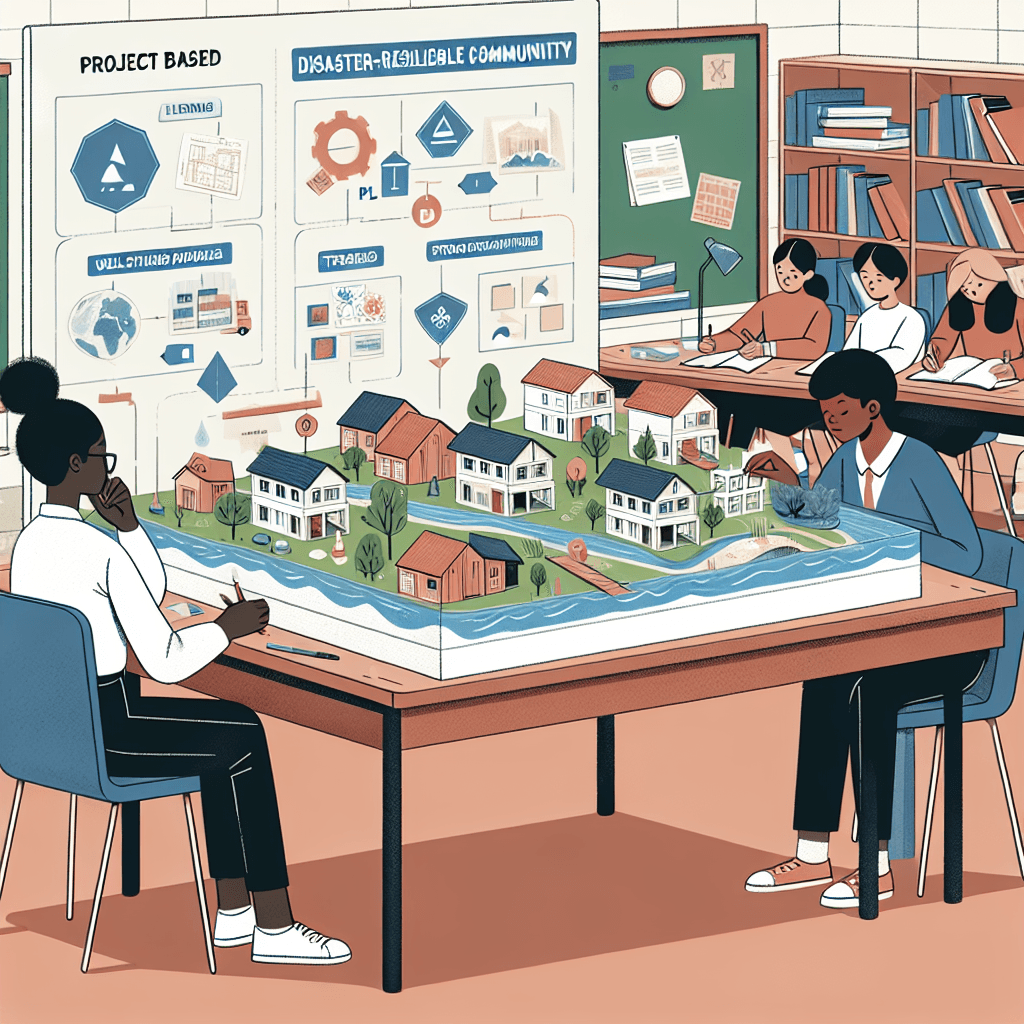
Disaster-Resilient Community Design Project
Inquiry Framework
Question Framework
Driving Question
The overarching question that guides the entire project.How can we design and build sustainable and resilient homes and community buildings after a natural disaster while focusing on renewable energy and eco-friendly materials?Essential Questions
Supporting questions that break down major concepts.- What are the sustainable building practices that can be implemented to withstand natural disasters?
- How can renewable energy sources be utilized effectively in different geographic locations?
- What factors should be considered when choosing eco-friendly building materials?
- How do buildings and utilities support a community's recovery after a natural disaster?
Standards & Learning Goals
Learning Goals
By the end of this project, students will be able to:- Students will understand and apply principles of sustainable building practices that can mitigate the impact of natural disasters.
- Students will learn to evaluate and select appropriate renewable energy systems for different geographic locations.
- Students will design and construct scale models of buildings using eco-friendly materials.
- Students will develop skills in critical thinking and problem-solving by addressing real-world challenges.
- Students will enhance their communication skills by presenting their designs and justifying their choices based on evidence and research.
- Students will be able to discuss the differences between natural and manmade disasters.
Next Generation Science Standards
Common Core Standards
Entry Events
Events that will be used to introduce the project to studentsVirtual Reality Tour of Disaster Zones
Students will embark on a virtual reality tour of various global locations impacted by different natural disasters. As they explore the aftermath and engage with survivor stories, they’ll start thinking about how architecture, technology, and innovative building practices can transform these spaces into resilient communities.Portfolio Activities
Portfolio Activities
These activities progressively build towards your learning goals, with each submission contributing to the student's final portfolio.Resilient Structure Designers
Students will work in groups to define the criteria for creating disaster-resilient buildings. This exercise introduces students to the concept of building resilient and sustainable communities by setting criteria and constraints based on the impacts of various environmental factors and the needs of urban recovery.Steps
Here is some basic scaffolding to help students complete the activity.Final Product
What students will submit as the final product of the activityA document detailing the criteria and constraints for resilient building designs.Alignment
How this activity aligns with the learning objectives & standardsAligns with MS-ETS1-1: Define criteria and constraints of a design problem considering scientific principles.Eco-Energy Investigators
Students will investigate different renewable energy sources suitable for their specific project location, evaluating their effectiveness and sustainability. This helps to integrate scientific principles into the design process, promoting environmental awareness and practical application of energy sciences.Steps
Here is some basic scaffolding to help students complete the activity.Final Product
What students will submit as the final product of the activityAn energy strategy plan document detailing the renewable energy sources chosen and their integration into building designs.Alignment
How this activity aligns with the learning objectives & standardsAligns with MS-ESS3-3 & MS-PS3-3: Applying scientific principles for energy integration and environmental impact.Sustainable Material Scouts
In this activity, students will research and select eco-friendly building materials for their scale model projects. By analyzing the environmental implications of different materials, they gain insight into how material choice affects long-term sustainability.Steps
Here is some basic scaffolding to help students complete the activity.Final Product
What students will submit as the final product of the activityA materials dossier that lists and justifies selected building materials.Alignment
How this activity aligns with the learning objectives & standardsAligns with MS-ESS3-3: Monitoring and minimizing human environmental impact.Model Makers Mastery
Students will now use their research to construct scale models of their designed resilient home and utility building. This activity focuses on the application of research in tangible product creation.Steps
Here is some basic scaffolding to help students complete the activity.Final Product
What students will submit as the final product of the activityA physical scale model of a resilient home and a utility building using chosen materials.Alignment
How this activity aligns with the learning objectives & standardsAligns with MS-ETS1-1 & MS-ETS1-2: Designing and constructing solutions to meet defined criteria.Design Justification Presenters
In the final phase, students will present their models and articulate the research and design choices made. This enhances their communication skills and understanding of design effectiveness.Steps
Here is some basic scaffolding to help students complete the activity.Final Product
What students will submit as the final product of the activityA comprehensive presentation detailing design choices and justifications.Alignment
How this activity aligns with the learning objectives & standardsAligns with CCSS.ELA-LITERACY.W.6.1: Writing arguments with clear reasons and relevant evidence.Rubric & Reflection
Portfolio Rubric
Grading criteria for assessing the overall project portfolioDisaster Resilience and Sustainability Project Rubric
Criteria Development
Evaluation of students' ability to define clear and precise criteria for disaster-resilient buildings using scientific principles and constraints.Understanding of Resilience and Sustainability
Measures students' understanding of sustainable building practices that improve resilience to natural disasters.
Exemplary
4 PointsDemonstrates a sophisticated understanding of sustainable and resilient building practices with comprehensive criteria that incorporate forward-thinking solutions for natural disaster mitigation.
Proficient
3 PointsExhibits thorough understanding of key sustainable building practices with criteria that clearly address resilience to natural disasters.
Developing
2 PointsShows emerging understanding of sustainable practices with some relevant criteria for resilience, though lacking depth.
Beginning
1 PointsDisplays minimal understanding of sustainability and resilience with incomplete or vague criteria.
Scientific Integration
Assess the ability to integrate scientific principles and environmental impacts into building criteria.
Exemplary
4 PointsCritically integrates scientific principles and environment impacts, showing deep insight into sustainable design choices.
Proficient
3 PointsSuccessfully incorporates scientific principles and relevant environmental impacts into design criteria.
Developing
2 PointsIncorporates some scientific principles and understanding of environmental impacts but lacks consistency.
Beginning
1 PointsLimited integration of scientific principles, with minimal consideration of environmental impacts.
Renewable Energy Strategy
Assessment of students' ability to research, select, and justify renewable energy solutions suitable for their project's geographic context.Research and Selection of Energy Sources
Evaluates the research and selection process of suitable renewable energy sources.
Exemplary
4 PointsConducts extensive research and selects energy solutions superbly tailored to geographic context with innovative strategy.
Proficient
3 PointsSelects appropriate renewable energy sources that fit the project context, showing a solid research foundation.
Developing
2 PointsResearches and selects basic renewable energy solutions with limited relevance or innovation.
Beginning
1 PointsConducts minimal research with inappropriate or poorly justified energy selections.
Sustainable Material Selection
The students' ability to evaluate and justify eco-friendly materials for building construction is assessed.Material Evaluation and Justification
Assessment of material selection based on environmental impact and sustainability.
Exemplary
4 PointsProvides a comprehensive evaluation and thoughtful selection of eco-friendly materials with high environmental consideration.
Proficient
3 PointsPresents sound evaluation and selection of materials that meet eco-friendly standards.
Developing
2 PointsDemonstrates basic evaluation of materials, with partial alignment to eco-friendly standards.
Beginning
1 PointsShows minimal evaluation, with poorly justified or unsustainable material choices.
Model Construction and Presentation
Evaluates the construction quality, design, and effectiveness of the final scale model alongside presentation skills.Model Design and Construction
Assesses the design, quality, and fidelity of the constructed scale models.
Exemplary
4 PointsCreates an exceptionally detailed and accurate scale model that fulfills all design criteria with originality and precision.
Proficient
3 PointsConstructs a detailed and coherent model that effectively adheres to design criteria.
Developing
2 PointsProduces a basic model with partial alignment to design criteria, occasionally lacking in detail.
Beginning
1 PointsDevelops an incomplete or inaccurate model that struggles to meet design criteria.
Presentation and Justification
The effectiveness and clarity of the presentation, and how well design choices are justified and supported by evidence.
Exemplary
4 PointsDelivers a highly persuasive presentation with comprehensive justification of design choices supported by robust research.
Proficient
3 PointsPresents a clear and coherent argument, justifying design choices with relevant evidence.
Developing
2 PointsOffers a basic presentation with some attempts to justify design choices, but lacks strong evidence.
Beginning
1 PointsStruggles to present and justify design choices effectively, with weak or unsupported evidence.