
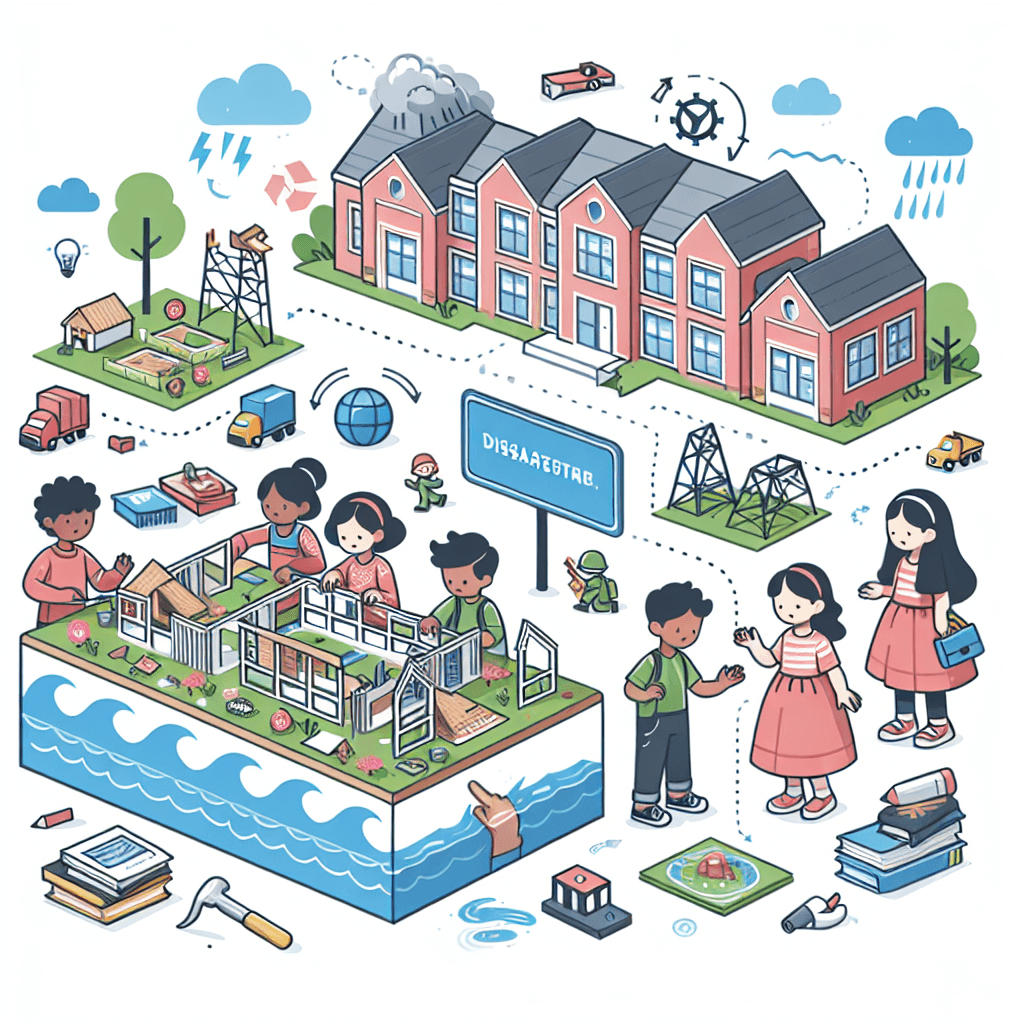
Disaster-Resistant School: Designing for Natural Disasters
Inquiry Framework
Question Framework
Driving Question
The overarching question that guides the entire project.How can we design a school that protects students from the natural disasters common in our region while also being affordable, sustainable, and integrated with the community?Essential Questions
Supporting questions that break down major concepts.- How do different natural disasters impact buildings and infrastructure?
- What design principles and materials can enhance a building's resistance to specific natural disasters (e.g., earthquakes, floods, hurricanes)?
- How can we balance the need for disaster resistance with cost-effectiveness and environmental sustainability in school design?
- What are the specific natural disasters that pose the greatest risk to our region, and how do their characteristics inform our design choices?
- How can the design of a school building contribute to the safety and well-being of its occupants during and after a natural disaster?
- How can we integrate renewable energy sources and water conservation systems into the school design to enhance its resilience?
- How can we use technology and innovative engineering solutions to create a smart, disaster-resistant school?
- How can community needs and local resources be integrated into the design and construction of the school?
Standards & Learning Goals
Learning Goals
By the end of this project, students will be able to:- Students will be able to identify and describe various natural disasters common to their region, explaining their causes and effects.
- Students will apply scientific principles to design a school building that can withstand specific natural disasters, considering factors like structural integrity, materials, and energy efficiency.
- Students will evaluate the cost-effectiveness and environmental sustainability of different design choices for disaster-resistant buildings.
- Students will integrate renewable energy sources and water conservation systems into their school design to enhance its resilience and reduce its environmental impact.
- Students will use technology and innovative engineering solutions to create a smart, disaster-resistant school.
- Students will present their school designs to an audience, explaining the scientific principles behind their design choices and justifying their decisions in terms of cost, sustainability, and community integration.
Entry Events
Events that will be used to introduce the project to studentsEmergency Broadcast Interruption
Simulate a sudden emergency broadcast interrupting class, announcing an imminent natural disaster (specific to the region). Students must immediately brainstorm initial design ideas for a disaster-resistant school based on limited information, fostering a sense of urgency and relevance.Disaster Simulation Challenge
Divide the class into teams, each representing a different engineering firm. Present each team with a unique disaster scenario (e.g., earthquake, flood, hurricane) and limited resources. They must quickly sketch a school design to withstand the specific disaster, promoting quick thinking and collaborative problem-solving.Portfolio Activities
Portfolio Activities
These activities progressively build towards your learning goals, with each submission contributing to the student's final portfolio.Disaster Data Dive
Students research common natural disasters in their region, gathering data on frequency, intensity, and impact. This activity builds foundational knowledge about the types of disasters the school design must address.Steps
Here is some basic scaffolding to help students complete the activity.Final Product
What students will submit as the final product of the activityA disaster data report with visual aids, summarizing the key characteristics of natural disasters in the region.Alignment
How this activity aligns with the learning objectives & standardsAddresses the learning goal: Students will be able to identify and describe various natural disasters common to their region, explaining their causes and effects.Blueprint Brainstorm
Students explore architectural blueprints and identify key structural components. This activity introduces students to the basics of building design and terminology.Steps
Here is some basic scaffolding to help students complete the activity.Final Product
What students will submit as the final product of the activityAnnotated blueprints with labeled structural components and explanations of their functions.Alignment
How this activity aligns with the learning objectives & standardsLays the groundwork for the learning goal: Students will apply scientific principles to design a school building that can withstand specific natural disasters, considering factors like structural integrity, materials, and energy efficiency.Material Matters
Students investigate the properties of different building materials and their suitability for disaster resistance. They will consider factors like strength, flexibility, cost, and environmental impact.Steps
Here is some basic scaffolding to help students complete the activity.Final Product
What students will submit as the final product of the activityA materials comparison chart, outlining the pros and cons of different building materials for disaster-resistant construction.Alignment
How this activity aligns with the learning objectives & standardsAddresses the learning goal: Students will apply scientific principles to design a school building that can withstand specific natural disasters, considering factors like structural integrity, materials, and energy efficiency, and evaluate the cost-effectiveness and environmental sustainability of different design choices for disaster-resistant buildings.Sustainable Sanctuary
Students research and integrate renewable energy sources (solar, wind, geothermal) and water conservation systems into their school design. They will consider the environmental and economic benefits of these systems.Steps
Here is some basic scaffolding to help students complete the activity.Final Product
What students will submit as the final product of the activityA detailed plan for integrating renewable energy sources and water conservation systems into the school design, including diagrams and cost estimates.Alignment
How this activity aligns with the learning objectives & standardsAddresses the learning goal: Students will integrate renewable energy sources and water conservation systems into their school design to enhance its resilience and reduce its environmental impact.Disaster-Resistant Design Pitch
Students create a presentation showcasing their disaster-resistant school design, explaining the scientific principles behind their choices and justifying their decisions based on cost, sustainability, and community integration.Steps
Here is some basic scaffolding to help students complete the activity.Final Product
What students will submit as the final product of the activityA compelling presentation showcasing the disaster-resistant school design, along with a Q&A session to address questions from the audience.Alignment
How this activity aligns with the learning objectives & standardsAddresses the learning goal: Students will present their school designs to an audience, explaining the scientific principles behind their design choices and justifying their decisions in terms of cost, sustainability, and community integration.Rubric & Reflection
Portfolio Rubric
Grading criteria for assessing the overall project portfolioDesign a Disaster-Resistant School Rubric
Understanding Natural Disasters
Assessment of students’ ability to describe various natural disasters common to their region, including their causes and effects.Research and Data Analysis
Ability to thoroughly research regional natural disasters and accurately analyze data on frequency, intensity, and impact.
Exemplary
4 PointsDemonstrates sophisticated analysis of disaster data, providing comprehensive visual representations that accurately depict frequency, intensity, and impact.
Proficient
3 PointsDemonstrates thorough analysis of disaster data with clear visual representations that accurately depict frequency and intensity.
Developing
2 PointsShows emerging analysis of disaster data with basic visual representations that may overlook certain aspects like intensity or impact.
Beginning
1 PointsShows initial analysis of disaster data with incomplete or inaccurate visual representations.
Disaster Impact Description
Quality of the description of how different natural disasters affect buildings and infrastructure.
Exemplary
4 PointsProvides a comprehensive and detailed description of the diverse impacts of natural disasters on buildings, integrating scientific principles.
Proficient
3 PointsProvides a clear and accurate description of the impacts of natural disasters on buildings, grounded in scientific understanding.
Developing
2 PointsProvides a basic description of the impacts of natural disasters on buildings with occasional inaccuracies.
Beginning
1 PointsProvides an unclear or inaccurate account of how natural disasters impact buildings.
Design and Engineering Principles
Evaluation of students' use of design and engineering principles to develop a disaster-resistant school.Blueprint Analysis and Design
Insight into architectural blueprints and ability to identify key structural components and their functions.
Exemplary
4 PointsIdentifies and labels all critical structural components with insightful annotations on their functions within a blueprint.
Proficient
3 PointsIdentifies and labels most structural components and provides clear explanations of their functions.
Developing
2 PointsIdentifies some structural components with basic annotations, missing some key elements.
Beginning
1 PointsStruggles to identify critical structural components or provide accurate explanations.
Material Suitability Evaluation
Critique of material selection for disaster resistance, considering properties like strength, flexibility, cost, and environmental impact.
Exemplary
4 PointsProvides a detailed and thoughtful evaluation of material properties, considering all relevant factors to recommend optimal choices for specific disasters.
Proficient
3 PointsProvides a thorough and logical evaluation of material properties, recommending suitable materials for specific disasters.
Developing
2 PointsEvaluates material properties with minor inaccuracies or omissions, offering limited recommendations.
Beginning
1 PointsProvides a superficial evaluation of material properties with unclear or unsupported recommendations.
Sustainability Integration
Assessment of the plan to integrate renewable energy sources and water conservation systems into the school design.
Exemplary
4 PointsDemonstrates an innovative and comprehensive plan for integrating renewable energy and water systems with detailed cost-benefit analysis.
Proficient
3 PointsProvides a well-thought-out plan for integrating renewable energy and water systems, supported by clear cost-efficiency justifications.
Developing
2 PointsOffers a basic plan for sustainability integration with limited rationale or omissions in justification.
Beginning
1 PointsPresents an incomplete or unsupported plan for sustainability integration.
Communication and Presentation Skills
Evaluation of students’ ability to communicate their design process and justify decisions effectively.Clarity and Organization
Quality and structure of the presentation and arguments made to justify design decisions.
Exemplary
4 PointsPresents an exceptionally well-organized and clear narrative, justifying design decisions with thorough scientific and practical reasoning.
Proficient
3 PointsProvides a clear and organized presentation with logical justifications for design choices.
Developing
2 PointsPresents a basic narrative that lacks some clarity or organizational coherence, with vague justification of decisions.
Beginning
1 PointsStruggles to present an organized or clear narrative and justifications.
Engagement and Interaction
Ability to engage with the audience and respond to questions effectively during the Q&A session.
Exemplary
4 PointsEngages the audience with confidence, expertly addressing questions and providing insightful responses.
Proficient
3 PointsEngages the audience effectively, addressing questions with clear and appropriate responses.
Developing
2 PointsEngages with the audience with hesitations or basic answers during the Q&A session.
Beginning
1 PointsStruggles to engage with the audience or provide satisfactory answers to questions.