
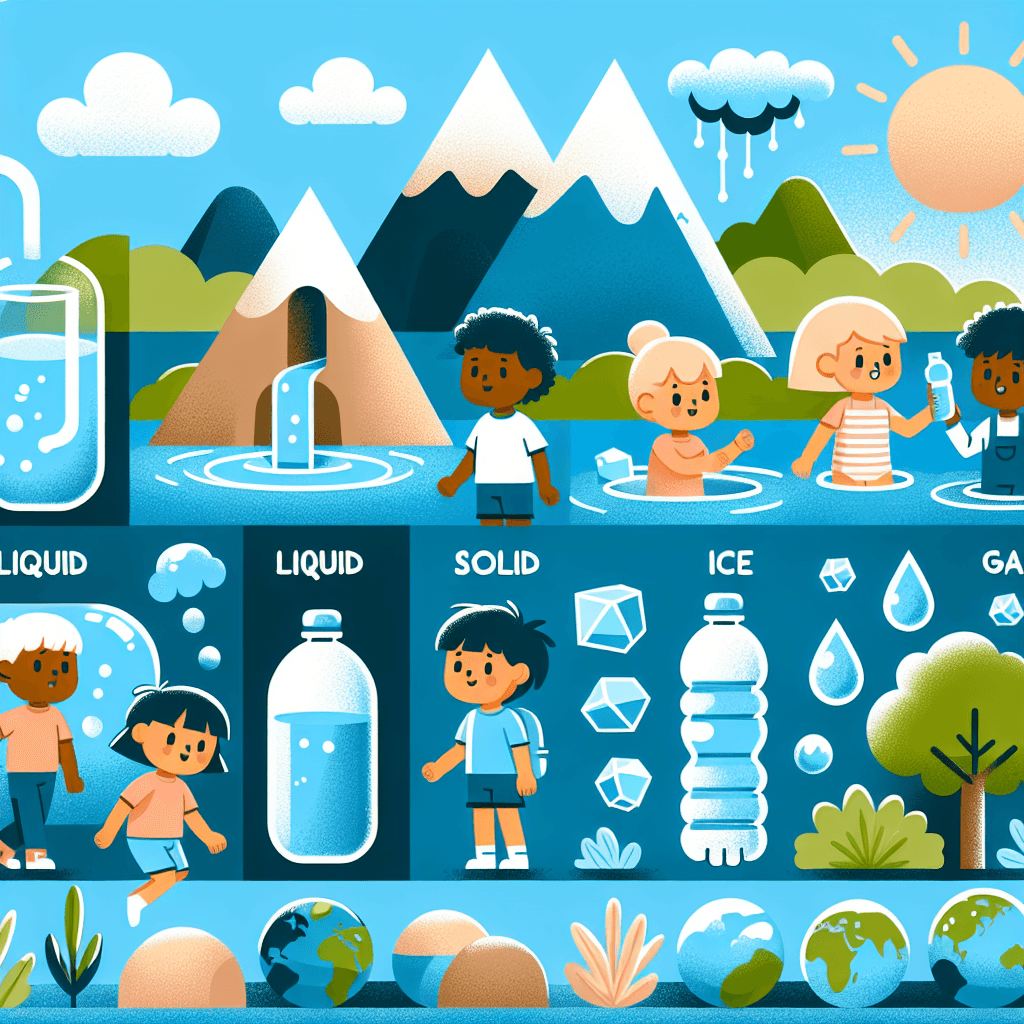
Discovering Water in its Various Forms and Locations
Inquiry Framework
Question Framework
Driving Question
The overarching question that guides the entire project.How does water in its various forms and locations impact life on Earth?Essential Questions
Supporting questions that break down major concepts.- What are the different places we can find water on our planet?
- How can we tell the difference between solid and liquid forms of water?
- Why is it important to know if water is drinkable?
- What role does temperature play in changing the state of water?
- How do rivers, lakes, and glaciers contribute to the availability of fresh water?
Standards & Learning Goals
Learning Goals
By the end of this project, students will be able to:- Identify and describe where water is found on Earth, including differentiating between fresh and salt water.
- Understand the difference between solid and liquid forms of water and how temperature impacts these states.
- Recognize and name different bodies of water (e.g., rivers, lakes, oceans, glaciers) and distinguish if the water is drinkable.
- Explain how rivers, lakes, and glaciers contribute to fresh water availability on Earth.
Next Generation Science Standards
Entry Events
Events that will be used to introduce the project to studentsWater Hunt Adventure
Kick-off the project by organizing a 'Water Hunt Adventure' where students explore their school or local community to find different sources and states of water. They can document their findings through drawings or photographs, sparking their curiosity about the diversity and availability of water.Mystery Water Samples
Introduce the project with a mysterious box containing various samples labeled 'Mystery Water.' Each sample has a unique background story, and students must use clues and research to determine the water's origin and state, engaging their investigative and critical thinking skills.Virtual Field Trip to Water Museum
Launch the learning experience with a virtual field trip to an interactive water museum showcasing global water bodies. Students will encounter various forms of water and their significance, connecting to their everyday experiences with water and inspiring questions about its role and state.Water States Experiment
Begin with a hands-on experiment where students observe ice melting into water and then evaporating into steam. This tangible demonstration of water's changing states will pique students' curiosity about where and how these processes occur naturally on Earth.Local Water Heroes
Kickstart the project by inviting a local environmentalist or water conservation expert to speak about their efforts in preserving water resources. This real-world connection will captivate students' interest and inspire them to explore water's importance in their community and beyond.Portfolio Activities
Portfolio Activities
These activities progressively build towards your learning goals, with each submission contributing to the student's final portfolio.Water Explorer's Map
Students will create a visual map to pinpoint different locations where water is found on Earth. They'll label fresh and salt water sources and illustrate these bodies of water using creative art supplies. This activity will solidify students' understanding of the geographical locations and characteristics of various water bodies.Steps
Here is some basic scaffolding to help students complete the activity.Final Product
What students will submit as the final product of the activityA detailed, creatively illustrated map showcasing the locations and types of water sources on Earth.Alignment
How this activity aligns with the learning objectives & standardsAligns with 2-ESS2-3 by helping students identify where water is found and differentiate between fresh and salt water sources.Water State Transformation Drama
Through role-play and drama, students will embody the transformation of water between its solid and liquid states, acting out how temperature affects these changes. This engaging artistic expression will help students grasp the concept of state changes more tangibly and memorably.Steps
Here is some basic scaffolding to help students complete the activity.Final Product
What students will submit as the final product of the activityA classroom drama performance vividly showing the transformation of water states influenced by temperature.Alignment
How this activity aligns with the learning objectives & standardsEnriches understanding of ESS2.C by illustrating the roles of changing temperatures on water, helping students differentiate solid and liquid water.Water Taste Test Challenge
This sensory activity involves a taste test of different water samples to determine their drinkability. Students will taste various samples labeled as 'fresh water' and 'saltwater' and discuss their observations, learning the importance of water's potability.Steps
Here is some basic scaffolding to help students complete the activity.Final Product
What students will submit as the final product of the activityA class presentation about the importance of water potability and which bodies of water contain drinkable water.Alignment
How this activity aligns with the learning objectives & standardsEngages students with 2-ESS2-3 by evaluating and communicating information on drinkable water sources.Glacier Adventure Journal
Students will immerse themselves in a creative storytelling project by imagining themselves on a glacier exploration. They will write a journal entry describing the experience and the role of glaciers as fresh water sources.Steps
Here is some basic scaffolding to help students complete the activity.Final Product
What students will submit as the final product of the activityA personal journal entry about a glacier exploration, highlighting glaciers as essential fresh water sources.Alignment
How this activity aligns with the learning objectives & standardsSupports comprehension of ESS2.C by detailing how glaciers serve as sources of fresh water on Earth's surface.Rubric & Reflection
Portfolio Rubric
Grading criteria for assessing the overall project portfolioWater Explorer and Transformation Learning Assessment
Understanding and Application of Scientific Concepts
Evaluate student comprehension of water's location on Earth, its states, and potability.Identifying Water Sources
Assess the ability to identify and describe various water sources, distinguishing between fresh and salt water.
Exemplary
4 PointsAccurately identifies and describes all major water sources, correctly differentiating fresh from salt water, using sophisticated terminology.
Proficient
3 PointsCorrectly identifies and describes most water sources, differentiating fresh from salt water with appropriate terminology.
Developing
2 PointsIdentifies some water sources with basic descriptions; differentiates fresh from salt water inconsistently.
Beginning
1 PointsStruggles to identify water sources; rarely differentiates between fresh and salt water.
Explaining Water State Changes
Evaluate understanding of water's state changes and the impact of temperature.
Exemplary
4 PointsArticulates a clear and detailed explanation of water state changes with precise examples, demonstrating complete understanding of temperature impacts.
Proficient
3 PointsProvides a clear explanation of water state changes; demonstrates understanding of temperature impacts with relevant examples.
Developing
2 PointsOffers basic explanations of water state changes; mentions temperature impacts with limited examples.
Beginning
1 PointsHas difficulty explaining water state changes; lacks clarity on temperature impacts.
Identifying Drinkability
Evaluate clarity in discerning drinkable water sources and the importance of water's potability.
Exemplary
4 PointsClearly distinguishes drinkable from non-drinkable water sources, providing comprehensive explanation of potability significance.
Proficient
3 PointsAdequately identifies drinkable water sources and explains the importance of potability.
Developing
2 PointsIdentifies some drinkable water sources with basic explanation of potability's importance.
Beginning
1 PointsRarely distinguishes between drinkable water sources; unclear on potability significance.
Communication and Creativity
Assesses the effectiveness and creativity in students' final presentations and representations.Creative Map Creation
Evaluate the creativity and thoroughness in map illustrations, depicting water sources.
Exemplary
4 PointsProduces a highly creative map with extensive detail, employing unique illustrations and labels for water sources.
Proficient
3 PointsCreates a detailed and creative map with appropriate illustrations and labels.
Developing
2 PointsPresents a basic map with some details, using unimaginative illustrations and labels.
Beginning
1 PointsSubmits an incomplete map with limited illustrations and information.
Dramatic Expression of State Changes
Assess the clarity and engagement in performing water state changes.
Exemplary
4 PointsDelivers a captivating and accurate performance, clearly conveying water state changes and temperature effects.
Proficient
3 PointsPerforms a clear and well-organized portrayal of state changes with visible temperature effects.
Developing
2 PointsOffers a basic performance with minor expression of state changes and temperature involvement.
Beginning
1 PointsStruggles to convey state changes effectively, with minimal engagement or clarity.