
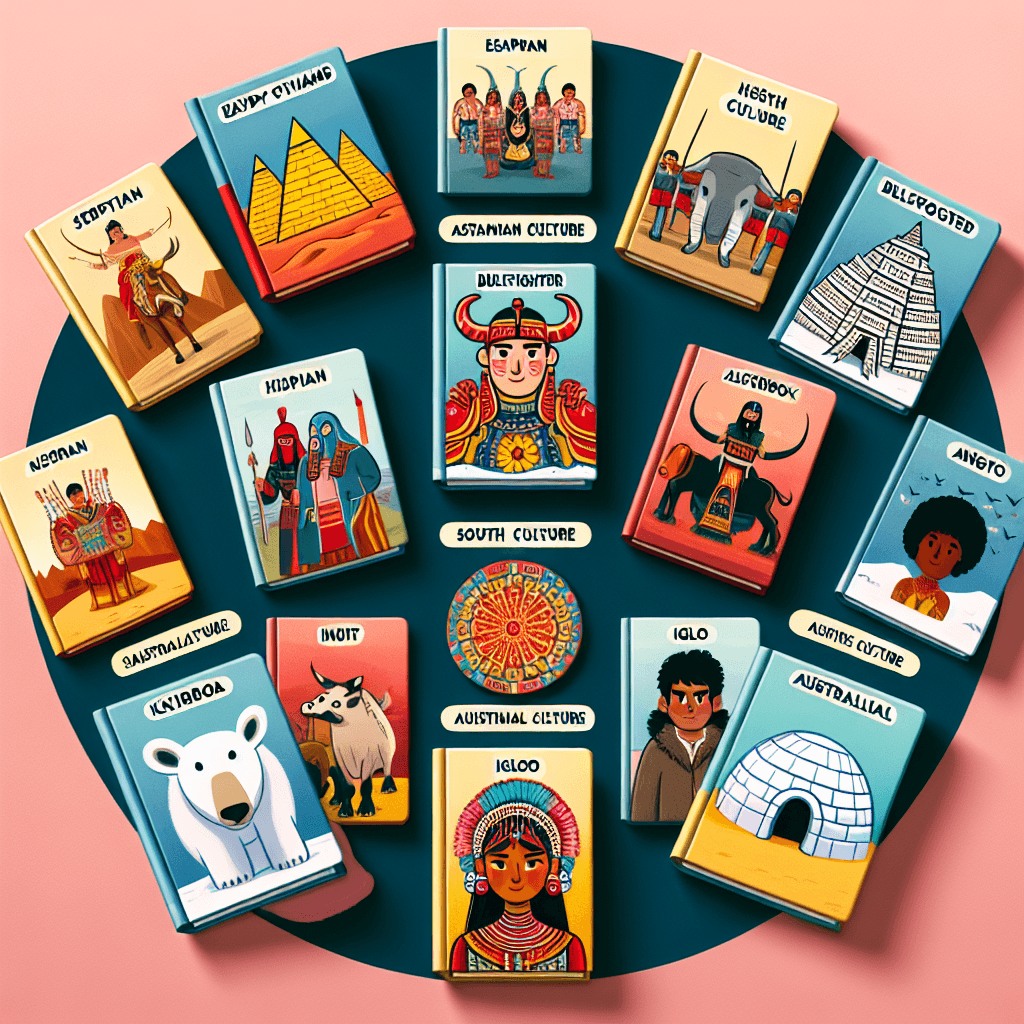
Diverse Cultural Storybooks: Sharing Tales from Around the World
Inquiry Framework
Question Framework
Driving Question
The overarching question that guides the entire project.How can creating storybooks of cultural tales from around the world help us understand cultural diversity and its influence on our community and interactions?Essential Questions
Supporting questions that break down major concepts.- What are the key elements that make up a culture?
- How can stories from different cultures help us understand and appreciate diversity?
- In what ways do cultural stories reflect the values and traditions of a community?
- How does our understanding of different cultures influence our interactions with others?
Standards & Learning Goals
Learning Goals
By the end of this project, students will be able to:- Students will identify and describe key elements of culture, including language, traditions, and beliefs.
- Students will analyze cultural stories to understand and appreciate cultural diversity.
- Students will create a storybook that showcases elements of different cultures and tells a meaningful cultural tale.
- Students will evaluate the impact of cultural understanding on community interactions and relationships.
Pennsylvania Academic Standards
Common Core Standards
Entry Events
Events that will be used to introduce the project to studentsMystery Culture Box
Introduce a "Mystery Box" filled with cultural artifacts, books, clothing, and music from various parts of the world. Students will use these items to decode the culture and ethnicity they belong to, relating these to human characteristics, settlement, and economic activities. This tangible connection piques interest and encourages students to explore how cultures are woven into societal fabrics.Portfolio Activities
Portfolio Activities
These activities progressively build towards your learning goals, with each submission contributing to the student's final portfolio.Cultural Elements Exploration
In this engaging activity, students will delve deeper into the elements of culture and ethnicity identified in their detective diaries. They will compile vivid descriptions and examples of cultural elements such as language, traditions, and beliefs.Steps
Here is some basic scaffolding to help students complete the activity.Final Product
What students will submit as the final product of the activityA detailed report or presentation on the elements of the chosen culture.Alignment
How this activity aligns with the learning objectives & standardsThis activity aligns with 8.4.3.A by identifying the elements of culture and ethnicity.Illustration & Storytelling Workshop
In this creative workshop, students bring their storybooks to life with illustrations and storytelling. They will use visuals to enhance the narrative and demonstrate their comprehensive understanding of cultural stories.Steps
Here is some basic scaffolding to help students complete the activity.Final Product
What students will submit as the final product of the activityA complete cultural storybook with both written and illustrated elements.Alignment
How this activity aligns with the learning objectives & standardsThis activity supports CCSS.ELA-LITERACY.RI.3.7 by using illustrations and narratives to demonstrate understanding of cultural elements.Rubric & Reflection
Portfolio Rubric
Grading criteria for assessing the overall project portfolioCultural Storybook Creation Rubric
Understanding Cultural Elements
Assesses how well students identify and comprehend diverse cultural elements through research and presentation.Identification of Cultural Elements
Measures the student's ability to identify key cultural elements such as language, traditions, and beliefs.
Exemplary
4 PointsAccurately identifies a wide range of cultural elements, providing detailed and insightful examples and explanations.
Proficient
3 PointsCorrectly identifies several cultural elements with clear and relevant explanations.
Developing
2 PointsIdentifies some cultural elements but with limited explanation or detail.
Beginning
1 PointsStruggles to identify cultural elements with minimal explanation or understanding.
Analysis of Cultural Stories
Evaluates the student's capability to analyze cultural stories and their impact on understanding diversity.
Exemplary
4 PointsConducts a deep analysis of cultural stories, identifying core values, traditions, and societal impacts with nuance.
Proficient
3 PointsProvides a clear analysis of cultural stories, accurately identifying key themes and their significance.
Developing
2 PointsOffers a basic understanding of cultural stories, with some identification of themes and significance.
Beginning
1 PointsMinimal analysis of cultural stories, struggling to connect themes to cultural significance.
Creative Expression and Storytelling
Assesses creativity and effectiveness in narrating and illustrating cultural stories in a storybook format.Narrative Elements
Evaluates the structure, coherence, and creativity of the cultural narrative written by the student.
Exemplary
4 PointsCrafts a compelling and coherent narrative with rich details and creativity that reflects cultural understanding.
Proficient
3 PointsStructures a clear and organized narrative with relevant details reflecting cultural understanding.
Developing
2 PointsWrites a basic narrative with some structure and details, though lacking depth or creativity.
Beginning
1 PointsStruggles with narrative coherence and detail, with minimal cultural reflection.
Illustrative Quality
Measures the effectiveness of illustrations in reflecting and enhancing the cultural narrative.
Exemplary
4 PointsCreates illustrations that beautifully enhance the story, accurately reflecting cultural settings and events.
Proficient
3 PointsProduces clear illustrations that support the story and accurately depict cultural settings.
Developing
2 PointsProvides simple illustrations with limited connection to the story or cultural accuracy.
Beginning
1 PointsIllustrations do little to support the narrative or depict the cultural setting.