
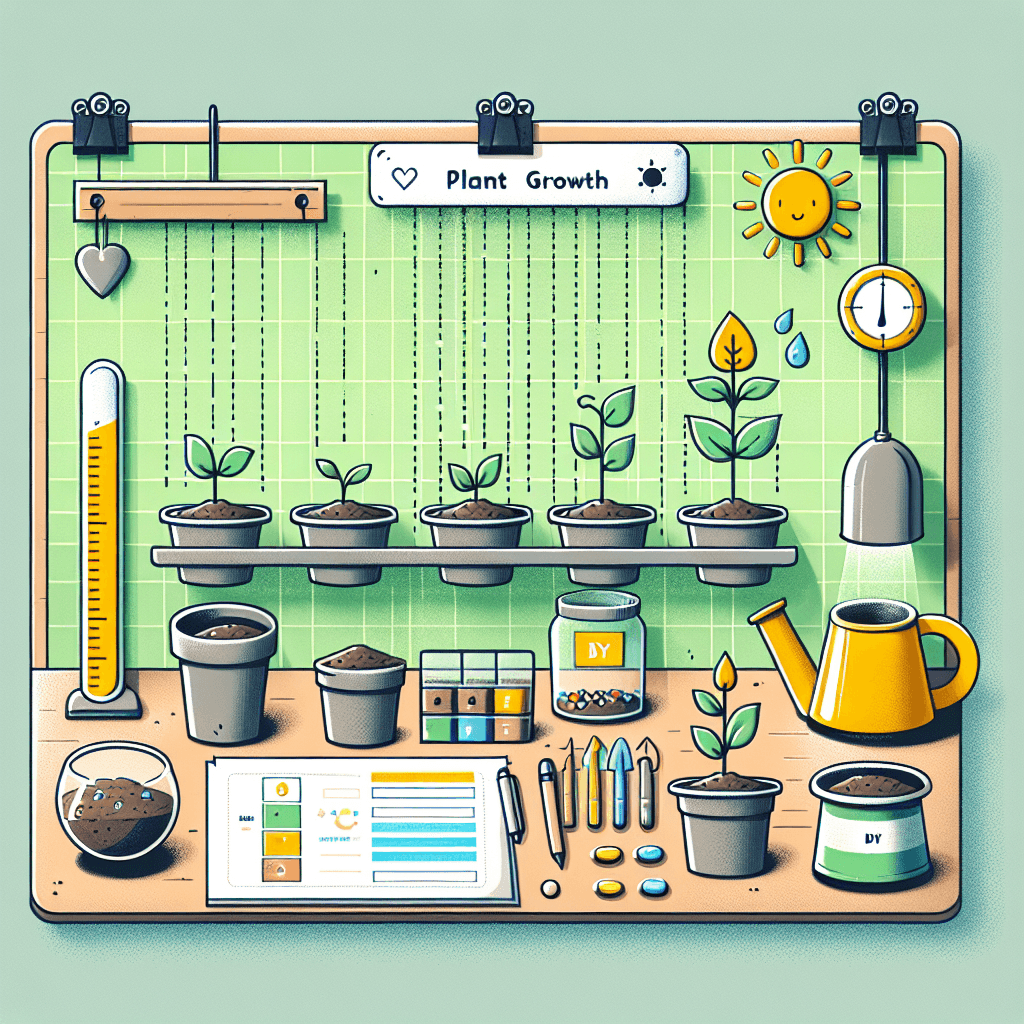
DIY Plant Growth Stations
Inquiry Framework
Question Framework
Driving Question
The overarching question that guides the entire project.How can we design and construct effective DIY plant growth stations to investigate and demonstrate how plants primarily use air and water for growth and what observable effects occur with varying levels of these resources?Essential Questions
Supporting questions that break down major concepts.- How do plants use air and water for growth?
- What are the observable effects when plants receive varying amounts of air and water?
- How can we design and build a station to experiment with plant growth?
- What arguments can support the idea that plants derive materials for growth primarily from air and water?
Standards & Learning Goals
Learning Goals
By the end of this project, students will be able to:- Students will design and construct plant growth stations, applying engineering and scientific principles to create effective experimental setups.
- Students will observe and document the effects of different air and water conditions on plant growth, developing skills in data collection and analysis.
- Students will learn to support arguments with empirical evidence, focusing on the idea that plants get materials primarily from air and water.
- Students will enhance their understanding of plant biology and ecology through hands-on experimentation and observation.
Next Generation Science Standards
Entry Events
Events that will be used to introduce the project to studentsMysterious Seed Delivery
Students receive a mysterious package containing various seeds with a note asking them to discover what conditions will grow the healthiest plants. This entry event links directly to the project's core goal by sparking curiosity about plant growth conditions, and invites students to investigate the roles of air and water through experimentation.Portfolio Activities
Portfolio Activities
These activities progressively build towards your learning goals, with each submission contributing to the student's final portfolio.Design Your Growth Station
Students start by designing their unique plant growth stations with various compartments for controlling water and air availability. This activity encourages creativity while grounding designs in scientific research.Steps
Here is some basic scaffolding to help students complete the activity.Final Product
What students will submit as the final product of the activityA detailed sketch of a custom plant growth station design, ready for construction.Alignment
How this activity aligns with the learning objectives & standardsAligns with the design and engineering aspects of the project, as well as the standard 5-LS1-1 by setting up conditions to observe.Constructing the Station
Students bring their designs to life by constructing their plant growth stations. This is a hands-on activity where students can apply engineering skills and teamwork.Steps
Here is some basic scaffolding to help students complete the activity.Final Product
What students will submit as the final product of the activityA fully constructed plant growth station ready for experimentation.Alignment
How this activity aligns with the learning objectives & standardsSupports the engineering focus of standard 5-LS1-1 by allowing students to build relevant tools for investigating plant growth.Grow and Observe
Students plant seeds in their growth stations and begin the observation phase. This activity focuses on documenting changes and understanding the role of air and water in plant growth.Steps
Here is some basic scaffolding to help students complete the activity.Final Product
What students will submit as the final product of the activityAn observation journal detailing plant growth under varying air and water conditions.Alignment
How this activity aligns with the learning objectives & standardsAligns with the data collection and analysis aspects of standard 5-LS1-1, emphasizing empirical observation.Analysis and Argumentation
In this phase, students analyze their observational data, develop conclusions about the role of air and water in plant growth, and prepare their arguments.Steps
Here is some basic scaffolding to help students complete the activity.Final Product
What students will submit as the final product of the activityA well-structured argument supporting the role of air and water in plant growth, backed by collected evidence.Alignment
How this activity aligns with the learning objectives & standardsDirectly addresses standard 5-LS1-1 by requiring students to support their arguments with data-driven evidence.Rubric & Reflection
Portfolio Rubric
Grading criteria for assessing the overall project portfolioDIY Plant Growth Stations Rubric
Design and Creativity
Measures the originality and effectiveness of the growth station design, including how well the design reflects scientific principles related to air and water in plant growth.Design Conceptualization
Evaluation of the initial design ideas and their grounding in scientific principles.
Exemplary
4 PointsConcepts are original, well-grounded in scientific principles, and innovative, demonstrating a deep understanding of plant growth needs.
Proficient
3 PointsConcepts are clear, reflect scientific principles appropriately, and effectively address plant growth needs.
Developing
2 PointsDesign reflects some understanding of scientific principles with limited originality and effectiveness.
Beginning
1 PointsDesign lacks originality and understanding of scientific principles related to plant growth.
Integration of Air and Water Controls
How well students have included mechanisms to control air and water in their design sketches.
Exemplary
4 PointsIncorporates innovative and effective mechanisms to regulate air and water, with advanced design considerations.
Proficient
3 PointsIncorporates effective mechanisms to regulate air and water with clear function.
Developing
2 PointsIncludes basic control mechanisms with partial functionality.
Beginning
1 PointsLacks functional mechanisms for regulating air and water.
Construction and Engineering Skills
Assesses students' ability to translate design sketches into a functional growth station, emphasizing teamwork and problem-solving during construction.Construction Execution
Evaluation of the construction process, including adherence to design sketches and functionality of the growth station.
Exemplary
4 PointsSuccessfully constructs a fully functional station, perfectly aligned with design sketches, demonstrating outstanding craftsmanship.
Proficient
3 PointsConstructs a functional station closely matching the design sketches with good craftsmanship.
Developing
2 PointsPartially constructs the station with some functionality, requiring additional refinement.
Beginning
1 PointsStruggles to construct a functional station and does not adhere well to design sketches.
Team Collaboration
How effectively students work in teams during the construction phase to solve problems and support one another.
Exemplary
4 PointsDemonstrates leadership and active participation, significantly supporting team coherence and productivity.
Proficient
3 PointsActively participates and contributes to team success through collaboration.
Developing
2 PointsParticipates inconsistently with limited contribution to team success.
Beginning
1 PointsShows minimal participation and struggles with teamwork.
Observation and Analysis
Focuses on the quality of observational data collected, its analysis, and how well it supports the building of scientific arguments.Data Collection and Documentation
The thoroughness and accuracy of observational data collection and documentation in journals.
Exemplary
4 PointsCollects comprehensive and meticulous data, showing exceptional precision in documenting observations.
Proficient
3 PointsCollects accurate data with clear documentation of observations.
Developing
2 PointsPartially collects and documents data with some gaps.
Beginning
1 PointsData collection is incomplete and poorly documented.
Argument Construction
Strength of arguments based on empirical data, emphasizing clarity, organization, and use of evidence in supporting claims about air and water's roles.
Exemplary
4 PointsConstructs a compelling, well-organized argument using robust evidence from data, reflecting deep understanding and insight.
Proficient
3 PointsDevelops a clear and well-organized argument with supportive data evidence.
Developing
2 PointsPresents a basic argument that lacks organization and robustness in data use.
Beginning
1 PointsArgument lacks clarity and is weakly supported by data.