
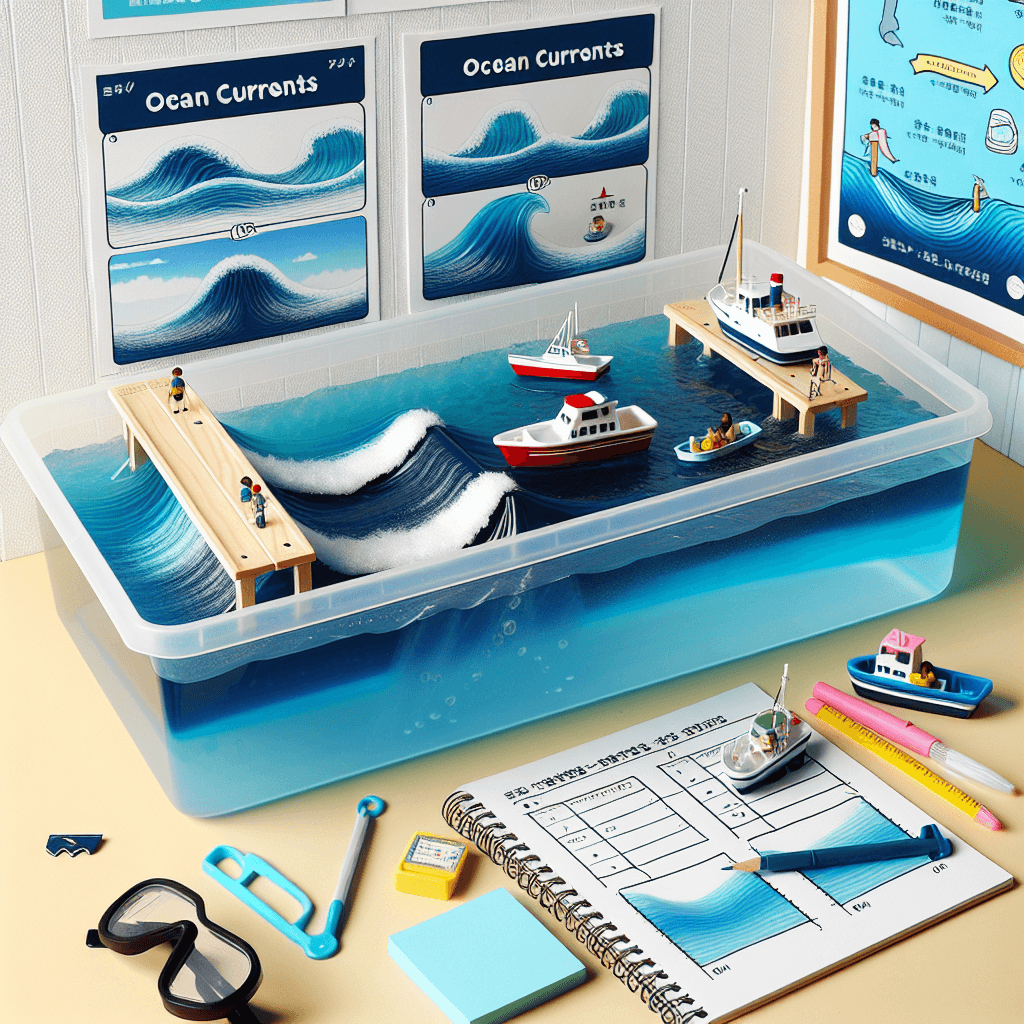
DIY Wave Tank: Exploring Ocean Currents
Inquiry Framework
Question Framework
Driving Question
The overarching question that guides the entire project.How can we design and build a wave tank to investigate the effects of thermal energy on ocean currents and their impact on global climate patterns?Essential Questions
Supporting questions that break down major concepts.- What role do thermal energy transfers play in the formation of ocean currents?
- How do ocean currents impact global climate patterns?
- What are some methods scientists use to study ocean currents and why?
Standards & Learning Goals
Learning Goals
By the end of this project, students will be able to:- Students will understand how thermal-energy transfers contribute to the formation of ocean currents.
- Students will explore the impact of ocean currents on global climate patterns.
- Students will design and build a functional wave tank to model ocean currents.
- Students will analyze and interpret data to understand the role of the sun's energy and Earth's gravity in water movement.
- Students will apply scientific inquiry and engineering principles to refine their wave tank designs.
Custom
Next Generation Science Standards
Entry Events
Events that will be used to introduce the project to studentsWeather Forecasting Challenge
Launch the project with a challenge that tasks students with predicting the weather using current maps and ocean current patterns. Students will connect their in-class wave tank experiments to real-world climate data, linking scientific inquiry with everyday observations.Portfolio Activities
Portfolio Activities
These activities progressively build towards your learning goals, with each submission contributing to the student's final portfolio.Thermal Energy Transfer Exploration
This activity focuses on understanding how thermal energy transfers contribute to ocean currents. Students will engage in mini-experiments to simulate thermal energy effects in water using basic materials.Steps
Here is some basic scaffolding to help students complete the activity.Final Product
What students will submit as the final product of the activityRecorded observations and insights into thermal energy effects on water movement.Alignment
How this activity aligns with the learning objectives & standardsAligns with 7.ESS.2 (thermal energy transfers in ocean currents) and builds foundational knowledge for wave tank experimentation.Wave Characteristics Investigation
Students will study the physical characteristics of waves and their role in simulating ocean currents within their wave tanks. This step is crucial for understanding wave energy and movement.Steps
Here is some basic scaffolding to help students complete the activity.Final Product
What students will submit as the final product of the activityComprehensive data analysis of wave characteristics and potential influences on tank design.Alignment
How this activity aligns with the learning objectives & standardsSupports MS-PS4-3 (analyzing features of waves) and enhances understanding of wave dynamics relevant to tank design.Wave Tank Construction & Testing
With a solid understanding of waves and thermal energy, students will construct their wave tanks and perform initial tests to observe ocean current simulations.Steps
Here is some basic scaffolding to help students complete the activity.Final Product
What students will submit as the final product of the activityA functioning wave tank capable of simulating ocean currents and thermal energy transfers.Alignment
How this activity aligns with the learning objectives & standardsAligns with MS-ETS1-4 (model generation for iterative testing) and MS-ESS2-6 (modeling water cycling through Earth's systems).Data Analysis & Interpretation Workshop
Students will analyze the data collected from their wave tanks to understand the broader impacts of ocean currents on global climate patterns. This involves interpreting results and making connections to the driving question.Steps
Here is some basic scaffolding to help students complete the activity.Final Product
What students will submit as the final product of the activityData-driven presentation linking wave tank findings to global climate impact insights.Alignment
How this activity aligns with the learning objectives & standardsAligns with MS-ESS2-6 (understanding energy's role in water cycling) and fosters data analysis skills critical to scientific inquiry.Rubric & Reflection
Portfolio Rubric
Grading criteria for assessing the overall project portfolioWave Tank Experiment Assessment Rubric
Understanding of Scientific Concepts
Assessment of student's comprehension of thermal energy transfers, ocean currents, and their impact on global climate.Conceptual Understanding
Measures the depth of understanding of thermal energy transfer and ocean currents.
Exemplary
4 PointsDemonstrates sophisticated understanding of how thermal energy influences ocean currents and climate patterns with comprehensive explanations and connections to scientific principles.
Proficient
3 PointsDemonstrates thorough understanding with clear explanations of energy transfers affecting ocean currents and climate.
Developing
2 PointsShows emerging understanding with basic explanations of thermal energy effects on currents.
Beginning
1 PointsShows initial understanding with limited explanations and recognition of energy transfers.
Application of Concepts
Evaluates the ability to apply scientific concepts in the wave tank model construction and experimentation.
Exemplary
4 PointsApplies concepts innovatively and adapts understanding to the construction and operation of an exemplary wave tank model.
Proficient
3 PointsEffectively applies concepts to build a functional wave tank model showing clear understanding.
Developing
2 PointsApplies concepts inconsistently, resulting in a partially successful wave tank model.
Beginning
1 PointsStruggles to apply concepts, leading to incomplete or non-functional models.
Data Analysis and Interpretation
Assessment of student's ability to analyze and interpret data collected from the wave tank experiments.Data Analysis Skills
The ability to analyze data accurately and draw meaningful conclusions about wave behaviors and climate impacts.
Exemplary
4 PointsProduces insightful data analyses with well-supported conclusions and connections to climate concepts.
Proficient
3 PointsProvides clear analyses and reasonable conclusions with some connections to climate concepts.
Developing
2 PointsProduces basic analyses with limited conclusions and weak connections to climate concepts.
Beginning
1 PointsStruggles with data analysis, yielding unclear or unsupported conclusions.
Data Presentation
Evaluates the clarity and effectiveness of data presentation and visualization tools used in communicating findings.
Exemplary
4 PointsUtilizes advanced visualization tools to communicate findings clearly and effectively, demonstrating a strong understanding of data and its real-world applications.
Proficient
3 PointsUses visualization tools effectively to communicate findings, showing a clear understanding of data.
Developing
2 PointsUses basic visualization tools, with some effort to communicate findings, but with unclear focus and moderate understanding.
Beginning
1 PointsMinimal use of visualization tools, leading to unclear communication of findings.
Collaboration and Communication
Assessment of student's collaboration with peers and communication skills throughout the experimental process.Collaborative Effort
Measures the effectiveness of teamwork and contribution to group tasks during the project.
Exemplary
4 PointsShows leadership and actively engages in all group tasks, facilitating collaboration and achieving group goals.
Proficient
3 PointsContributes effectively to group tasks, consistently promoting collaboration to achieve group goals.
Developing
2 PointsParticipates in group tasks but with inconsistent contribution and occasional need for guidance.
Beginning
1 PointsRequires support to participate in group tasks, hindering collaboration and group progress.
Communication Skills
Evaluates the clarity, coherence, and effectiveness of communication with peers and during presentations.
Exemplary
4 PointsCommunicates ideas and findings with exceptional clarity and coherence, enhancing understanding among peers.
Proficient
3 PointsCommunicates ideas clearly and coherently, effectively conveying understanding.
Developing
2 PointsCommunicates ideas with some clarity, though occasionally lacks coherence.
Beginning
1 PointsStruggles to communicate ideas clearly and coherently, often resulting in misunderstandings.