
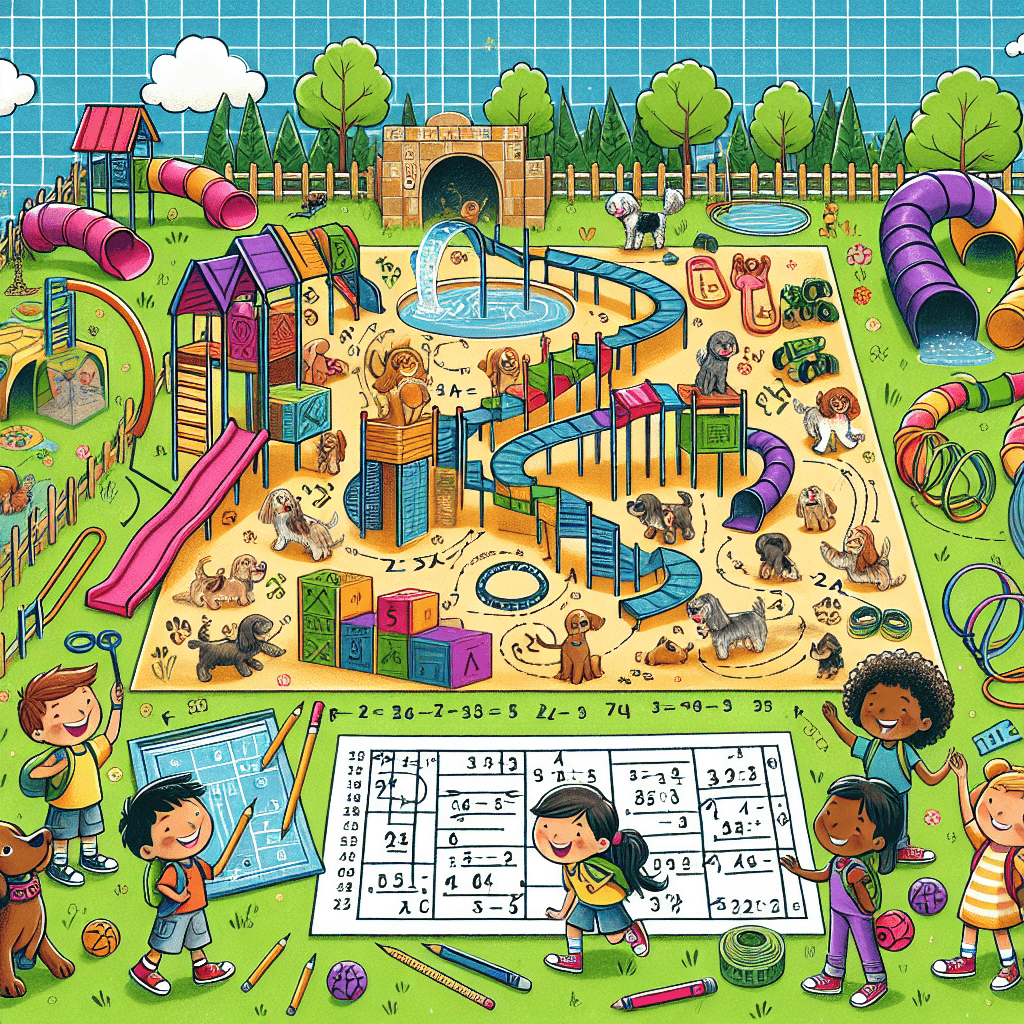
Dog Park Designer: Math Adventure for 3rd Graders
Inquiry Framework
Question Framework
Driving Question
The overarching question that guides the entire project.How can we design a dog park that is both fun and safe for dogs while staying within a budget, using our knowledge of measurement, area, and perimeter?Essential Questions
Supporting questions that break down major concepts.- How can we use math to create a fun and safe space for dogs to play?
- How does understanding measurement help us design the perfect dog park?
- What is the best way to calculate the costs involved in building a dog park?
Standards & Learning Goals
Learning Goals
By the end of this project, students will be able to:- Calculate the area and perimeter of the dog park.
- Design a dog park within a specific budget.
- Apply knowledge of measurement to create a safe and fun space for dogs.
- Apply addition and subtraction to calculate total costs for the dog park project.
- Demonstrate understanding of place value when determining costs and dimensions.
- Tell time to schedule park activities.
- Estimate costs and measurements for the dog park project.
- Use multiplication to calculate the area of the dog park.
Entry Events
Events that will be used to introduce the project to studentsPawsitive Parks Foundation Challenge
The class receives a letter from the 'Pawsitive Parks Foundation,' a fictional organization, asking for help. They include a 'problem': The foundation has land and some money, but no design expertise to build a safe and fun dog park. Can your students help by designing a park that fits specific criteria?Portfolio Activities
Portfolio Activities
These activities progressively build towards your learning goals, with each submission contributing to the student's final portfolio.Measurement Explorers: Perimeter Practice
Students will begin by learning how to measure different objects using standard units and then apply this knowledge to calculate the perimeter of simple shapes.Steps
Here is some basic scaffolding to help students complete the activity.Final Product
What students will submit as the final product of the activityA worksheet with measurements of classroom objects and calculated perimeters of squares and rectangles.Alignment
How this activity aligns with the learning objectives & standardsLearning Goal: Calculate the area and perimeter of the dog park. Standard: Working with basic measurements.Area Aces: Multiplication Masters
Students will apply their knowledge of multiplication, specifically 2 times tables, to calculate the area of different sections of the dog park. This activity reinforces multiplication skills in a practical context.Steps
Here is some basic scaffolding to help students complete the activity.Final Product
What students will submit as the final product of the activityA scaled drawing of the dog park with each section labeled with its area, calculated using multiplication.Alignment
How this activity aligns with the learning objectives & standardsLearning Goal: Calculate the area and perimeter of the dog park. Standard: Weekly memorization of 2 times tables up to 12. Use multiplication to calculate the area of the dog park.Budget Boss: Cost Calculators
Students will research the costs of various dog park amenities (benches, water fountains, play equipment) and use addition and subtraction to determine if their park design stays within the given budget.Steps
Here is some basic scaffolding to help students complete the activity.Final Product
What students will submit as the final product of the activityA detailed budget proposal outlining the costs of each amenity and the total cost of the dog park, ensuring it stays within the budget.Alignment
How this activity aligns with the learning objectives & standardsLearning Goal: Design a dog park within a specific budget. Standard: Working with money. Apply addition and subtraction to calculate total costs for the dog park project.Time Tellers: Schedule Superstars
Students will learn how to tell time on an analog clock and create a schedule of activities for the dog park, considering time slots for different events and maintenance.Steps
Here is some basic scaffolding to help students complete the activity.Final Product
What students will submit as the final product of the activityA daily schedule for the dog park, including specific times for activities, breaks, and maintenance, displayed on an analog clock.Alignment
How this activity aligns with the learning objectives & standardsLearning Goal: Tell time to schedule park activities. Standard: Learn how to tell time on an analog clock.Rubric & Reflection
Portfolio Rubric
Grading criteria for assessing the overall project portfolioDog Park Designer Rubric
Measurement and Perimeter Skills
This category assesses the accuracy of measurements, correct perimeter calculations, appropriate use of measurement units, and overall clarity and organization.Measurement Accuracy and Perimeter Calculation
Accuracy of measurements and perimeter calculations
Beginning
1 PointsMeasurements are inaccurate, and perimeter calculations are incorrect; shows minimal understanding of measurement units.
Developing
2 PointsMeasurements are sometimes accurate, and perimeter calculations contain errors; shows some understanding of measurement units.
Proficient
3 PointsMeasurements are accurate, and perimeter calculations are mostly correct; demonstrates a good understanding of measurement units.
Exemplary
4 PointsMeasurements are precise and accurate, and perimeter calculations are entirely correct; demonstrates a comprehensive understanding of measurement units.
Application of Measurement Units
Use of appropriate units of measurement
Beginning
1 PointsIncorrect or missing units of measurement are used; demonstrates a lack of understanding of appropriate units.
Developing
2 PointsUnits of measurement are sometimes used correctly, but inconsistencies are present; shows limited understanding of appropriate units.
Proficient
3 PointsUnits of measurement are used correctly throughout the worksheet; demonstrates a good understanding of appropriate units.
Exemplary
4 PointsUnits of measurement are used correctly and consistently, demonstrating a sophisticated understanding of their importance.
Worksheet Presentation
Clarity and organization of the worksheet
Beginning
1 PointsThe worksheet is disorganized and difficult to follow; measurements and calculations are unclear.
Developing
2 PointsThe worksheet is somewhat organized but may be difficult to follow in places; some measurements and calculations are unclear.
Proficient
3 PointsThe worksheet is organized and easy to follow; measurements and calculations are clearly presented.
Exemplary
4 PointsThe worksheet is exceptionally organized, clear, and visually appealing, enhancing the understanding of the measurements and calculations.
Area and Multiplication Application
This category evaluates the accuracy of area calculations, application of multiplication skills, and clarity and detail of the scaled drawing.Area Calculation Accuracy
Accuracy of area calculations using multiplication
Beginning
1 PointsArea calculations are frequently incorrect, indicating a poor understanding of multiplication and area concepts.
Developing
2 PointsArea calculations contain some errors, suggesting a developing understanding of multiplication and area concepts.
Proficient
3 PointsArea calculations are mostly accurate, demonstrating a good understanding of multiplication and area concepts.
Exemplary
4 PointsArea calculations are consistently accurate and precise, showcasing a comprehensive understanding of multiplication and area concepts.
Multiplication Skills
Application of multiplication skills
Beginning
1 PointsStruggles to apply multiplication skills; demonstrates difficulty in using multiplication to find area.
Developing
2 PointsApplies multiplication skills inconsistently, with some errors in calculation.
Proficient
3 PointsEffectively applies multiplication skills to calculate the area of different sections.
Exemplary
4 PointsDemonstrates advanced multiplication skills and applies them flawlessly to calculate the area of all sections.
Drawing Clarity and Accuracy
Clarity and accuracy of the scaled drawing
Beginning
1 PointsThe drawing is unclear, lacks labels, and does not accurately represent the dog park sections.
Developing
2 PointsThe drawing is somewhat clear but contains inaccuracies and missing labels.
Proficient
3 PointsThe drawing is clear, accurately represents the dog park sections, and includes appropriate labels.
Exemplary
4 PointsThe drawing is exceptionally clear, detailed, and accurately scaled, with comprehensive labels and annotations that enhance understanding.
Budget Management and Cost Analysis
This category assesses the accuracy of cost calculations, thoroughness of research on amenity costs, and the clarity and completeness of the budget proposal.Budget Accuracy
Accuracy of cost calculations and budget management
Beginning
1 PointsCost calculations are frequently incorrect, and the budget is poorly managed, resulting in significant overspending or underspending.
Developing
2 PointsCost calculations contain some errors, and the budget is managed with limited success; overspending or underspending is evident.
Proficient
3 PointsCost calculations are mostly accurate, and the budget is well-managed, with minimal deviation from the allocated amount.
Exemplary
4 PointsCost calculations are precise and accurate, and the budget is meticulously managed, demonstrating a comprehensive understanding of financial planning.
Cost Research
Thoroughness of the research on amenity costs
Beginning
1 PointsLimited research is evident; amenity costs are unrealistic or missing.
Developing
2 PointsSome research is evident, but amenity costs may lack detail or accuracy.
Proficient
3 PointsDetailed research is evident, and amenity costs are realistic and well-documented.
Exemplary
4 PointsExtensive research is evident, with a comprehensive analysis of amenity costs from various sources; costs are realistic, accurate, and thoroughly documented.
Budget Proposal Clarity
Clarity and completeness of the budget proposal
Beginning
1 PointsThe budget proposal is unclear, incomplete, and lacks essential details.
Developing
2 PointsThe budget proposal is somewhat clear but contains missing information and organizational issues.
Proficient
3 PointsThe budget proposal is clear, complete, and well-organized, providing all necessary details.
Exemplary
4 PointsThe budget proposal is exceptionally clear, detailed, and professionally presented, demonstrating a comprehensive understanding of budgeting principles.
Time Management and Scheduling
This category assesses the student's ability to accurately tell time, schedule activities logically, and create a visually appealing schedule.Time Telling Accuracy
Accuracy of time telling on an analog clock
Beginning
1 PointsUnable to accurately tell time on an analog clock; schedule lacks realistic time assignments.
Developing
2 PointsHas difficulty accurately telling time on an analog clock; schedule contains significant time-telling errors.
Proficient
3 PointsAccurately tells time on an analog clock; schedule generally aligns with realistic time assignments.
Exemplary
4 PointsDemonstrates advanced time-telling skills on an analog clock; schedule is flawlessly aligned with realistic and efficient time assignments.
Activity Scheduling
Reasonableness and flow of scheduled activities
Beginning
1 PointsActivities are scheduled illogically, with no consideration for the duration or flow of the day.
Developing
2 PointsActivities are scheduled with some consideration for duration and flow, but significant improvements are needed.
Proficient
3 PointsActivities are scheduled reasonably, with good consideration for the duration and flow of the day.
Exemplary
4 PointsActivities are scheduled exceptionally well, demonstrating a sophisticated understanding of time management and optimal flow for the dog park.
Schedule Presentation
Visual appeal and clarity of the schedule
Beginning
1 PointsThe schedule is visually unappealing and difficult to understand.
Developing
2 PointsThe schedule is somewhat visually appealing but lacks clarity in places.
Proficient
3 PointsThe schedule is visually appealing and easy to understand.
Exemplary
4 PointsThe schedule is exceptionally visually appealing, creative, and enhances understanding, making it both informative and engaging.