
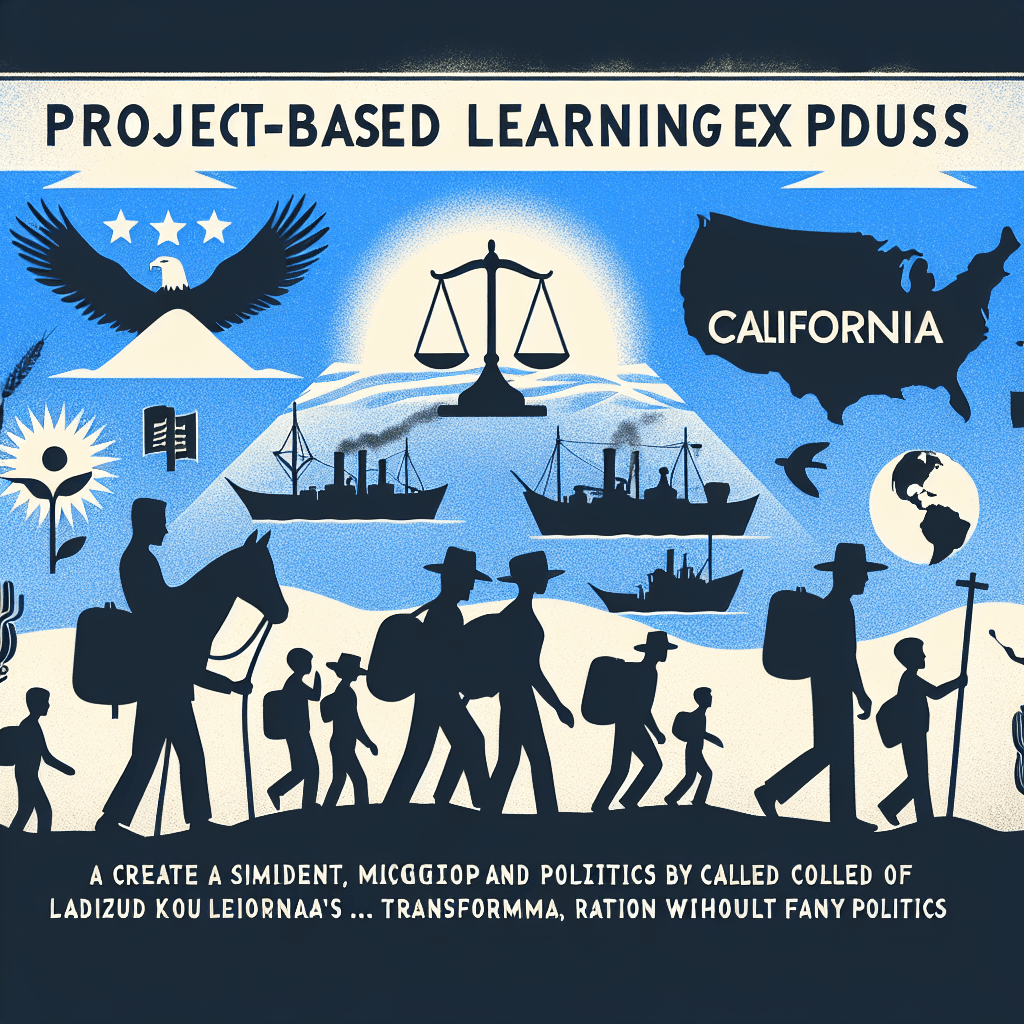
Dust Bowl Exodus: Migration, Politics, and California’s Transformation
Inquiry Framework
Question Framework
Driving Question
The overarching question that guides the entire project.How did the convergence of environmental crisis and economic collapse in the 1930s redefine the American social and political landscape through the lens of those displaced by the Dust Bowl?Essential Questions
Supporting questions that break down major concepts.- How did the combination of unwise agricultural practices and natural disaster create a man-made environmental crisis in the Great Plains?
- In what ways did the depopulation of rural regions during the 1930s permanently alter the demographic landscape of the United States?
- How did the arrival of "Dust Bowl" refugees challenge California’s social, economic, and political systems?
- Why do economic and environmental catastrophes often lead to the rise of extreme political movements on both the left and the right?
- How can the stories of migrant families help us understand the 'human toll' of the Great Depression beyond just economic statistics?
Standards & Learning Goals
Learning Goals
By the end of this project, students will be able to:- Students will analyze the causal relationship between unwise agricultural practices and the environmental collapse of the Dust Bowl to understand the origins of the 1930s ecological crisis.
- Students will evaluate the demographic and socioeconomic shifts in California resulting from the influx of Dust Bowl refugees, focusing on the strain on public resources and the evolution of social tensions.
- Students will examine and compare the rise of political movements on both the left and right during the Great Depression, identifying how economic desperation fuels ideological shifts.
- Students will synthesize primary source accounts (diaries, photography, oral histories) to construct a narrative of the 'human toll' that transcends quantitative economic data.
- Students will argue how the convergence of environmental and economic crises can lead to long-term changes in federal and state policy regarding land use and social welfare.
California History-Social Science Content Standards
Common Core State Standards (History/Social Studies)
Entry Events
Events that will be used to introduce the project to studentsThe 'Bum Blockade' Confrontation
Students arrive to find the classroom door 'guarded' by classmates or posters acting as the 1936 'Bum Blockade,' where they are interrogated on their 'value' to the state of California. They are presented with authentic anti-migrant flyers and must argue for their right to enter based on their skills, challenging them to experience the immediate social friction and xenophobia faced by Dust Bowl refugees.Portfolio Activities
Portfolio Activities
These activities progressively build towards your learning goals, with each submission contributing to the student's final portfolio.Dust & Dirt: The Autopsy of an Eco-Disaster
In this opening activity, students act as 'environmental forensic investigators' to determine why the Great Plains literally blew away. They will examine primary source photos of farming equipment from the 1920s, meteorological data, and soil reports to differentiate between natural drought and man-made ecological errors like over-plowing and the removal of native grasses.Steps
Here is some basic scaffolding to help students complete the activity.Final Product
What students will submit as the final product of the activityA 'Forensic Report' infographic that illustrates the 3-5 primary causes of the Dust Bowl, categorized into 'Natural' and 'Man-Made' factors.Alignment
How this activity aligns with the learning objectives & standardsThis activity directly addresses CA HSS-11.6.3 by focusing on how 'unwise agricultural practices' and 'natural disasters' combined to create the Dust Bowl. It aligns with the learning goal of analyzing the causal relationship between human activity and environmental collapse.The Great Exodus: Mapping the Displaced
Students will investigate the massive demographic shift of the 1930s. They will use historical census data to identify which counties lost the most population and trace the 'Exodus' routes, such as Route 66. To humanize the data, they will read 'Letters from the Dust Bowl' to understand the heartbreaking decision to abandon ancestral lands.Steps
Here is some basic scaffolding to help students complete the activity.Final Product
What students will submit as the final product of the activityAn interactive or annotated digital migration map that features at least three 'story waypoints' containing snippets of primary source journals or letters from families who fled the plains.Alignment
How this activity aligns with the learning objectives & standardsThis activity aligns with CA HSS-11.6.3 regarding the 'depopulation of rural regions.' It also meets CCSS.ELA-LITERACY.RH.11-12.7 by requiring students to integrate quantitative data (census maps) with qualitative data (personal letters).California Dreamin' or California Screamin'?
Students will explore the cold reality that met refugees upon arrival in California. Using Dorothea Lange’s photography and historical records of the 'Bum Blockade' and 'Hoovervilles,' students will analyze the economic competition between migrant labor and local workers, as well as the social stigma (the 'Okie' identity) that developed during this era.Steps
Here is some basic scaffolding to help students complete the activity.Final Product
What students will submit as the final product of the activityA 'Dual Perspectives' Photo Essay. Students will pair iconic migrant photographs with local California newspaper editorials from the 1930s to show the clash between the migrants' needs and the state's resistance.Alignment
How this activity aligns with the learning objectives & standardsThis aligns with CA HSS-11.6.3 (social and economic impacts in California) and RH.11-12.7 (evaluating diverse media like Dorothea Lange's photography). It explores the friction between migrants and established California systems.Radical Reactions: The Politics of Despair
In this activity, students examine how the desperation of the Depression led people to look toward radical political solutions. They will compare 'Left-Wing' movements (like Upton Sinclair's EPIC or the rise of labor unions) with 'Right-Wing' or populist reactions (like the Townsend Plan or critics of the New Deal's expansion).Steps
Here is some basic scaffolding to help students complete the activity.Final Product
What students will submit as the final product of the activityA 'Political Platform Pitch' where students create a flyer for a 1930s political movement, outlining its solution to the 'Human Toll' and identifying whether it falls on the Left or Right of the spectrum.Alignment
How this activity aligns with the learning objectives & standardsThis activity covers the part of CA HSS-11.6.3 concerning 'political movements of the left and right' and CA HSS-11.6.4 (New Deal controversies). It asks students to evaluate how economic desperation fuels ideological shifts.Voices of the Dust: A Narrative Synthesis
Students will finalize their portfolios by creating a narrative synthesis that tells the story of a fictional (but historically accurate) migrant family. They must incorporate the environmental cause, the migration journey, the social reception in California, and the political climate they encountered. This allows students to demonstrate empathy while showing mastery of historical facts.Steps
Here is some basic scaffolding to help students complete the activity.Final Product
What students will submit as the final product of the activityA 'Human Toll' Time Capsule or Digital Documentary. This product will include a reflective essay answering the driving question: 'How did the convergence of environmental and economic crises redefine the American landscape?'Alignment
How this activity aligns with the learning objectives & standardsThis serves as the synthesis of all standards, specifically RH.11-12.3 (evaluating various explanations for events). It requires students to look back at the environmental, economic, and political threads to answer the driving question.Rubric & Reflection
Portfolio Rubric
Grading criteria for assessing the overall project portfolioThe Dust Bowl & The Human Toll: Portfolio Assessment Rubric
Historical Forensic Analysis
Focuses on the forensic investigation of the Dust Bowl's origins and the causal link between human activity and ecological collapse.Environmental and Economic Causality
Analyzes the relationship between 1920s agricultural practices (over-plowing, tractor use) and natural factors (drought) to explain the Dust Bowl's origins.
Exemplary
4 PointsProvides a sophisticated analysis of the interplay between specific agricultural techniques and meteorological data. Identifies complex causal chains and distinguishes expertly between natural and man-made factors with high-quality visual evidence.
Proficient
3 PointsThoroughly explains the relationship between farming practices and the environmental collapse. Clearly categorizes 3-5 causes into natural and man-made factors using relevant primary source evidence.
Developing
2 PointsIdentifies basic causes of the Dust Bowl but may struggle to differentiate between man-made errors and natural disasters. The causal chain is present but lacks specific historical or scientific detail.
Beginning
1 PointsShows initial understanding of the Dust Bowl but provides minimal or inaccurate evidence regarding agricultural practices or environmental data. Categorization is incomplete.
Migration and Demographic Synthesis
Evaluates the student's ability to synthesize quantitative data with personal narratives to understand the scope of the Great Exodus.Geographic and Demographic Evidence
Uses census data and primary sources to map the depopulation of the Great Plains and the migration patterns toward California.
Exemplary
4 PointsExpertly integrates quantitative census data with deeply moving qualitative story waypoints. Maps show complex migration routes (e.g., Route 66) with profound insights into the human decision-making process.
Proficient
3 PointsSuccessfully uses 1930/1940 census data to color-code population loss and identifies clear 'Push' and 'Pull' factors. Includes three relevant story waypoints from primary source journals.
Developing
2 PointsCreates a basic map showing population shifts but may lack accuracy in color-coding or detail in the 'Push/Pull' factors. Story waypoints are present but lack depth or primary source connection.
Beginning
1 PointsMigration map is incomplete or inaccurate. Struggles to identify demographic shifts or connect personal narratives to the larger historical movement.
Social Impacts and Perspectives
Assesses the student's ability to evaluate the social and economic impacts of the migration through multiple historical lenses.Perspective-Taking and the 'Human Toll'
Analyzes the social and economic friction in California using Dorothea Lange’s photography and historical accounts of the 'Bum Blockade.'
Exemplary
4 PointsDemonstrates exceptional empathy and historical perspective by weaving together visual analysis and conflicting social arguments. Captions provide profound insight into the 'Okie' identity and systemic resistance.
Proficient
3 PointsEffectively compares the viewpoints of migrants and local Californians. Uses specific photographic evidence and historical records (like the 'Bum Blockade') to illustrate social and economic tensions.
Developing
2 PointsShows an emerging understanding of the challenges in California. Pairs photographs with captions, but the dual perspectives may be superficial or lack historical context from the era.
Beginning
1 PointsProvides minimal analysis of the social reception in California. Captions are repetitive or fail to address the actual economic and social arguments of the 1930s.
Political and Ideological Evaluation
Evaluates the student's understanding of how economic desperation fuels political shifts and the rise of radical movements.Ideological Analysis and Comparison
Compares Left-wing and Right-wing political responses to the Great Depression and their proposals for addressing the crisis.
Exemplary
4 PointsProduces an innovative political pitch that captures the nuance of 1930s radicalism. Expertly compares movements like Sinclair's EPIC with conservative critiques using a detailed Venn diagram.
Proficient
3 PointsAccurately identifies and compares Left and Right political movements. Clearly outlines how each movement proposed to address the human toll and the role of the federal government.
Developing
2 PointsIdentifies political movements but may oversimplify their platforms or struggle to distinguish between Left and Right ideologies. The comparison lacks specific details on proposed solutions.
Beginning
1 PointsShows limited understanding of the political climate. Struggles to define the movements or their relationship to the economic crisis.
Narrative Synthesis and Argumentation
Assesses the final synthesis of the project, focusing on the student's ability to argue how the convergence of crises changed the nation.Synthesizing the Driving Question
Synthesizes all portfolio artifacts into a cohesive narrative that answers the driving question about the redefinition of the American landscape.
Exemplary
4 PointsSynthesizes all threads—environmental, economic, and political—into a masterful narrative. The reflection provides a profound argument on the permanent shift in federal policy and the human spirit.
Proficient
3 PointsSuccessfully integrates evidence from previous activities to tell a historically accurate story of a migrant family. Reflection clearly answers the driving question with supporting evidence.
Developing
2 PointsNarrative is present but may feel disconnected from the evidence gathered in previous steps. Reflection provides a basic answer to the driving question without deep synthesis.
Beginning
1 PointsFinal product is incomplete or fails to address the driving question. Narrative lacks historical accuracy or fails to incorporate the required thematic elements.