
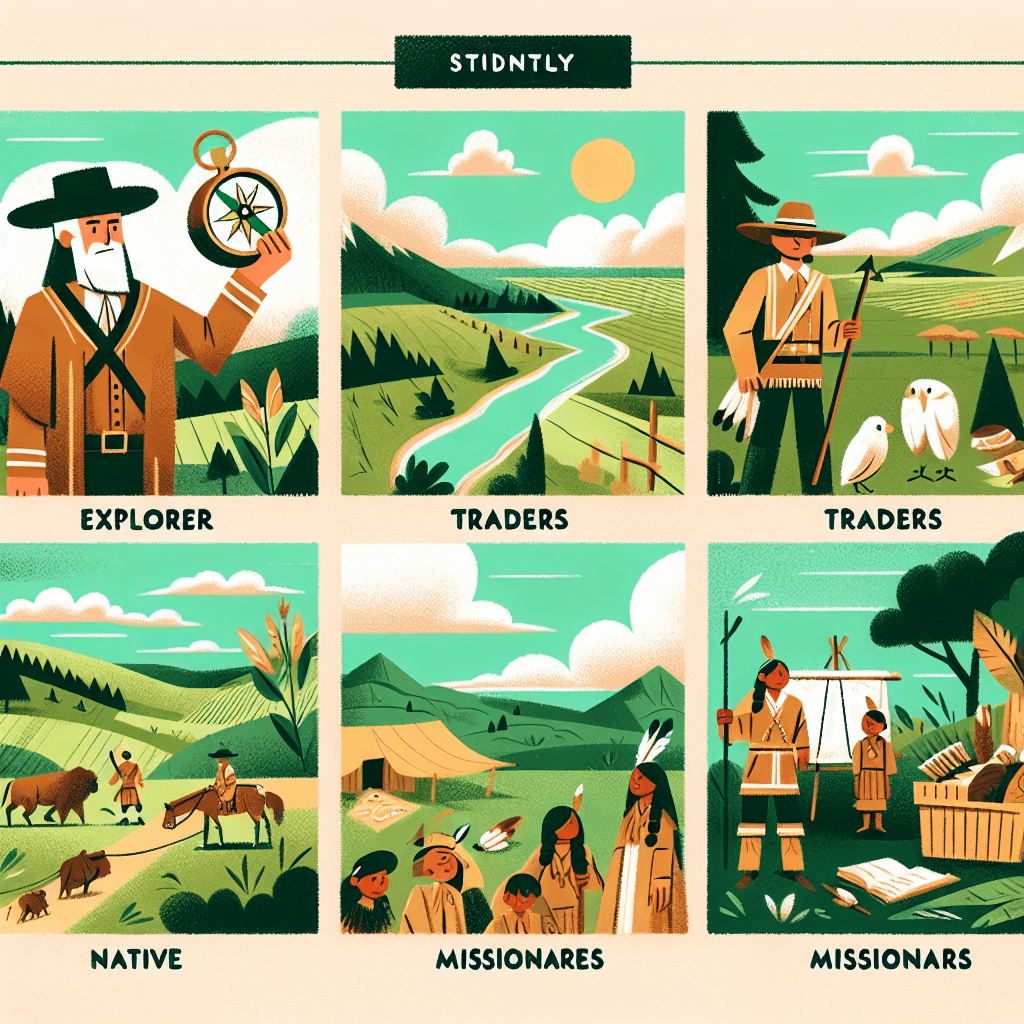
Early Nebraska: Explorers, Traders, and Missionaries
Inquiry Framework
Question Framework
Driving Question
The overarching question that guides the entire project.How did the arrival of explorers, fur traders, and missionaries shape Nebraska's environment, culture, and communities, and how do different perspectives inform our understanding of this period?Essential Questions
Supporting questions that break down major concepts.- How did the arrival of explorers, fur traders, and missionaries change the lives of people already living in Nebraska?
- In what ways did these groups interact with the environment, and what were the consequences?
- How can we use primary and secondary sources to understand different perspectives on this time period in Nebraska history?
- What were the motivations of explorers, fur traders, and missionaries in early Nebraska, and how did these motivations impact their actions?
- What lasting impact did these groups have on the geography, culture, and communities of Nebraska?
Standards & Learning Goals
Learning Goals
By the end of this project, students will be able to:- Students will analyze primary and secondary sources to evaluate the credibility and context surrounding the arrival of explorers, fur traders, and missionaries in Nebraska.
- Students will explain the multiple perspectives of various groups, including marginalized and underrepresented groups, regarding the impact of explorers, fur traders, and missionaries in Nebraska.
- Students will investigate and evaluate the changes in human and physical geography of Nebraska due to the arrival of explorers, fur traders, and missionaries.
- Students will identify and analyze patterns of continuity and change over time in Nebraska's history, focusing on the period of exploration, fur trade, and missionary activities.
- Students will identify and evaluate the changes in human and physical geography of Nebraska due to the arrival of explorers, fur traders, and missionaries.
- Students will demonstrate effective research skills using a variety of sources to gather information about the explorers, fur traders, and missionaries in early Nebraska.
- Students will use technology tools to present their research findings in a clear and engaging manner.
- Students will write narratives, arguments, or informative texts to convey their understanding of the impact of explorers, fur traders, and missionaries on Nebraska's environment, culture, and communities.
- Students will collaborate with peers to analyze historical events and create a comprehensive understanding of the topic.
- Students will reflect on the ethical considerations involved in studying historical events and the importance of understanding multiple perspectives.
- Students will improve communication skills by presenting findings and participating in group discussions related to the topic.
- Students will demonstrate comprehension of key vocabulary related to the history of explorers, fur traders, and missionaries in early Nebraska.
- Students will develop critical thinking skills by evaluating the impact of historical events and considering multiple perspectives.
- Students will enhance creativity by designing innovative ways to present their research and understanding of the topic.
- Students will cultivate curiosity about the history of Nebraska and the people who shaped its development.
- Students will acquire leadership skills by taking initiative in group projects and guiding discussions about the topic.
- Students will learn effective time management by organizing research and completing tasks within the project timeline.
- Students will expand their research skills by exploring diverse sources such as primary documents, maps, and artifacts.
- Students will engage with diverse perspectives by studying the experiences of different groups involved in the history of early Nebraska.
- Students will develop problem-solving skills by analyzing the challenges faced by explorers, fur traders, missionaries, and indigenous communities in Nebraska.
- Students will gain a deeper understanding of the interconnectedness of history, geography, culture, and community in early Nebraska.
- Students will refine communication skills by presenting research findings to diverse audiences such as peers, teachers, and community members.
- Students will practice critical analysis by identifying bias and credibility in various historical sources.
- Students will expand their historical empathy by understanding the motivations and perspectives of diverse groups in early Nebraska.
- Students will enhance their creative expression by producing multimedia presentations showcasing their research findings and insights.
- Students will develop digital literacy skills by utilizing online databases, digital archives, and interactive maps for research.
- Students will cultivate responsible citizenship by reflecting on the importance of understanding history for shaping a better future.
- Students will build teamwork skills by collaborating on research assignments, group discussions, and presentation designs.
- Students will refine self-reflection skills by assessing their individual contributions to the project and identifying areas for growth.
- Students will gain interdisciplinary knowledge by connecting historical events in Nebraska to broader social, economic, and environmental contexts.
- Students will develop persuasive argumentation skills by defending their research-based claims with evidence and reasoning.
- Students will cultivate cultural awareness by exploring the diverse traditions, languages, and values of indigenous communities in Nebraska.
- Students will enhance their information literacy skills by evaluating the accuracy and relevance of sources for their research projects.
- Students will foster civic engagement by participating in discussions about contemporary issues related to the historical context of early Nebraska.
- Students will develop ethical reasoning skills by analyzing the moral implications of historical actions and policies in early Nebraska.
- Students will promote effective collaboration by respecting diverse opinions, sharing resources, and resolving conflicts constructively.
- Students will cultivate adaptability by adjusting their research strategies, project designs, and presentation formats to meet evolving project requirements.
- Students will enhance their visual communication skills by creating compelling graphics, charts, and maps to illustrate their research findings.
- Students will foster creativity and imagination by developing alternative scenarios and hypothetical solutions to historical challenges.
- Students will promote intellectual curiosity by posing critical questions, pursuing independent research, and sharing insights with peers.
- Students will cultivate empathy and compassion by understanding the human impact of historical events and policies on individuals and communities.
- Students will foster global awareness by connecting historical events in Nebraska to broader global trends, movements, and cultural exchanges.
- Students will enhance their problem-solving skills by identifying root causes of historical conflicts and developing strategies for conflict resolution.
- Students will promote critical thinking by challenging assumptions, evaluating evidence, and constructing reasoned arguments based on reliable sources.
- Students will cultivate self-directed learning by setting personal goals, managing time effectively, and monitoring their progress towards project objectives.
- Students will foster lifelong learning by developing a passion for history, a commitment to inquiry, and a desire to expand their knowledge and understanding of the world.
Nebraska Social Studies Standards
Entry Events
Events that will be used to introduce the project to studentsLiving History Encampment
Stage a mock "encampment" scenario in the classroom, complete with replica tools, maps, and clothing from the era. Students step into the roles of different historical figures (explorer, fur trader, missionary, or indigenous person) and participate in a simulated trading session or negotiation, fostering empathy and understanding.Unearthing the Past
Begin with a short, engaging video clip showcasing a modern-day archaeological dig in Nebraska where artifacts from this period are being unearthed. An archaeologist poses questions about the stories these artifacts might tell, prompting students to become historical investigators themselves.Portfolio Activities
Portfolio Activities
These activities progressively build towards your learning goals, with each submission contributing to the student's final portfolio.Primary Source Deep Dive
Students will examine various primary source documents (excerpts from explorers' journals, fur traders' contracts, missionaries' letters) to understand the initial interactions and perspectives of these groups. They will learn to identify the author, intended audience, and purpose of each document.Steps
Here is some basic scaffolding to help students complete the activity.Final Product
What students will submit as the final product of the activityA collection of annotated primary source excerpts. Each excerpt will include a summary of the document's content, the author's perspective, and potential biases.Alignment
How this activity aligns with the learning objectives & standardsSS 4.4.3.a (Analyze key sources in Nebraska history to determine credibility and context.)Voices of the Past: Multi-Perspective Showcase
Students will research and present the perspectives of different groups impacted by the arrival of explorers, fur traders, and missionaries, focusing on the experiences of Indigenous peoples. They will explore how these events were viewed differently based on cultural background, economic status, and social roles.Steps
Here is some basic scaffolding to help students complete the activity.Final Product
What students will submit as the final product of the activityA multi-perspective presentation (e.g., a panel discussion, a staged debate, or a digital story) showcasing the viewpoints of explorers, fur traders, missionaries, and Indigenous peoples.Alignment
How this activity aligns with the learning objectives & standardsSS 4.4.2 (Analyze and explain multiple perspectives of events in Nebraska, including historically marginalized and underrepresented groups.)Nebraska's Changing Landscape
Students will investigate the environmental impact of the arrival of explorers, fur traders, and missionaries on Nebraska's geography. They will examine changes in land use, resource management, and the introduction of new species.Steps
Here is some basic scaffolding to help students complete the activity.Final Product
What students will submit as the final product of the activityA visual representation (e.g., a map, a diorama, or a digital model) showing the changes in Nebraska's human and physical geography during this period, accompanied by a written explanation of the causes and consequences of these changes.Alignment
How this activity aligns with the learning objectives & standardsSS 4.3.5.a (Identify and evaluate how changes in human and physical geography have shaped Nebraska.)Rubric & Reflection
Portfolio Rubric
Grading criteria for assessing the overall project portfolioExplorers, Fur Traders, and Missionaries in Early Nebraska - Portfolio Rubric
Primary Source Engagement
This category assesses the student's ability to engage deeply with primary source documents, extracting meaningful information, and analyzing perspective.Content Summary
Demonstrates the ability to thoroughly summarize the content of primary source excerpts.
Exemplary
4 PointsProvides a comprehensive and insightful summary, capturing the nuances and key details of the excerpt.
Proficient
3 PointsProvides a clear and accurate summary, covering the main points of the excerpt.
Developing
2 PointsProvides a partial or incomplete summary, missing some key details or showing some inaccuracies.
Beginning
1 PointsStruggles to provide a coherent summary, showing significant misunderstandings of the excerpt.
Perspective and Bias Analysis
Demonstrates the ability to effectively identify and analyze the author's perspective and potential biases within the primary source document.
Exemplary
4 PointsInsightfully analyzes the author's perspective, revealing subtle biases and their potential impact on the document's content. Demonstrates a sophisticated understanding of historical context.
Proficient
3 PointsClearly identifies the author's perspective and discusses potential biases with relevant supporting evidence.
Developing
2 PointsIdentifies the author's perspective but offers limited analysis of potential biases.
Beginning
1 PointsStruggles to identify the author's perspective or recognize potential biases in the document.
Annotation Quality
Demonstrates effective annotation skills, enhancing understanding and analysis of the primary source excerpts.
Exemplary
4 PointsAnnotations are insightful, thorough, and directly linked to the text, providing a deeper understanding of the primary source. Annotations reflect advanced critical thinking.
Proficient
3 PointsAnnotations are clear, relevant, and provide useful summaries and analyses of the primary source excerpts.
Developing
2 PointsAnnotations are basic and somewhat relevant, but may lack depth or clarity.
Beginning
1 PointsAnnotations are minimal, irrelevant, or missing, failing to demonstrate engagement with the primary source.
Multi-Perspective Analysis
This category assesses the student's ability to research, understand, and present different perspectives related to the topic.Research Depth
Demonstrates thorough research skills by gathering comprehensive and relevant information about the assigned stakeholder group.
Exemplary
4 PointsConducts exceptionally thorough research, gathering a wealth of information from diverse and credible sources to provide a nuanced understanding of the group's experiences.
Proficient
3 PointsConducts thorough research, gathering relevant information from credible sources to represent the group's experiences accurately.
Developing
2 PointsConducts basic research, gathering some relevant information but missing key details or perspectives.
Beginning
1 PointsConducts minimal research, failing to gather sufficient information to accurately represent the group's experiences.
Viewpoint Representation
Demonstrates the ability to accurately and effectively represent the assigned group's viewpoint, including their motivations, actions, and consequences.
Exemplary
4 PointsPresents an exceptionally accurate and compelling representation of the group's viewpoint, demonstrating a deep understanding of their motivations, actions, and the consequences they faced.
Proficient
3 PointsPresents an accurate representation of the group's viewpoint, including their motivations, actions, and the consequences they faced.
Developing
2 PointsPresents a partially accurate representation of the group's viewpoint, with some omissions or oversimplifications.
Beginning
1 PointsPresents an inaccurate or incomplete representation of the group's viewpoint, failing to capture their motivations, actions, or consequences.
Presentation Effectiveness
Demonstrates effective presentation skills, engaging the audience and conveying information in a clear and compelling manner. Demonstrates an ability to compare and contrast different perspectives.
Exemplary
4 PointsDelivers a captivating and insightful presentation that holds the audience's attention throughout. Skillfully compares and contrasts different perspectives, revealing complex relationships and nuances. Demonstrates leadership in facilitating discussion.
Proficient
3 PointsDelivers a clear and engaging presentation that effectively conveys information. Compares and contrasts different perspectives, highlighting key similarities and differences.
Developing
2 PointsDelivers a presentation that is somewhat unclear or disorganized, with limited engagement. Attempts to compare and contrast different perspectives, but the analysis is superficial.
Beginning
1 PointsDelivers a presentation that is confusing, disorganized, and fails to engage the audience. Struggles to compare and contrast different perspectives.
Geographic Impact Assessment
This category evaluates the student's ability to analyze changes in Nebraska's geography and assess the impact of human activities on the environment.Change Identification
Demonstrates the ability to identify and analyze changes in land use, settlement patterns, and resource extraction in Nebraska during the specified period.
Exemplary
4 PointsProvides a comprehensive and insightful analysis of changes, demonstrating a sophisticated understanding of the complex interrelationships between land use, settlement patterns, and resource extraction.
Proficient
3 PointsProvides a clear and accurate analysis of changes, identifying key trends and patterns in land use, settlement, and resource extraction.
Developing
2 PointsProvides a basic analysis of changes, identifying some key trends but missing important details or connections.
Beginning
1 PointsStruggles to identify or analyze changes in land use, settlement patterns, or resource extraction.
Environmental Impact Analysis
Demonstrates thorough research and understanding of the environmental impact of these changes, including deforestation, introduction of invasive species, and changes in wildlife populations.
Exemplary
4 PointsConducts exceptionally thorough research and presents a nuanced understanding of the complex and far-reaching environmental impacts, connecting them to broader ecological and social consequences.
Proficient
3 PointsConducts thorough research and clearly explains the environmental impact of these changes, providing specific examples and supporting evidence.
Developing
2 PointsConducts basic research and identifies some of the environmental impacts, but lacks detail or supporting evidence.
Beginning
1 PointsConducts minimal research and fails to adequately address the environmental impact of these changes.
Visual Representation & Explanation
Effectively creates a visual representation that accurately illustrates the changes in Nebraska's human and physical geography, accompanied by a clear and concise written explanation.
Exemplary
4 PointsCreates a visually stunning and informative representation that effectively communicates the changes in Nebraska's geography, accompanied by a compelling and insightful written explanation. Demonstrates exceptional creativity and technical skill.
Proficient
3 PointsCreates a clear and accurate visual representation that effectively illustrates the changes in Nebraska's geography, accompanied by a clear and concise written explanation.
Developing
2 PointsCreates a visual representation that is somewhat unclear or inaccurate, with a written explanation that lacks detail or clarity.
Beginning
1 PointsCreates a visual representation that is confusing, incomplete, or inaccurate, with a written explanation that is minimal or missing.