
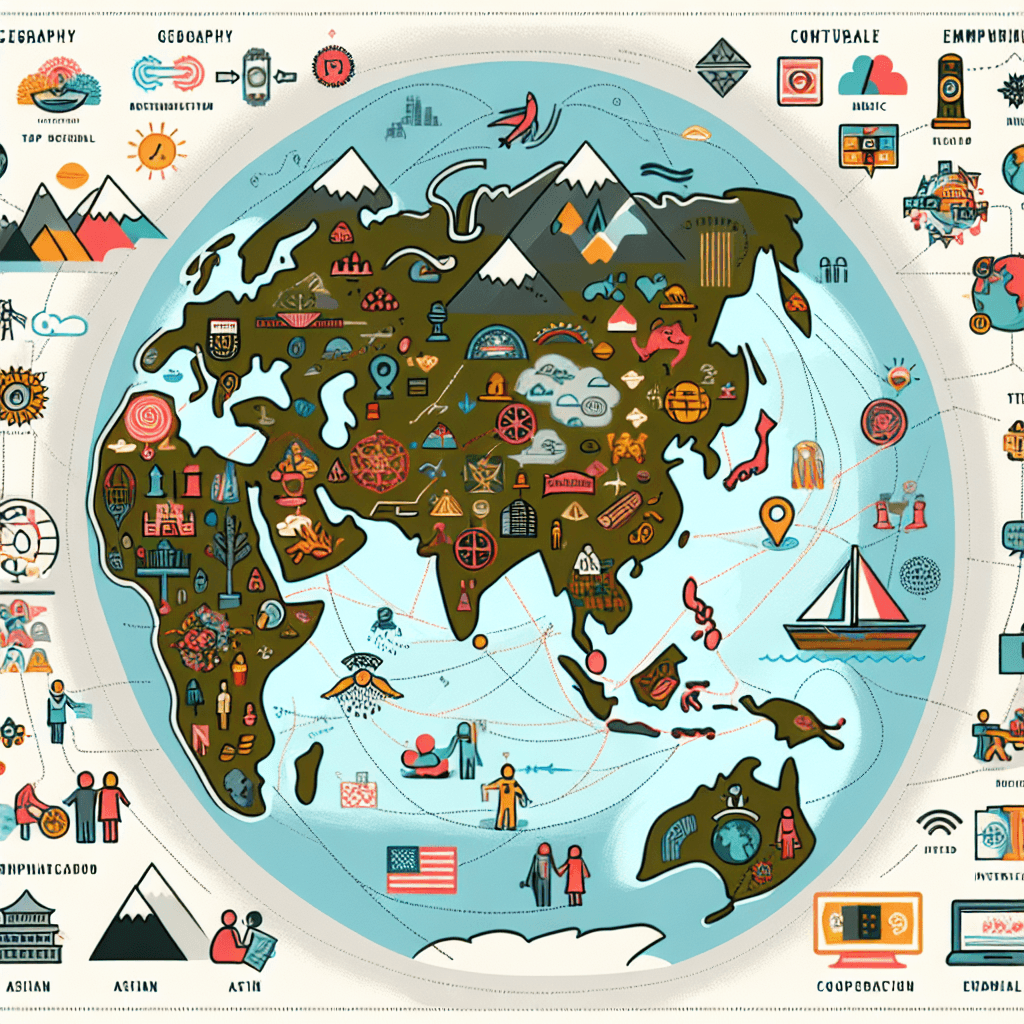
Eastern Hemisphere: Geography and Human Interaction
Inquiry Framework
Question Framework
Driving Question
The overarching question that guides the entire project.How does the interaction between physical geography and human adaptation shape the diverse cultures and economies of the Eastern Hemisphere?Essential Questions
Supporting questions that break down major concepts.- How do physical features impact how people live in the Eastern Hemisphere?
- What are the different ways people have adapted to and modified the environment in the Eastern Hemisphere?
- How does the geography of the Eastern Hemisphere affect trade and culture?
Standards & Learning Goals
Learning Goals
By the end of this project, students will be able to:- Identify and describe the major physical features of the Eastern Hemisphere.
- Explain how people have adapted to and modified the environment in the Eastern Hemisphere.
- Analyze the relationship between geography, trade, and culture in the Eastern Hemisphere.
- Write informative texts to present research findings about the Eastern Hemisphere.
ELA
Entry Events
Events that will be used to introduce the project to studentsInvestigating the Impact of Current Events on the Eastern Hemisphere
Select a recent significant event (political, environmental, or cultural) in the Eastern Hemisphere. Analyze its causes, effects, and connections to the region's geography and human-environment interactions. Present findings in a format that informs and engages peers, fostering critical thinking about real-world impacts.Portfolio Activities
Portfolio Activities
These activities progressively build towards your learning goals, with each submission contributing to the student's final portfolio.Geography, Trade, and Culture Connection Analysis
Students analyze the relationship between geography, trade, and cultural development in a specific region of the Eastern Hemisphere.Steps
Here is some basic scaffolding to help students complete the activity.Final Product
What students will submit as the final product of the activityAn analytical essay that explains how geography, trade, and culture are interconnected in a selected region of the Eastern Hemisphere.Alignment
How this activity aligns with the learning objectives & standardsAddresses learning goal: Analyze the relationship between geography, trade, and culture in the Eastern Hemisphere. Aligns with WHST.6-8.9 by requiring students to draw evidence from informational texts to support their analysis of the relationship between geography, trade, and culture.Eastern Hemisphere Informative Report
Students write a comprehensive report summarizing their research findings about a specific aspect of the Eastern Hemisphere's geography and its impact on human activities.Steps
Here is some basic scaffolding to help students complete the activity.Final Product
What students will submit as the final product of the activityA well-researched and informative report that presents findings about a specific aspect of the Eastern Hemisphere's geography and its impact on human activities.Alignment
How this activity aligns with the learning objectives & standardsAddresses learning goal: Write informative texts to present research findings about the Eastern Hemisphere. Aligns with WHST.6-8.2 by requiring students to write informative/explanatory texts and WHST.6-8.9 by requiring them to draw evidence from informational texts.Decoding Geographical Terminology
Students create a glossary of key geographical terms related to the Eastern Hemisphere, demonstrating their understanding of the vocabulary used in texts and discussions.Steps
Here is some basic scaffolding to help students complete the activity.Final Product
What students will submit as the final product of the activityA comprehensive glossary of geographical terms related to the Eastern Hemisphere, showcasing understanding of key vocabulary.Alignment
How this activity aligns with the learning objectives & standardsAddresses learning goal: Understanding geographical terminology. Aligns with RH.6-8.4 by requiring students to determine the meaning of words and phrases as they are used in a text related to geography.Human Adaptation Case Study
Students investigate and document a specific example of how humans have adapted to or modified the environment in the Eastern Hemisphere.Steps
Here is some basic scaffolding to help students complete the activity.Final Product
What students will submit as the final product of the activityA case study presentation that explains how humans have adapted to or modified the environment in a specific location within the Eastern Hemisphere.Alignment
How this activity aligns with the learning objectives & standardsAddresses learning goal: Explain how people have adapted to and modified the environment in the Eastern Hemisphere. Aligns with WHST.6-8.2 by requiring students to write informative/explanatory texts about human adaptation and modification.Eastern Hemisphere Physical Feature Explorer
Students create a visual guide showcasing the major physical features of a chosen region within the Eastern Hemisphere.Steps
Here is some basic scaffolding to help students complete the activity.Final Product
What students will submit as the final product of the activityA detailed visual guide with maps and descriptions of the major physical features of a selected region in the Eastern Hemisphere.Alignment
How this activity aligns with the learning objectives & standardsAddresses learning goal: Identify and describe the major physical features of the Eastern Hemisphere. Aligns with RH.6-8.2 by requiring students to determine central ideas from sources about physical features.Rubric & Reflection
Portfolio Rubric
Grading criteria for assessing the overall project portfolioEastern Hemisphere Inquiry and Analysis Rubric
Critical Analysis and Synthesis
Assessment of students' ability to critically analyze the interaction between geography, trade, culture, and human adaptation in the Eastern Hemisphere and synthesize information from multiple sources.Integration of Sources
Ability to integrate information from various sources to support analysis.
Exemplary
4 PointsSeamlessly integrates comprehensive information from a diverse array of primary and secondary sources to provide an in-depth analysis.
Proficient
3 PointsEffectively integrates information from multiple sources to support analysis, showing a thorough understanding of the topic.
Developing
2 PointsIntegrates information from a limited number of sources with partial success in supporting analysis.
Beginning
1 PointsStruggles to integrate information from sources, often lacking relevance or depth in supporting analysis.
Depth of Analysis
Depth and clarity of analysis regarding the relationships between geography, culture, trade, and adaptation.
Exemplary
4 PointsProvides sophisticated, keen insights into the complex relationships between geography, culture, trade, and adaptation.
Proficient
3 PointsOffers clear and logical analysis of the interrelationships, demonstrating thorough understanding.
Developing
2 PointsPresents basic analysis with some understanding of interrelationships, yet lacks depth.
Beginning
1 PointsExhibits minimal analysis with little understanding of relationships.
Use of Evidence
Effectiveness in using evidence to support analysis and research.
Exemplary
4 PointsSelects and uses evidence that is compelling and well-integrated to substantiate claims and analysis.
Proficient
3 PointsSelects appropriate evidence to support analysis, demonstrating clear understanding.
Developing
2 PointsUses evidence inconsistently, with some support for analysis.
Beginning
1 PointsLimited or irrelevant evidence is provided to support analysis.
Communication and Presentation
Assessment of students' skills in presenting information clearly and engagingly through written texts and visual aids.Clarity of Writing
Clarity, coherence, and organization of writing in texts and reports.
Exemplary
4 PointsWrites with exceptional clarity and organization, facilitating understanding through precise and engaging language.
Proficient
3 PointsWrites clearly and coherently with logical organization, effectively conveying information.
Developing
2 PointsWriting clarity and organization are inconsistent, affecting overall coherence.
Beginning
1 PointsWriting lacks clarity and coherence, often disorganized or confusing.
Use of Visual Aids
Effectiveness in using visual aids such as maps, charts, or diagrams.
Exemplary
4 PointsUtilizes visual aids expertly to enhance comprehension and engagement, adding significant value to presentations.
Proficient
3 PointsUses visual aids effectively to support understanding and engagement.
Developing
2 PointsInconsistent use of visual aids, with limited impact on comprehension.
Beginning
1 PointsRarely uses visual aids, which may be ineffective or distracting when used.
Understanding of Geographical Terms
Assessment of students' understanding and use of geographical terminology related to the Eastern Hemisphere.Terminology Application
Application and understanding of geographical terminology in context.
Exemplary
4 PointsDemonstrates exceptional command and application of geographical terms, enriching contextual understanding.
Proficient
3 PointsApplies geographical terms correctly and contextually, showing understanding.
Developing
2 PointsUses geographical terms with partial understanding or application, lacking precision.
Beginning
1 PointsLimited use and understanding of geographical terms, often inaccurate.