
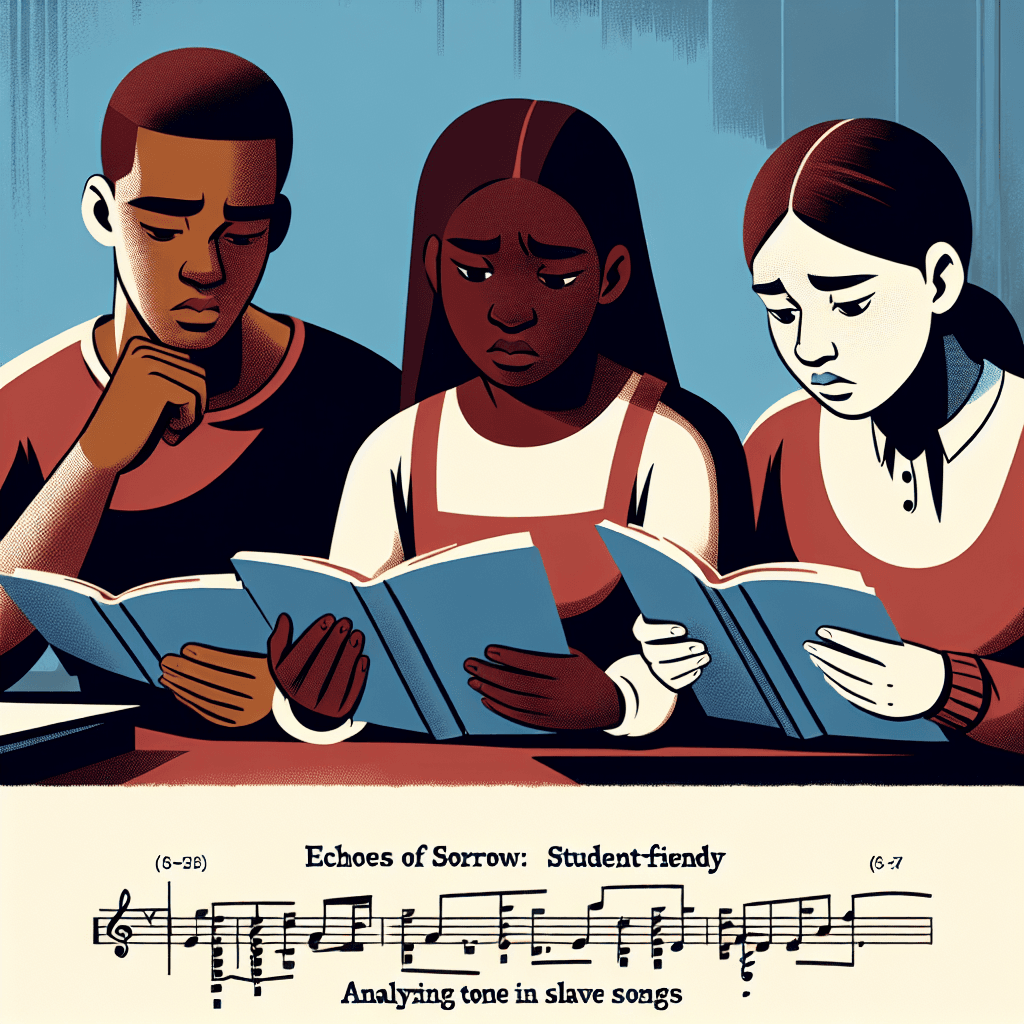
Echoes of Sorrow: Analyzing Tone in Slave Songs
Inquiry Framework
Question Framework
Driving Question
The overarching question that guides the entire project.How can we use Frederick Douglass’s specific word choices and analogies to curate an experience that exposes the "soul-killing" reality hidden within artistic expression?Essential Questions
Supporting questions that break down major concepts.- How do Frederick Douglass’s specific word choices—such as 'anguish,' 'dehumanizing,' and 'obdurate'—shape the tone and emotional impact of his narrative?
- How does the contrast between 'rapturous tones' and 'pathetic sentiments' create a specific meaning that outsiders often misunderstood?
- How does Douglass use figurative language and analogies (like the man on a 'desolate island') to redefine the reader's understanding of 'happiness' versus 'relief'?
- In what ways does Douglass use 'connotative' language to transform 'rude and incoherent songs' into a 'testimony' against slavery?
- How can we analyze the 'soul-killing' effects of a system by looking at the artistic expressions of those within it?
Standards & Learning Goals
Learning Goals
By the end of this project, students will be able to:- Analyze how Frederick Douglass uses specific vocabulary—such as 'anguish,' 'dehumanizing,' and 'obdurate'—to establish a tone that critiques the 'soul-killing' nature of slavery.
- Deconstruct the analogy of the 'desolate island' to explain the emotional subtext and psychological state of enslaved people as described in the text.
- Evaluate the relationship between the technical sound of the songs ('rapturous tone') and their connotative meaning ('sorrows of the heart') to identify the author's message.
- Synthesize textual evidence to create a 'testimony' or curated experience that communicates the hidden reality of slave songs to an audience, correcting historical misconceptions.
Common Core State Standards (English Language Arts)
Entry Events
Events that will be used to introduce the project to studentsThe Great House Farm: Masking the Narrative
Students are presented with a 'Travel Brochure' for the Great House Farm that uses glowing, technical language to describe its prestige, alongside a 'Secret Translation' key containing Douglass’s actual descriptions (e.g., 'soul-killing effects,' 'bitterest anguish'). Students must act as 'Historical Myth-Busters' to identify how specific word choices in the brochure mask a 'horrible character.' This initiates a project on how language can be used both to reveal and to hide the dehumanizing reality of slavery.Portfolio Activities
Portfolio Activities
These activities progressively build towards your learning goals, with each submission contributing to the student's final portfolio.The Emotional Palette of the Pine Woods
Students will act as 'Emotional Cartographers,' mapping out the specific vocabulary Douglass uses to describe the Great House Farm and the songs. Instead of just defining words, students will analyze the 'emotional weight' of Douglass’s vocabulary, categorizing words by their intensity and impact on the reader's perception of slavery's 'soul-killing' nature.Steps
Here is some basic scaffolding to help students complete the activity.Final Product
What students will submit as the final product of the activityAn 'Emotional Tone Map' (visual or digital) that categorizes at least 10 specific words/phrases from the text, explaining their connotation and their role in building the passage's overall tone.Alignment
How this activity aligns with the learning objectives & standardsThis activity aligns with RI.8.4 by requiring students to determine the connotative meanings of specific words (e.g., 'anguish,' 'dehumanizing') and analyze how these choices establish a somber and critical tone. It also supports RI.8.1 through the use of direct textual evidence.The Sound of Testimony: Curating the Great House Farm Exhibit
In this culminating activity, students act as historical curators. They will select a 'Sound' (a specific song or phrase from the text) and create a 'Museum Testimony' exhibit. This exhibit must use Douglass’s specific vocabulary and analogies to educate others on the 'soul-killing' reality of the Great House Farm, effectively correcting the historical misconception of slave happiness.Steps
Here is some basic scaffolding to help students complete the activity.Final Product
What students will submit as the final product of the activityA 'Curated Testimony Exhibit' (digital slide deck, physical poster, or recording) that includes a primary quote, a linguistic analysis of Douglass’s word choice, an explanation of the 'Desolate Island' analogy, and a concluding statement on the 'dehumanizing character' of slavery.Alignment
How this activity aligns with the learning objectives & standardsThis final activity synthesizes RI.8.4 (word choice, tone, and figurative language) with W.8.2 (writing informative/explanatory texts). It requires students to use their analysis to curate an educational experience for others.Rubric & Reflection
Portfolio Rubric
Grading criteria for assessing the overall project portfolioUnmasking the Great House Farm: Narrative Analysis Rubric
Linguistic and Aesthetic Analysis
This category evaluates the student's ability to deconstruct Douglass's specific word choices and their impact on the reader's understanding of the text's emotional landscape.Connotative Vocabulary Analysis (RI.8.4)
Students determine the technical (denotation) and emotional (connotation) meanings of specific words like 'anguish,' 'dehumanizing,' and 'obdurate.'
Exemplary
4 PointsDemonstrates a sophisticated understanding of linguistic nuance; explains how specific connotations (e.g., 'reverberate') create complex layers of meaning beyond the literal text. Analysis is insightful and precise.
Proficient
3 PointsCorrectly identifies technical and emotional meanings for chosen words. Explains the difference between what the word says and what it feels like within the context of Douglass's narrative.
Developing
2 PointsIdentifies words and provides basic definitions, but the distinction between technical and emotional meaning is inconsistent or surface-level. Connotative analysis lacks depth.
Beginning
1 PointsIdentifies few words or provides only literal definitions. Shows little to no understanding of how Douglass uses words to carry emotional weight.
Tone and Emotional Impact (RI.8.4)
Students analyze how word choice and the contrast between 'rapturous tone' and 'pathetic sentiment' establish the somber, critical tone of the passage.
Exemplary
4 PointsProvides a profound analysis of how word choice builds a 'soul-killing' tone. Expertly connects the 'masking' of pain through song to Douglass’s overarching critique of slavery.
Proficient
3 PointsEffectively explains how specific words contribute to the overall tone. Shows a clear understanding of how Douglass uses language to evoke sadness and expose the reality of the Great House Farm.
Developing
2 PointsIdentifies the tone of the passage but provides limited or inconsistent evidence of how specific words create that tone. The connection between vocabulary and mood is weak.
Beginning
1 PointsStruggles to identify the tone or misinterprets it as positive (contentment). Fails to link word choice to the emotional impact of the text.
Reasoning and Author's Purpose
This category assesses the student's ability to understand complex comparisons and the author's purpose in refuting historical misconceptions.Analogical Reasoning (RI.8.4)
Students deconstruct Douglass’s analogy of the 'desolate island' to explain the psychological state of enslaved people and the difference between 'relief' and 'happiness.'
Exemplary
4 PointsSynthesizes the analogy with high-level abstract thinking; explains the psychological complexity of 'relief' vs 'joy' and applies this to the 'soul-killing' reality described in the driving question.
Proficient
3 PointsClearly explains the 'desolate island' analogy and how it helps the reader understand that singing does not equal happiness. The explanation is logical and grounded in the text.
Developing
2 PointsSummarizes the analogy but struggles to explain its deeper meaning or its relationship to the misconception of slave 'contentment.' Analysis is literal rather than symbolic.
Beginning
1 PointsMentions the analogy but misinterprets it or provides no explanation of how it functions within Douglass's argument.
Point of View and Conflicting Evidence (RI.8.6)
Students analyze how Douglass identifies and responds to the misconception that slave songs were evidence of happiness.
Exemplary
4 PointsEvaluates the conflicting viewpoints with sophistication, showing how Douglass uses irony and specific evidence to dismantle the 'contentment' myth held by outsiders.
Proficient
3 PointsIdentifies Douglass’s point of view regarding the songs and explains how he uses the text to correct the false 'happiness' narrative. Analysis is clear and accurate.
Developing
2 PointsRecognizes that Douglass disagrees with the 'happiness' viewpoint but provides a vague or incomplete analysis of how he refutes that evidence.
Beginning
1 PointsFails to recognize the conflicting viewpoints or Douglass's specific purpose in clarifying the meaning of the songs.
Evidence and Communication
This category focuses on the student's ability to compile their analysis into a coherent, evidence-based final product that addresses the driving question.Synthesis and Curation (W.8.2)
The final exhibit (Emotional Tone Map and Curated Testimony) is well-organized, informative, and uses Douglass's vocabulary to educate the audience.
Exemplary
4 PointsThe exhibit is a masterfully curated experience that uses layout, tone, and precise language to 'expose' the hidden reality. It shows exceptional creativity and professional-level organization.
Proficient
3 PointsThe exhibit is well-organized and clearly communicates the 'soul-killing' reality of slavery. Uses at least three technical/connotative terms effectively to support the curator's note.
Developing
2 PointsThe exhibit includes the required components but lacks a cohesive flow. The 'Curator's Note' or 'Tone Analysis' may be underdeveloped or missing key vocabulary.
Beginning
1 PointsThe exhibit is incomplete or disorganized. It fails to convey the intended message or use the required vocabulary and textual evidence.
Textual Evidence and Inference (RI.8.1)
Students cite specific, powerful textual evidence to support their analysis of the 'hidden' meaning of the songs.
Exemplary
4 PointsCites the most impactful and relevant textual evidence available. Inferences are deeply rooted in the text and show a profound understanding of Douglass's 'testimony.'
Proficient
3 PointsProvides clear and relevant textual evidence to support inferences about the 'sorrows of the heart.' The connection between the quote and the analysis is explicit.
Developing
2 PointsUses textual evidence, but it may be weak, repetitive, or only tangentially related to the analysis. Inferences are basic or lack support.
Beginning
1 PointsProvides little to no textual evidence. Relies on generalities rather than Douglass’s specific words to support claims.