
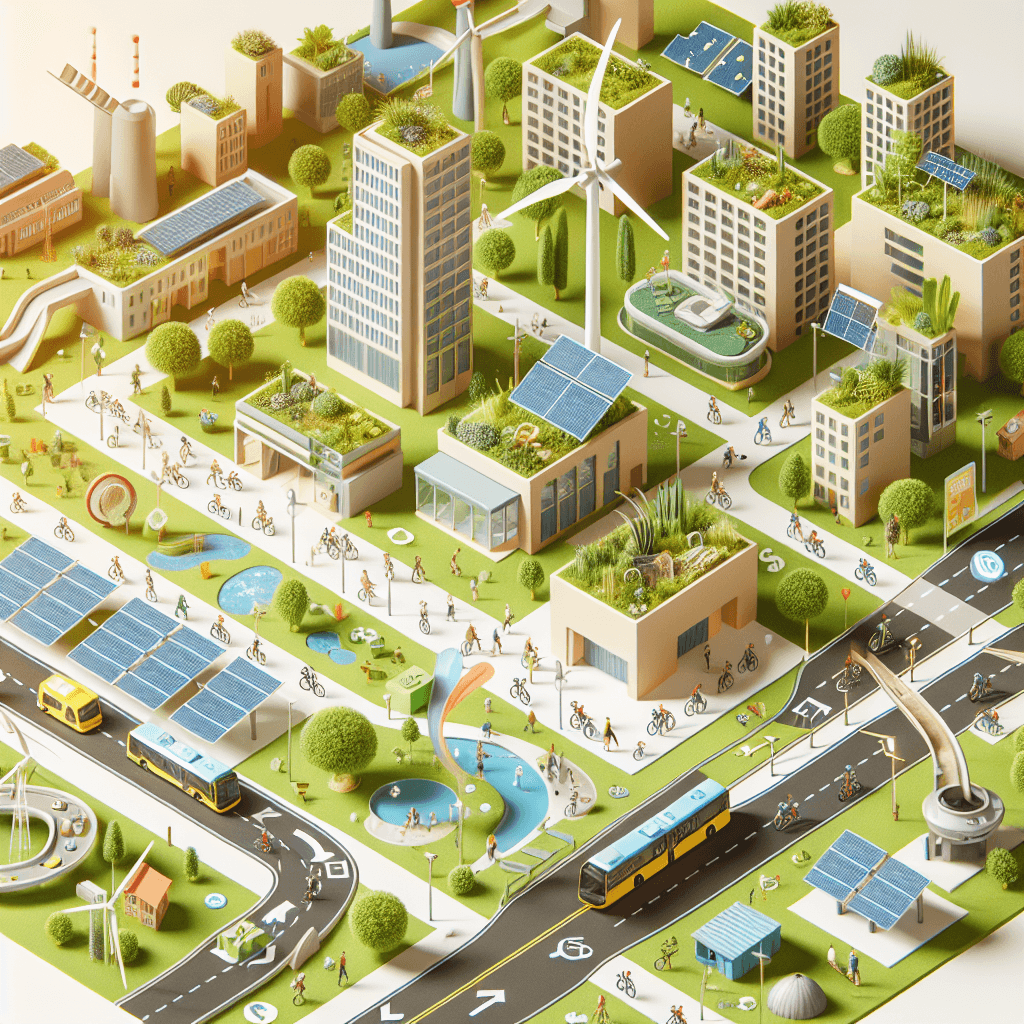
Eco-City Model: Designing Sustainable Human-Environment Interactions
Inquiry Framework
Question Framework
Driving Question
The overarching question that guides the entire project.How can we design a sustainable city model that balances human needs with environmental responsibility, considering the impacts of human activities, technology, population size, and resource management?Essential Questions
Supporting questions that break down major concepts.- How do human activities impact the environment in various cities across the world?
- In what ways can technology be used to create sustainable cities?
- What are some examples of sustainable practices that can be incorporated into city planning?
- How does the size and growth of a population influence the environment within a city?
- What resources are most critical for sustaining a city, and how can they be managed responsibly?
Standards & Learning Goals
Learning Goals
By the end of this project, students will be able to:- Students will understand the impact of human activities on the environment in various cities globally.
- Students will identify and analyze how technology can be integrated into urban planning to promote sustainability.
- Students will explore and implement sustainable practices in their city models, considering resources like water, energy, and food.
- Students will evaluate the relationship between population growth and environmental strain, and propose solutions to mitigate negative effects.
- Students will develop research skills by sourcing information and drawing evidence to support their city planning decisions.
Michigan Social Studies Standards
Common Core State Standards
Next Generation Science Standards
Entry Events
Events that will be used to introduce the project to studentsMystery Box Challenge
Students receive a mystery box containing various 'problems' (like pollution, waste, traffic jams) and must brainstorm creative solutions to address these in their eco-city model, promoting problem-solving and critical thinking.Portfolio Activities
Portfolio Activities
These activities progressively build towards your learning goals, with each submission contributing to the student's final portfolio.Intro to Eco-City Building
Students will begin their exploration of sustainable urban design by learning core concepts. This foundational activity sets the stage for understanding the balance between human needs and environmental responsibilities.Steps
Here is some basic scaffolding to help students complete the activity.Final Product
What students will submit as the final product of the activityA class-generated list of key elements essential to a sustainable city.Alignment
How this activity aligns with the learning objectives & standardsSupports 6-G5.1.1 by introducing human-environment interactions through urban design and technology.City Watch: A Global Tour
Students explore various cities worldwide to see how human activities have impacted the environment. They will analyze different urban areas to gather ideas for their eco-city model.Steps
Here is some basic scaffolding to help students complete the activity.Final Product
What students will submit as the final product of the activityResearch presentations that showcase key issues and solutions observed in cities around the world.Alignment
How this activity aligns with the learning objectives & standardsAligns with CCSS.ELA-LITERACY.WHST.6-8.7 by involving research and presentation based on multiple sources and inquiries.Sustainable Tech Think Tank
In this activity, students brainstorm and design innovative technologies that could be incorporated into their eco-city models to enhance sustainability.Steps
Here is some basic scaffolding to help students complete the activity.Final Product
What students will submit as the final product of the activityA technology concept plan that includes diagrams and explanations of how each innovation will function within the city model.Alignment
How this activity aligns with the learning objectives & standardsSupports MS-ESS3-3 by applying scientific principles to create methods that reduce human environmental impact.Resource Rally: Managing Urban Needs
Students will explore the critical resources needed for city sustenance and develop strategies for responsible management within their eco-city models.Steps
Here is some basic scaffolding to help students complete the activity.Final Product
What students will submit as the final product of the activityA report detailing strategies for managing essential urban resources sustainably.Alignment
How this activity aligns with the learning objectives & standardsTargets 6-G5.1.1 by examining resource management's role in urban planning.Population Dynamics and Environmental Impact
Students evaluate how population growth can strain the environment and explore solutions to mitigate these effects in their city designs.Steps
Here is some basic scaffolding to help students complete the activity.Final Product
What students will submit as the final product of the activityData-driven analysis on population impacts and strategies for sustainable management within cities.Alignment
How this activity aligns with the learning objectives & standardsSupports 6-G5.1.1 by focusing on the relationship between population size and environmental impact.The Eco-City Showcase
The project culminates with students presenting their sustainable city models, showcasing their understanding and innovative ideas.Steps
Here is some basic scaffolding to help students complete the activity.Final Product
What students will submit as the final product of the activityA 3D model of an eco-city with a detailed presentation of its sustainable features and technologies.Alignment
How this activity aligns with the learning objectives & standardsEmbodies all standards, allowing students to demonstrate comprehensive learning and creative problem-solving.Rubric & Reflection
Portfolio Rubric
Grading criteria for assessing the overall project portfolioEco-City Model Building Assessment Rubric
Understanding of Human-Environment Interactions
Evaluates student grasp of how human activities impact and modify their environment, specifically through urban design.Impact Analysis
Assesses ability to analyze and describe human impact on the environment from the project research.
Exemplary
4 PointsProvides a comprehensive analysis of various forms of human impact on multiple environments, showcasing advanced understanding.
Proficient
3 PointsDemonstrates solid analysis of human impacts, with examples from multiple environments showing comprehension.
Developing
2 PointsShows basic recognition and understanding of human impacts, but lacks breadth or depth in analysis.
Beginning
1 PointsDemonstrates limited recognition of human impact, with superficial or incomplete examples.
Sustainable Design Principles
Measures how well students incorporate sustainable principles into their models.
Exemplary
4 PointsIntegrates multiple innovative and effective sustainable practices, clearly explained with strong rationale.
Proficient
3 PointsIncorporates significant sustainable practices with clear connections to urban planning concepts.
Developing
2 PointsIncludes some sustainable elements, but with limited innovation or explanation.
Beginning
1 PointsShows minimal incorporation of sustainable practices with little to no explanation.
Research and Information Sourcing
Assesses the depth of research and the ability to source and apply information relevant to sustainable urban planning.Information Gathering
Evaluates research thoroughness and relevance of sourced information.
Exemplary
4 PointsGathers extensive and highly relevant information from diverse sources.
Proficient
3 PointsCollects relevant information from a range of sources, adequately supporting project tasks.
Developing
2 PointsSecures some relevant information but from limited or superficial sources.
Beginning
1 PointsGathers minimal and/or irrelevant information from few sources.
Collaborative Work and Presentation
Evaluates teamwork and effectiveness in presenting the Eco-City model and its features.Team Coordination
Assesses ability to work collaboratively and contribute to group objectives.
Exemplary
4 PointsShows leadership and fosters a positive dynamic, contributing significantly to group success.
Proficient
3 PointsWorks effectively as part of a team, contributing to group tasks and objectives.
Developing
2 PointsParticipates in group work, but with inconsistent engagement or contribution.
Beginning
1 PointsRarely contributes to group tasks, requiring external motivation or direction.
Presentation of Model
Measures effectiveness in communicating the features and innovations of the eco-city during presentations.
Exemplary
4 PointsPresents a compelling and clear overview of the model with excellent use of visual aids.
Proficient
3 PointsProvides a clear and coherent presentation with effective use of visual aids.
Developing
2 PointsDelivers a basic presentation that may lack clarity or engagement with limited visual aids usage.
Beginning
1 PointsStruggles to communicate model features, with unclear or incomplete presentation and visual use.