
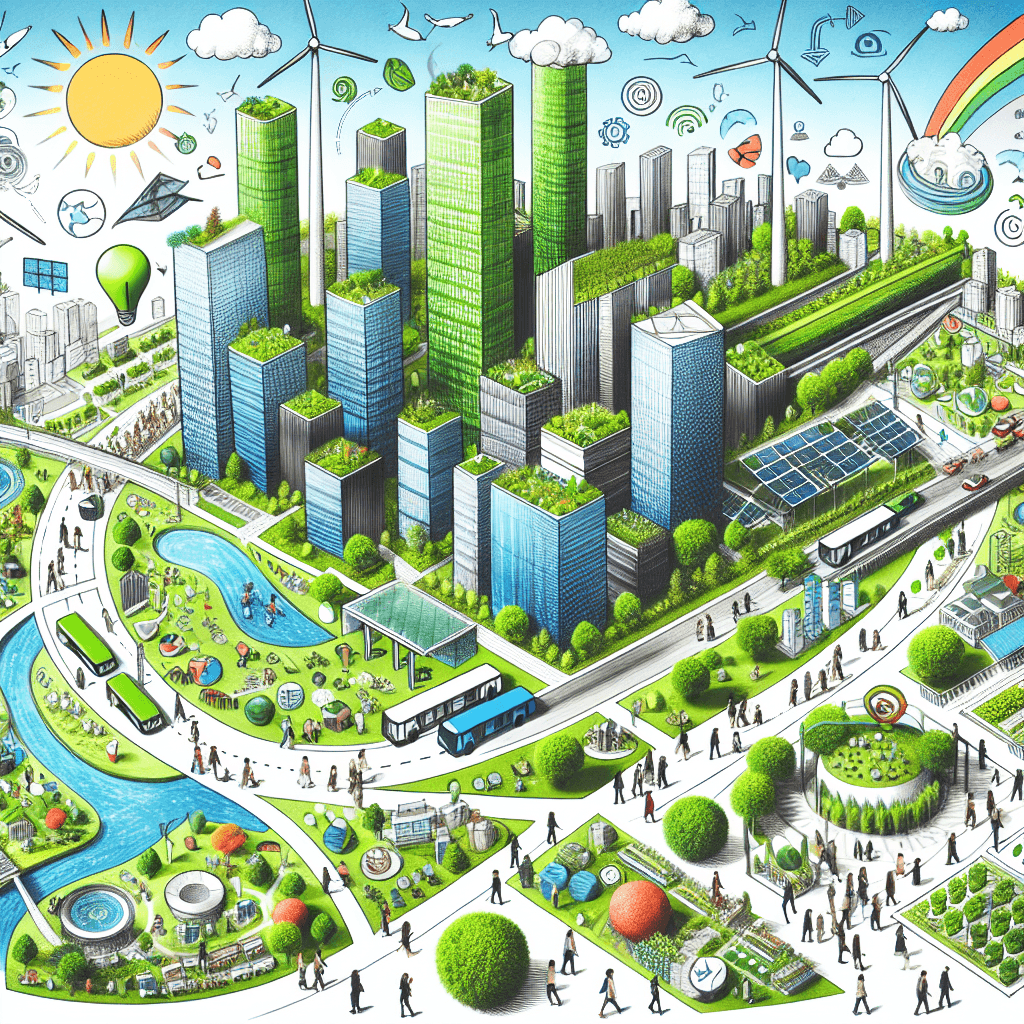
Eco-Engineers: Designing the Sustainable Cities of Tomorrow
Inquiry Framework
Question Framework
Driving Question
The overarching question that guides the entire project.How can we, as environmental engineers, design and build a model city that uses renewable energy and green spaces to create a sustainable future for our community and the planet?Essential Questions
Supporting questions that break down major concepts.- What makes a city 'sustainable,' and why is it important for our future?
- How can we use renewable energy sources to power a city while reducing our carbon footprint?
- What role do green spaces play in keeping an urban environment healthy for both people and wildlife?
- How can we design a city layout that minimizes waste and maximizes the use of natural resources?
- How does the engineering design process help us solve complex environmental problems in a growing world?
Standards & Learning Goals
Learning Goals
By the end of this project, students will be able to:- Explain the concept of urban sustainability and identify how specific green technologies contribute to a reduced carbon footprint.
- Compare and contrast different renewable energy sources (solar, wind, hydroelectric) and justify their placement within a city model for maximum efficiency.
- Apply the Engineering Design Process to brainstorm, prototype, and refine a physical or digital model of a sustainable city.
- Analyze the relationship between urban planning and environmental health, specifically focusing on the role of green spaces in supporting biodiversity and air quality.
- Present and defend city design choices using evidence gathered from research on environmental science and engineering principles.
Next Generation Science Standards (NGSS)
Common Core State Standards (ELA)
Entry Events
Events that will be used to introduce the project to studentsThe 2075 Blackout Broadcast
Students enter a darkened classroom to see a simulated 'Emergency Broadcast' from the Year 2075. A frantic mayor explains that the old power grid has permanently failed due to fossil fuel depletion, and the students are the lead architects recruited to build 'Resilience City'—the world's first fully self-sustaining urban center.Portfolio Activities
Portfolio Activities
These activities progressively build towards your learning goals, with each submission contributing to the student's final portfolio.The Power Grid Pro-Con Challenge
In this activity, students evaluate different renewable energy sources (solar, wind, hydroelectric) to determine which are best suited for their city's specific geography. They will create a comparative matrix to weigh the efficiency of each source against the needs of their urban population and the availability of green space. This helps them make data-driven decisions for their model.Steps
Here is some basic scaffolding to help students complete the activity.Final Product
What students will submit as the final product of the activityAn 'Energy Matrix & Zoning Map'—a color-coded chart comparing energy sources and a rough sketch of where these power plants and green spaces will be located.Alignment
How this activity aligns with the learning objectives & standardsAligns with NGSS 3-5-ETS1-2 (Generate and compare multiple possible solutions to a problem based on how well each is likely to meet the criteria).Resilience City Rising
This is the hands-on construction phase. Using recycled materials (cardboard, plastic bottles, etc.), students bring their 2D blueprints to life. As they build, they will inevitably encounter structural or spatial challenges, requiring them to iterate—changing their design on the fly just like real engineers. They must ensure that their green spaces are integrated and their energy sources are clearly represented.Steps
Here is some basic scaffolding to help students complete the activity.Final Product
What students will submit as the final product of the activityA physical 3D model of 'Resilience City' built primarily from recycled and sustainable materials.Alignment
How this activity aligns with the learning objectives & standardsAligns with the 'Developing and Using Models' science practice and the 'Plan and Carry Out Investigations' component of the Engineering Design Process.The Sustainability Scout Report
To begin their journey as environmental engineers, students must investigate how real-world cities are currently fighting climate change and resource depletion. Students will work in 'Urban Engineering Teams' to research specific sustainable practices such as vertical farming, greywater recycling, and carbon-neutral transportation. This activity builds the foundational knowledge needed to decide which features their own 'Resilience City' must include.Steps
Here is some basic scaffolding to help students complete the activity.Final Product
What students will submit as the final product of the activityA 'Sustainability Scout Report' featuring a list of three must-have technologies for their city, backed by research facts and citations.Alignment
How this activity aligns with the learning objectives & standardsAligns with NGSS 5-ESS3-1 (Obtain and combine information about ways individual communities use science ideas to protect Earth’s resources) and CCSS.ELA-LITERACY.W.5.7 (Conduct short research projects to build knowledge).Rubric & Reflection
Portfolio Rubric
Grading criteria for assessing the overall project portfolioResilience City: Sustainable Engineering Rubric
Scientific Inquiry and Research
This category assesses the student's ability to conduct research and use data to inform their engineering decisions before and during the design phase.Research and Information Synthesis
The ability to obtain, evaluate, and combine information from various sources to identify sustainable technologies and their pros/cons.
Exemplary
4 PointsSynthesizes high-quality information from multiple diverse sources; provides insightful pros/cons for three or more technologies with sophisticated reasoning.
Proficient
3 PointsCollects relevant information from several sources; clearly identifies pros and cons for three sustainable technologies with logical reasoning.
Developing
2 PointsGathers information from limited sources; identifies some benefits and challenges but reasoning may be basic or incomplete.
Beginning
1 PointsProvides minimal information with few sources; fails to clearly explain the benefits or challenges of sustainable technologies.
Data-Driven Solution Analysis
The skill of evaluating different renewable energy sources based on specific environmental constraints and data-driven decision making.
Exemplary
4 PointsDevelops a highly detailed Energy Matrix that perfectly aligns energy choices with site-specific climate data; provides an innovative zoning strategy.
Proficient
3 PointsCreates a clear Energy Matrix and Zoning Map that uses climate and terrain data to justify energy choices and industrial placement.
Developing
2 PointsProduces a basic Energy Matrix and Map; energy choices show some alignment with the site card but lack strong data-driven justification.
Beginning
1 PointsThe matrix or map is incomplete; energy choices are made without regard for the specific climate or terrain constraints.
Engineering Design and Modeling
Focuses on the physical creation of the city and the student's ability to navigate the iterative nature of the engineering design process.Iterative Design and Prototyping
The application of the engineering design process, including building a prototype and making necessary adjustments based on testing or spatial challenges.
Exemplary
4 PointsActively documents multiple design iterations in the log, showing how challenges led to sophisticated improvements in the final model.
Proficient
3 PointsUses the Design Log to track changes and successfully adjusts the physical model when building or spatial constraints are encountered.
Developing
2 PointsShows evidence of some model changes but the Design Log is inconsistent; adjustments are minor and don't fully address design challenges.
Beginning
1 PointsConstructs a model without documentation of changes; shows little evidence of testing or refining the design based on constraints.
Model Construction and Application
The intentional integration of green spaces and renewable energy systems within the physical 3D city model using appropriate materials.
Exemplary
4 PointsModel is impeccably constructed with creative use of recycled materials; green spaces and energy systems are seamlessly and realistically integrated.
Proficient
3 PointsBuilds a sturdy 3D model where renewable energy sources and green spaces are clearly visible and logically placed according to the blueprint.
Developing
2 PointsModel is constructed but lacks stability or clarity; green spaces or energy sources are present but their purpose or placement is unclear.
Beginning
1 PointsThe physical model is incomplete or fails to include the required renewable energy and green space elements.
Communication and Evidence
Assesses the student's ability to communicate their findings and justify their design as an environmental engineer.Scientific Communication and Defense
The ability to present city design choices clearly, using evidence from research and engineering principles to defend decisions.
Exemplary
4 PointsPresents a compelling and highly organized defense of the city; uses sophisticated scientific vocabulary and provides extensive evidence for all choices.
Proficient
3 PointsPresents design choices clearly and logically; uses appropriate facts and descriptive details from research to support main engineering ideas.
Developing
2 PointsShares city details but the presentation lacks logical sequencing; provides some evidence but reasoning for design choices is thin.
Beginning
1 PointsPresentation is disorganized or difficult to follow; fails to provide scientific evidence or reasoning for the city's sustainable features.