
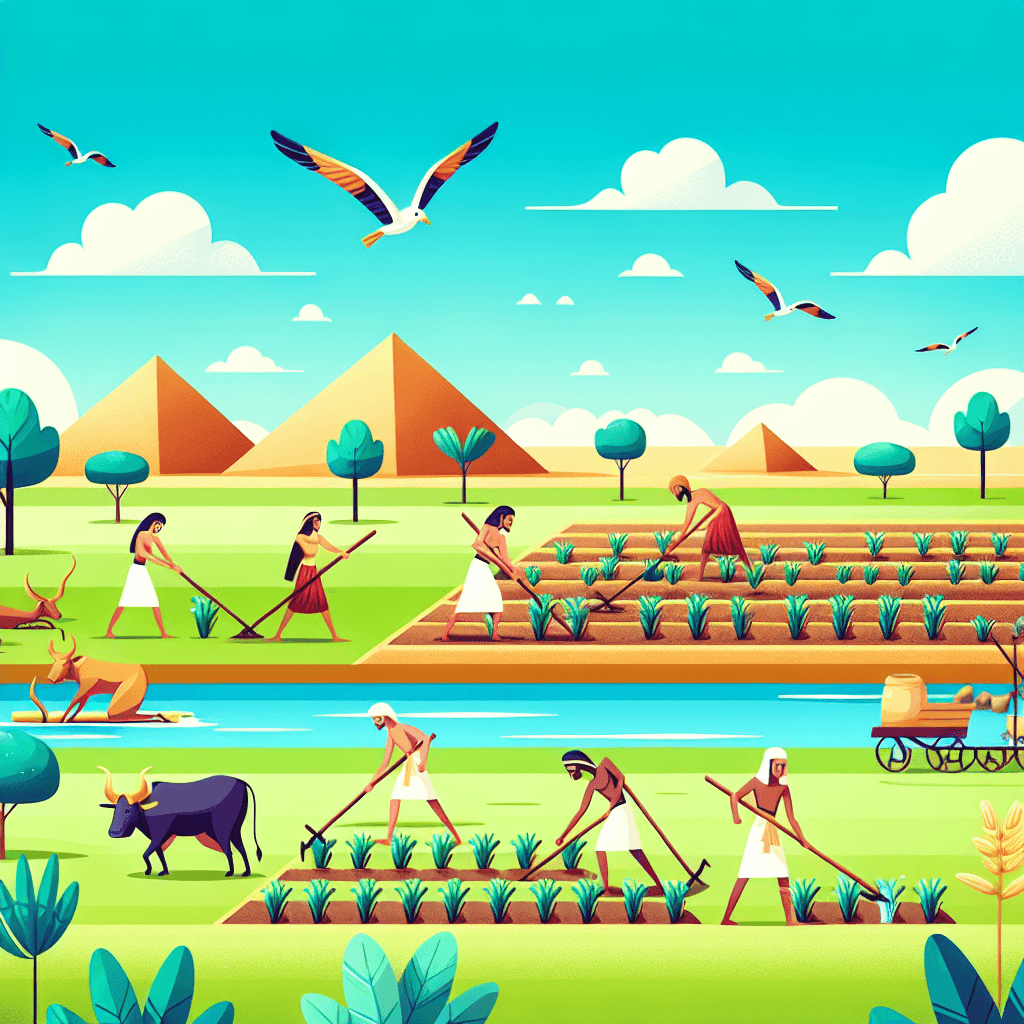
Eco-friendly Egyptian Farming: Ancient Practices for Sustainability
Inquiry Framework
Question Framework
Driving Question
The overarching question that guides the entire project.How can we redesign and adapt the sustainable farming methods of ancient Egypt to address contemporary agricultural challenges?Essential Questions
Supporting questions that break down major concepts.- What were the defining characteristics of ancient Egyptian society and how did they contribute to their agricultural success?
- How did the natural environment of ancient Egypt influence agricultural practices and societal development?
- What sustainable farming methods did ancient Egyptians use, and how can they be adapted for today's needs?
- In what ways did the ancient Egyptian society innovate in terms of technology and tools to improve their farming methods?
Standards & Learning Goals
Learning Goals
By the end of this project, students will be able to:- Understand the defining characteristics of ancient Egyptian society and its relationship to successful agricultural practices.
- Analyze the influence of the natural environment on the evolution of agriculture in ancient Egypt.
- Identify and describe sustainable farming methods used by ancient Egyptians that can be adapted to modern challenges.
- Evaluate ancient Egyptian innovations in technology and tools related to agriculture and propose adaptations for contemporary use.
Academic Standards
Entry Events
Events that will be used to introduce the project to studentsInteractive Geographical Detective Mission
Set up a detective-style mission where students receive clues about ancient Egyptian geography and climate. They must determine how these elements influenced farming practices, using satellite maps, weather data simulations, and historical records, leading to discussions on creating modern farming systems that adapt to and work with local environments.Eco-Sustainability Innovation Contest
Kick off with a contest where student teams create proposals for modern sustainable farming methods inspired by ancient Egyptian techniques. Introducing this through interactive presentations by guest speakers who are modern-day agricultural innovators links the old with the new and encourages students to consider their role in sustainable development.Portfolio Activities
Portfolio Activities
These activities progressively build towards your learning goals, with each submission contributing to the student's final portfolio.The Climate Connect: Natural Influences Workshop
This activity allows students to explore how the Egyptian climate influenced agricultural practices. They'll engage in discussions and create a mini-presentation on the relationships between natural environments and farming methods in ancient Egypt.Steps
Here is some basic scaffolding to help students complete the activity.Final Product
What students will submit as the final product of the activityA collaborative presentation discussing the influence of the Egyptian climate on agriculture, emphasizing its importance.Alignment
How this activity aligns with the learning objectives & standardsAligns with KL-024, focusing on environmental influences on ancient Egyptian agricultural lifestyles.Sustainable Secrets: Innovations Inspired by Egypt
Students investigate ancient Egyptian farming technologies and assess their potential modern applications. Groups will design models of these technologies and propose adaptations for current sustainable practices.Steps
Here is some basic scaffolding to help students complete the activity.Final Product
What students will submit as the final product of the activityA comprehensive model or diagram of an ancient Egyptian technology with proposed modern adaptations, presented to the class.Alignment
How this activity aligns with the learning objectives & standardsAligns with KE-054, as it involves understanding and describing ancient technologies and proposing modern advancements.Innovation Incubator: Propose Modern Methods
Building on previously studied agricultural techniques, students will innovate by proposing new sustainable farming methods using an understanding of ancient Egyptian practices.Steps
Here is some basic scaffolding to help students complete the activity.Final Product
What students will submit as the final product of the activityA detailed proposal and presentation for a modern sustainable farming method, drawing on historical insights.Alignment
How this activity aligns with the learning objectives & standardsAligns with all standards, synthesizing learning goals by proposing modern solutions informed by historical study.Rubric & Reflection
Portfolio Rubric
Grading criteria for assessing the overall project portfolioEco-friendly Egyptian Formulas Assessment Rubric
Historical Understanding
Evaluates the student's comprehension of ancient Egyptian society, its environment, and agricultural practices.Historical Accuracy
Measures the accuracy and depth of understanding regarding ancient Egyptian agricultural practices and related historical contexts.
Exemplary
4 PointsProvides an outstanding understanding of ancient Egyptian practices with detailed and contextually accurate historical references.
Proficient
3 PointsDemonstrates a thorough understanding of ancient Egyptian practices with accurate historical references.
Developing
2 PointsShows an emerging understanding of Egyptian practices with some historical accuracy.
Beginning
1 PointsDisplays minimal understanding of Egyptian practices with several inaccuracies.
Environmental Influence Analysis
Assesses the analysis of the natural environment's influence on ancient Egyptian agriculture.
Exemplary
4 PointsProvides comprehensive analysis of environmental influences with clear connections to agricultural practices.
Proficient
3 PointsOffers a clear analysis with evident connections to environmental influences on agriculture.
Developing
2 PointsProvides a basic analysis with some connections to environmental influences on agriculture.
Beginning
1 PointsLacks clear analysis or connections of environmental influences on agriculture.
Innovative Application
Focuses on the student's ability to apply historical knowledge to modern sustainability challenges through creative solutions.Innovation and Creativity
Evaluates the creativity and feasibility of proposed solutions inspired by historical practices.
Exemplary
4 PointsPresents highly creative and feasible solutions with innovative adaptations of ancient practices to modern problems.
Proficient
3 PointsOffers creative solutions with feasible adaptations of ancient practices.
Developing
2 PointsProvides some innovative ideas but with limited feasibility or creativity.
Beginning
1 PointsLacks creative solutions or feasible adaptations of ancient practices.
Technical Design and Presentation
Assesses the quality and clarity of technical designs and presentations related to sustainable adaptations.
Exemplary
4 PointsDelivers an exceptionally clear and professional presentation with well-developed technical designs.
Proficient
3 PointsPresents clear and well-structured technical designs.
Developing
2 PointsProvides somewhat clear presentations or technical designs.
Beginning
1 PointsOffers unclear presentations with poorly developed technical designs.
Collaboration and Reflection
Assesses teamwork and the ability to reflect on learning processes and outcomes.Team Contribution and Leadership
Evaluates the effectiveness of collaboration and leadership within group activities.
Exemplary
4 PointsDemonstrates leadership and significant contributions, fostering group collaboration and success.
Proficient
3 PointsContributes effectively and supports group collaboration.
Developing
2 PointsMakes some contributions with occasional participation in group activities.
Beginning
1 PointsParticipates minimally in group activities with limited contributions.
Reflective Practice
Measures the depth of student reflection on their learning process and outcomes.
Exemplary
4 PointsProvides deep, insightful reflections on learning processes, showing significant growth.
Proficient
3 PointsOffers clear reflections with evidence of learning and growth.
Developing
2 PointsProvides basic reflections showing some consideration of learning.
Beginning
1 PointsGives minimal reflections without clear evidence of learning.