
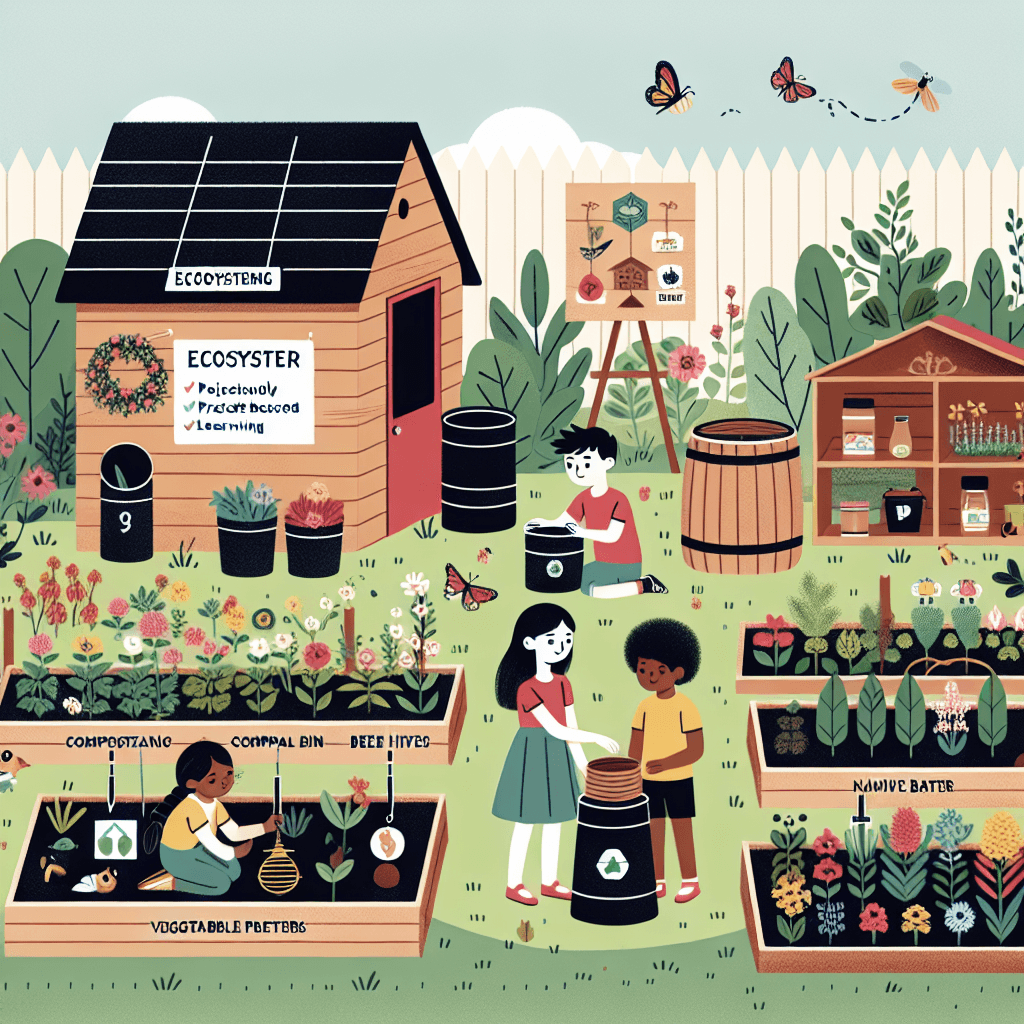
Eco-Friendly Gardens: Sustainable Garden Design for Ecosystems
Inquiry Framework
Question Framework
Driving Question
The overarching question that guides the entire project.How can we design a sustainable garden model that effectively integrates our knowledge of biotic and abiotic factors to support biodiversity and benefit the environment?Essential Questions
Supporting questions that break down major concepts.- What is a sustainable garden, and how can it benefit the environment?
- How do different biotic and abiotic factors interact in a garden ecosystem?
- What are the key components needed to design and maintain an eco-friendly garden?
- How can knowledge of ecosystems help in designing a sustainable garden model?
- Why is biodiversity important in a sustainable garden?
Standards & Learning Goals
Learning Goals
By the end of this project, students will be able to:- Students will understand the role of biotic and abiotic factors in creating and maintaining ecosystems.
- Students will learn to design a sustainable garden model that supports biodiversity.
- Students will explore the importance of biodiversity and how to support it in a garden setting.
- Students will apply scientific ideas to create and maintain environments that protect natural resources.
- Students will develop a model demonstrating how energy cycles through ecosystems via plants and animals.
Your Provided Standards
Next Generation Science Standards
Entry Events
Events that will be used to introduce the project to studentsUnexpected Guest
Invite a local gardening expert or an ecologist to bring various samples of 'mystery plants' that thrive in different ecosystems. Have the expert discuss how these plants interact with their environment, prompting students to consider how plant choices affect garden sustainability.Virtual Ecosystem Tour
Take students on an engaging virtual tour of diverse ecosystems around the world through an interactive video or VR experience. This visual journey will stimulate curiosity about how different climates and conditions affect garden designs and sustainability.Future Garden Challenge
Pose a challenge for students to imagine they are architects tasked with designing a garden that must thrive 50 years from now. Ask them to consider climate projections, available resources, and community needs, encouraging innovative and sustainable design proposals.Portfolio Activities
Portfolio Activities
These activities progressively build towards your learning goals, with each submission contributing to the student's final portfolio.Ecosystem Exploration
Students will learn about various ecosystems and their components through an interactive exploration activity.Steps
Here is some basic scaffolding to help students complete the activity.Final Product
What students will submit as the final product of the activityA detailed ecosystem journal with observations and notes on biotic and abiotic components.Alignment
How this activity aligns with the learning objectives & standardsThis activity aligns with Standard 5.L.4 by helping students understand relationships in ecosystems.Designing the Dream Garden
Students will brainstorm and sketch initial ideas for their sustainable garden using knowledge from their ecosystem exploration.Steps
Here is some basic scaffolding to help students complete the activity.Final Product
What students will submit as the final product of the activityInitial garden design sketches incorporating biotic and abiotic factors.Alignment
How this activity aligns with the learning objectives & standardsSupports 5.L.4 and 5-ESS3-1 by integrating ecosystem knowledge and sustainability principles.Sustainability Strategy Session
Students will develop strategies to enhance biodiversity and sustainability in their garden designs based on scientific concepts.Steps
Here is some basic scaffolding to help students complete the activity.Final Product
What students will submit as the final product of the activityRevised garden designs with enhanced biodiversity and sustainability strategies.Alignment
How this activity aligns with the learning objectives & standardsAligns with 5-ESS3-1 by applying community science to promote environmental protection.Energy Flow Modeling
Students will create models to demonstrate how energy flows through their garden ecosystems.Steps
Here is some basic scaffolding to help students complete the activity.Final Product
What students will submit as the final product of the activityDiagrammatic models showing energy flow in their garden ecosystems.Alignment
How this activity aligns with the learning objectives & standardsSupports Standard 5-PS3-1 by illustrating energy flow concepts related to ecosystems.Rubric & Reflection
Portfolio Rubric
Grading criteria for assessing the overall project portfolioSustainable Garden Design Rubric
Ecosystem Understanding
Evaluates student's comprehension of ecosystem components and their interactions in the context of a sustainable garden.Identification of Biotic and Abiotic Factors
Assesses the ability to accurately identify and describe biotic and abiotic elements in their garden design.
Exemplary
4 PointsIdentifies and describes all relevant biotic and abiotic factors with detailed explanations of interactions in the garden ecosystem.
Proficient
3 PointsIdentifies and describes most key biotic and abiotic elements, with some explanation of their interactions in the garden.
Developing
2 PointsIdentifies some biotic and abiotic factors but provides limited explanation of their role or interaction.
Beginning
1 PointsStruggles to identify key biotic and abiotic factors and lacks explanation of their interplay.
Explanation of Ecosystem Interactions
Evaluates the understanding of how different components within an ecosystem interact to support biodiversity and sustainability.
Exemplary
4 PointsProvides comprehensive explanations of ecosystem interactions and their impact on biodiversity and sustainability in the garden design.
Proficient
3 PointsExplains key interactions between ecosystem components with consideration of sustainability and biodiversity.
Developing
2 PointsDescribes some interactions but lacks depth in understanding of sustainability and biodiversity.
Beginning
1 PointsProvides minimal explanations with weak connections between ecosystem components.
Sustainability and Biodiversity Integration
Assesses the inclusion of strategies to promote sustainability and biodiversity in the garden design.Incorporation of Sustainable Practices
Evaluates the use of sustainable gardening practices in the design.
Exemplary
4 PointsCrafts a garden design that brilliantly incorporates multiple sustainable practices supported by scientific concepts.
Proficient
3 PointsDesign includes several sustainable practices with clear scientific support.
Developing
2 PointsIncorporates few sustainable practices with basic scientific rationale.
Beginning
1 PointsIncludes minimal sustainable practices with little scientific justification.
Enhancement of Biodiversity
Assesses the strategies incorporated to enhance and maintain biodiversity in the garden.
Exemplary
4 PointsDemonstrates innovative strategies to significantly enhance biodiversity with strong scientific backing.
Proficient
3 PointsIncludes a variety of strategies to promote biodiversity with adequate scientific support.
Developing
2 PointsProposes basic strategies to enhance biodiversity but lacks detailed scientific backing.
Beginning
1 PointsUses minimal strategies to promote biodiversity with scant scientific explanation.
Energy Flow Understanding
Evaluates student's understanding of energy flow in ecosystem designs.Energy Flow Diagram Clarity
Assesses the clarity and accuracy of energy flow diagrams created for the garden.
Exemplary
4 PointsDiagrams clearly and accurately map energy flow with intricate detail, demonstrating thorough understanding.
Proficient
3 PointsDiagrams are mostly clear and accurate, showing good understanding of energy flow.
Developing
2 PointsDiagrams show basic understanding of energy flow with some inaccuracies.
Beginning
1 PointsDiagrams lack clarity and accuracy, showing minimal understanding of energy flow.
Explanation of Energy Utilization
Evaluates the student's ability to explain how energy is utilized within the garden ecosystem.
Exemplary
4 PointsProvides comprehensive explanations of energy utilization within the garden, connecting to scientific principles.
Proficient
3 PointsExplains how energy is utilized in the garden with clear connections to scientific concepts.
Developing
2 PointsProvides basic explanations of energy utilization with limited connection to scientific ideas.
Beginning
1 PointsStruggles to explain energy utilization, with weak scientific connections.