
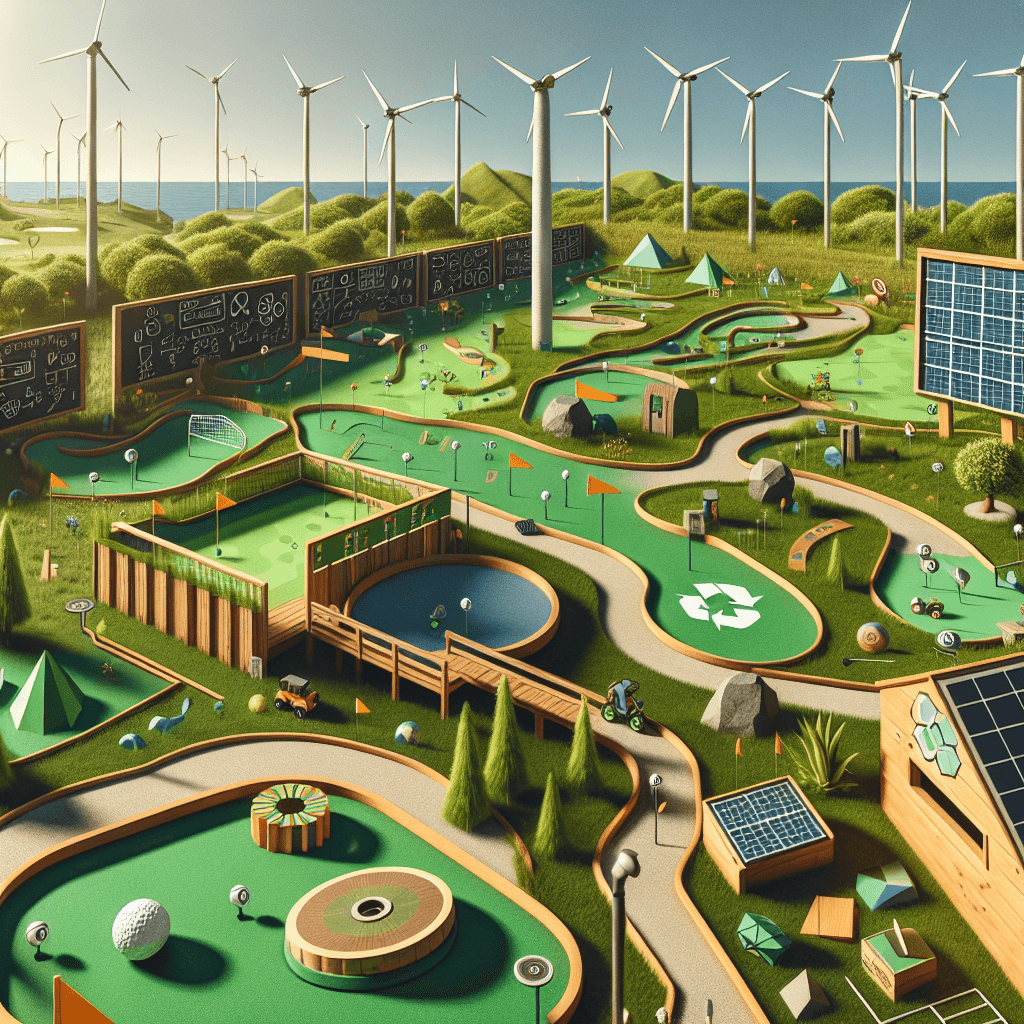
Eco-Friendly Mini-Golf Geometry
Inquiry Framework
Question Framework
Driving Question
The overarching question that guides the entire project.How can we apply geometric principles and measurements to design an innovative and eco-friendly mini-golf course that balances functionality, sustainability, and aesthetic appeal?Essential Questions
Supporting questions that break down major concepts.- What geometric principles can be used to design efficient and functional spaces?
- How can measurement and geometry contribute to sustainable design solutions?
- In what ways can eco-friendly considerations be integrated into recreational facility design?
- How does the choice of materials affect the sustainability and environmental impact of a design project?
- How can we use mathematics to solve real-world problems related to design and sustainability?
Standards & Learning Goals
Learning Goals
By the end of this project, students will be able to:- Students will apply geometric principles to design an efficient and functional mini-golf course layout.
- Students will calculate area, volume, and measurements relevant to the design of mini-golf course components.
- Students will integrate eco-friendly and sustainable practices into their design through material selection and use.
- Students will demonstrate an understanding of the relationship between geometric properties and sustainable design solutions.
- Students will solve real-world mathematical problems related to geometry and sustainability in a practical project.
Common Core Standards
Entry Events
Events that will be used to introduce the project to studentsEco-Architects for a Day
Introduce students to the challenge of becoming eco-architects tasked with designing a green mini-golf course within budget and environmental constraints. Provide them various real-world scenarios of pollution and climate change related to recreational designs to solve and present them with opportunities for inquiry into sustainable architecture practices.Portfolio Activities
Portfolio Activities
These activities progressively build towards your learning goals, with each submission contributing to the student's final portfolio.Geometric Exploration: Shape Scavenger Hunt
Start students on a geometric discovery journey by having them identify and categorize different shapes they might use in a mini-golf course. This will introduce them to basic geometric principles and get them thinking about how these shapes can be combined to create interesting obstacles and course designs.Steps
Here is some basic scaffolding to help students complete the activity.Final Product
What students will submit as the final product of the activityA shape inventory sheet that lists and categorizes geometric shapes found in real-world objects.Alignment
How this activity aligns with the learning objectives & standardsAligns with 8.G.A.1 by helping students understand basic properties of shapes used for transformations and design.Pythagorean Theorem Challenge: Optimizing Course Layout
Students will apply the Pythagorean Theorem to optimize the layout of their mini-golf course. This activity will involve creating right triangles to ensure efficient use of space and design functionality.Steps
Here is some basic scaffolding to help students complete the activity.Final Product
What students will submit as the final product of the activityA draft layout of a single hole, incorporating accurate measurements utilizing the Pythagorean Theorem.Alignment
How this activity aligns with the learning objectives & standardsMeets 8.G.B.7 by applying the Pythagorean Theorem in practical design scenarios.Environmental Impact Designer: Material Matters
In this activity, students will research and evaluate sustainable materials to use in their mini-golf course construction. This invites them to consider how material selection affects both design and environmental impact.Steps
Here is some basic scaffolding to help students complete the activity.Final Product
What students will submit as the final product of the activityA material proposal for the mini-golf course, detailing the selected sustainable materials and their benefits.Alignment
How this activity aligns with the learning objectives & standardsAligns with the learning goal of integrating eco-friendly practices, touching on sustainable design solutions.Transformative Design: Geometry in Motion
Students will explore how to use transformations, such as rotations and reflections, to create dynamic and visually appealing mini-golf course designs. They will experiment with moving and altering geometric shapes on graph paper.Steps
Here is some basic scaffolding to help students complete the activity.Final Product
What students will submit as the final product of the activityA series of mini-golf hole designs incorporating various transformations to enhance layout and appearance.Alignment
How this activity aligns with the learning objectives & standardsSupports 8.G.A.3 by helping students understand and apply transformations to design tasks.Volume Ventures: Calculating Obstacle Dimensions
In this activity, students use their knowledge of volume calculations to design and scale obstacles for their mini-golf course, applying the formulas for cones, cylinders, and spheres in real-world contexts.Steps
Here is some basic scaffolding to help students complete the activity.Final Product
What students will submit as the final product of the activityA detailed obstacle design with calculated dimensions using volume formulas.Alignment
How this activity aligns with the learning objectives & standardsFulfills 8.G.C.9 by applying volume calculations to design obstacles.Rubric & Reflection
Portfolio Rubric
Grading criteria for assessing the overall project portfolioEco-Friendly Mini-Golf Design Rubric
Geometric Understanding and Application
Assesses the student’s ability to apply geometric principles such as transformations and the Pythagorean Theorem in designing course layouts.Use of Geometric Shapes
Evaluates the student's ability to use geometric shapes effectively in their design, including understanding transformations and spatial efficiency.
Exemplary
4 PointsDemonstrates an advanced understanding and use of geometric shapes, showcasing sophisticated spatial efficiency and innovative transformation techniques to enhance the design's functionality and appeal.
Proficient
3 PointsDemonstrates a thorough understanding and application of geometric shapes and transformations, achieving solid spatial efficiency and design logic.
Developing
2 PointsShows a basic understanding of geometric shapes with limited application of transformations, resulting in inconsistent spatial use.
Beginning
1 PointsStruggles to apply geometric shapes and transformations, leading to poor spatial use and design inefficiencies.
Mathematical Calculations
Assesses accuracy in calculating areas, volumes, and side lengths using geometric formulas.
Exemplary
4 PointsUtilizes geometric formulas with high precision, calculating areas, volumes, and lengths accurately, demonstrating exceptional mathematical proficiency.
Proficient
3 PointsAccurately applies geometric formulas to calculate areas, volumes, and lengths, demonstrating consistent mathematical comprehension.
Developing
2 PointsApplies geometric formulas, though calculations show frequent errors or inconsistencies, indicating a need for further practice.
Beginning
1 PointsStruggles with applying geometric formulas accurately, resulting in numerous calculation errors.
Sustainability and Environmental Innovation
Evaluates the integration of sustainable practices in the design, focusing on materials selection and ecological impact.Material Selection
Considers the choice of materials in terms of sustainability, durability, cost, and environmental impact.
Exemplary
4 PointsSelects highly sustainable materials, providing detailed justification of choices based on environmental impact, durability, and cost-effectiveness.
Proficient
3 PointsChooses sustainable materials, offering justification based on positive environmental impact and practicality.
Developing
2 PointsChooses materials with some consideration of sustainability and environmental impact, with limited justification provided.
Beginning
1 PointsMakes material choices with little regard for sustainability or environmental impact, offering little to no justification.
Ecological Considerations
Evaluates how well the project integrates concepts of eco-friendliness and minimizes environmental impact.
Exemplary
4 PointsDemonstrates a comprehensive approach to integrating eco-friendly features throughout the design, clearly minimizing environmental impact while maximizing functionality.
Proficient
3 PointsIntegrates eco-friendly features effectively, maintaining a balance between ecological impact and design function.
Developing
2 PointsIncorporates some eco-friendly elements, although the integration is unbalanced or limited in scope.
Beginning
1 PointsIncludes few or no eco-friendly elements, with minimal consideration for environmental impact.
Project Presentation and Communication
Assesses how effectively students communicate and present their design ideas and rationale.Clarity and Organization
Evaluates the clarity of design description and overall organization of the presentation.
Exemplary
4 PointsPresents design ideas clearly and logically, with detailed organization and strong narrative that effectively conveys the design and thought process.
Proficient
3 PointsPresents design ideas clearly with logical organization and adequate explanation of design process.
Developing
2 PointsConveys design ideas with some clarity, though organization is inconsistent, leading to partial understanding of the design process.
Beginning
1 PointsPresentation is unclear and disorganized, hindering understanding of design ideas and process.
Visual and Aesthetic Quality
Assesses the visual appeal and creativity of the presented designs and layouts.
Exemplary
4 PointsDesigns are highly creative and visually compelling, demonstrating exceptional attention to detail and aesthetic quality.
Proficient
3 PointsDesigns are creative and visually appealing, showing good attention to detail.
Developing
2 PointsDesigns show some creativity and visual appeal, with room for enhancement in detail and aesthetics.
Beginning
1 PointsDesigns lack creativity and visual appeal, with minimal attention to detail and aesthetics.