
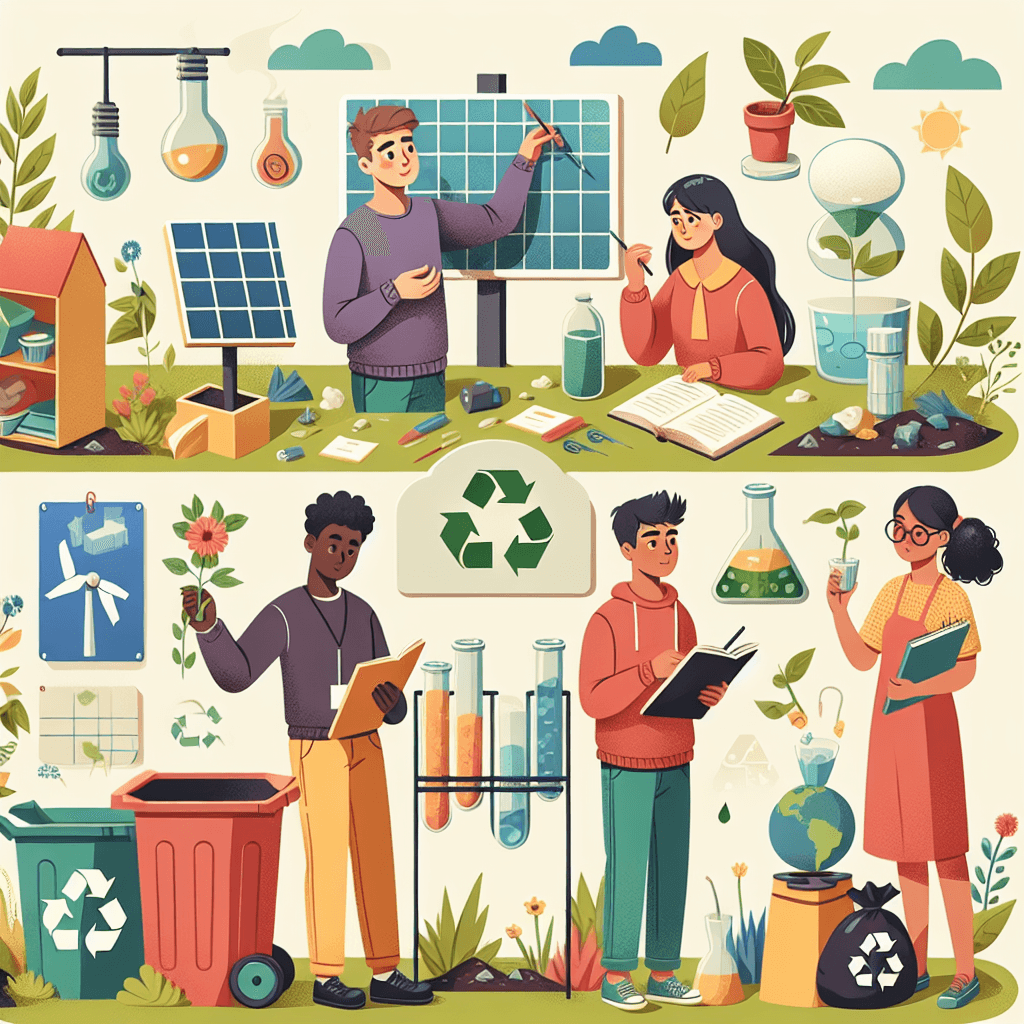
Eco-Innovators: Designing Sustainable Solutions for Environmental Challenges
Inquiry Framework
Question Framework
Driving Question
The overarching question that guides the entire project.What can we do with our community’s "dead" tech to stop toxic waste from poisoning our local land and water, while still making sure everyone can afford the devices they need?Essential Questions
Supporting questions that break down major concepts.- What actually happens to our soil and water when an old phone or laptop starts to "rot" in a landfill?
- Why are we throwing away so much more electronics than we used to, and what's hidden inside them that makes them so dangerous?
- How do we balance the high cost of recycling e-waste against the long-term cost of damaging our health and our planet?
- How can we use the engineering design process to build a system that makes it easy and "cool" for our neighbors to dispose of their electronics safely?
- If we fix the e-waste problem in our town, how do we make sure we aren't just shipping our trash—and its problems—to someone else's backyard?
Standards & Learning Goals
Learning Goals
By the end of this project, students will be able to:- Analyze and model how specific human activities disrupt the cycling of matter and flow of energy within a local ecosystem.
- Apply the Engineering Design Process to research, design, and prototype a solution to a local environmental challenge.
- Evaluate the viability of an environmental solution using the 'Triple Bottom Line' framework (environmental health, economic cost, and social impact).
- Communicate a data-driven proposal to community stakeholders that addresses potential trade-offs and unintended consequences of a sustainable intervention.
- Identify and justify the selection of materials and methods based on their sustainability and impact on the local community.
Next Generation Science Standards (NGSS)
Common Core State Standards (ELA/Science & Technical Subjects)
Entry Events
Events that will be used to introduce the project to studentsThe Tech Graveyard: E-Waste Forensics
A 'crime scene' of discarded smartphones, consoles, and batteries is cordoned off, accompanied by a mock report about heavy metals leaking into the local water table. Students must investigate the chemical composition of e-waste and propose a radical plan for 'urban mining' to recover resources rather than dumping them.Portfolio Activities
Portfolio Activities
These activities progressively build towards your learning goals, with each submission contributing to the student's final portfolio.The Blueprint of Constraints: Defining Success
Before building a solution, students must understand the 'Triple Bottom Line': Environmental Health, Economic Cost, and Social Equity. In this activity, students define the 'Rules of the Game' for their community e-waste solution. They will interview 'stakeholders' (peers or community members) to determine why people don't currently recycle tech and what would make it easier, cheaper, or 'cooler' to do so.Steps
Here is some basic scaffolding to help students complete the activity.Final Product
What students will submit as the final product of the activityA 'Design Criteria & Constraints Matrix' that outlines the specific requirements the final solution must meet to be successful for the community.Alignment
How this activity aligns with the learning objectives & standardsAligns with MS-ETS1-1, requiring students to define the criteria and constraints of a design problem, including human and environmental impacts. It also touches on the Triple Bottom Line learning goal.Urban Miners: Prototyping the Future
Students now move into the 'Urban Mining' phase, where they design a system, service, or device to recover e-waste resources or prevent dumping. This could be a community 'Repair Cafe' model, a localized 'Tech-Mining' bin, or a digital app for device swapping. After sketching their own, they will participate in a 'Critical Friends' gallery walk to evaluate each other's designs using a systematic scoring rubric based on their previously defined criteria.Steps
Here is some basic scaffolding to help students complete the activity.Final Product
What students will submit as the final product of the activityA Prototype Sketch or 3D Model accompanied by a 'Trade-Off Report' explaining why certain design choices were made over others.Alignment
How this activity aligns with the learning objectives & standardsAligns with MS-ETS1-2 (evaluating competing solutions) and MS-LS2-5 (evaluating solutions for maintaining ecosystem services). Students must use a systematic process to compare designs.The Sustainable Tech Summit: Pitching for the Planet
In the final phase, students prepare a 'Pitch for Change.' They must convince a panel of 'Community Stakeholders' (teachers, local leaders, or parents) that their solution is the most viable. They must specifically address the 'Global Connection': how their local solution prevents 'Toxic Trade'—the practice of shipping waste to developing nations. This activity synthesizes all their research, design, and evaluation into a persuasive call to action.Steps
Here is some basic scaffolding to help students complete the activity.Final Product
What students will submit as the final product of the activityA 'Sustainable Tech Proposal' (Presentation or Video) that includes the data-backed solution, a budget estimate, and an analysis of unintended consequences.Alignment
How this activity aligns with the learning objectives & standardsAligns with MS-ESS3-3 (designing a method for minimizing human impact) and the learning goal of communicating a data-driven proposal to stakeholders.The Toxic Trace: E-Waste Forensics
Following the 'Tech Graveyard' entry event, students act as forensic scientists to investigate what is actually inside their electronics. They will research specific heavy metals (like lead, mercury, and cadmium) found in common devices and map out the 'seepage path'—how these chemicals move from a landfill into the local groundwater and soil, affecting the cycling of matter in the ecosystem.Steps
Here is some basic scaffolding to help students complete the activity.Final Product
What students will submit as the final product of the activityA 'Chemical Profile & Seepage Map' (digital or physical) that identifies three toxic components of e-waste, their health/environmental risks, and a diagram of their movement through a local watershed.Alignment
How this activity aligns with the learning objectives & standardsThis activity aligns with MS-ESS3-3 by having students apply scientific principles to understand human impact on the environment and CCSS.ELA-LITERACY.RST.6-8.1 as students must gather and cite information from digital and print sources regarding chemical toxicity.Rubric & Reflection
Portfolio Rubric
Grading criteria for assessing the overall project portfolioThe Sustainable Tech & Urban Mining Portfolio Rubric
Scientific Investigation & Modeling
Evaluates the student's ability to act as a 'forensic scientist' by researching chemical toxicity and modeling the path of e-waste through local environmental systems.Scientific Modeling of Ecosystem Impact
The ability to research and model how toxic substances from electronics move through local ecosystems and affect the cycling of matter.
Exemplary
4 PointsDevelops a highly detailed and accurate seepage map that predicts complex chemical interactions and potential long-term ecological shifts. Evidence is backed by extensive, high-quality research on chemical properties.
Proficient
3 PointsCreates a clear and accurate seepage map showing the path of three toxins through the watershed. Accurately identifies chemical properties and their impact on soil/water.
Developing
2 PointsProvides a basic map of toxin movement, but may lack detail in the path of 'seepage' or contain minor inaccuracies regarding chemical properties.
Beginning
1 PointsAttempts to identify toxins, but the map is incomplete or fails to show a clear movement through the ecosystem. Research is minimal or incorrect.
Research & Evidence Integration
Effectiveness in using multiple digital and print sources to investigate e-waste and the ability to cite these sources using standard formatting.
Exemplary
4 PointsIntegrates diverse, high-credibility sources seamlessly into the investigation. Citations are flawlessly formatted, and information is synthesised to provide deep insight.
Proficient
3 PointsGathers relevant information from multiple sources with effective search terms. Correctly quotes/paraphrases and follows a standard citation format.
Developing
2 PointsUses limited sources or struggles to assess source credibility. Citations may be present but contain formatting errors or lack detail.
Beginning
1 PointsRelies on insufficient or unreliable sources. Citations are missing or do not follow a standard format.
Engineering Definition & Human Impact
Assesses how well students define the scope of the problem by engaging with stakeholders and establishing clear, science-based parameters for their designs.Needs Assessment & Data Analysis
The ability to design and execute a research tool (survey/interview) to identify community barriers and analyze that data to find constraints.
Exemplary
4 PointsAnalysis of data reveals subtle, intersectional barriers. Data is presented with sophisticated visualizations and a deep understanding of community nuances.
Proficient
3 PointsDevelops an effective 5-question tool and identifies three clear constraints based on data analysis (e.g., cost, access, privacy).
Developing
2 PointsSurvey questions are basic or data analysis is superficial. Only one or two major constraints are clearly identified from the data.
Beginning
1 PointsSurvey is poorly designed or data is not analyzed. Constraints are listed without a clear connection to evidence or community input.
Criteria & Constraints Definition
The precision in defining what a 'successful' solution looks like, specifically incorporating the 'Triple Bottom Line' (Environmental, Economic, and Social).
Exemplary
4 PointsCriteria are exceptionally precise and measurable. Demonstrates a sophisticated balance between competing Triple Bottom Line priorities with innovative success metrics.
Proficient
3 PointsClearly defines success criteria and constraints including cost, accessibility, and environmental health within a Design Brief.
Developing
2 PointsDefines some criteria, but they may be vague or fail to address one of the Triple Bottom Line pillars (e.g., misses social equity).
Beginning
1 PointsCriteria are too broad or irrelevant to the specific problem of e-waste. Fails to define clear constraints.
Sustainable Innovation & Prototyping
Evaluates the engineering phase where students move from concepts to tangible solutions, including peer critique and the analysis of competing design requirements.Prototype Design & Viability
The quality and viability of the proposed e-waste solution (system, service, or device) and the detail provided in the prototype sketch or model.
Exemplary
4 PointsPrototype is highly innovative and meticulously detailed. The model clearly demonstrates how the solution functions to maximize ecosystem services and community benefit.
Proficient
3 PointsCreates a detailed, labeled prototype sketch or 3D model that directly addresses the defined constraints and criteria.
Developing
2 PointsThe prototype addresses the problem but lacks detail in labeling or does not fully account for the established success criteria.
Beginning
1 PointsThe design is generic, lacks labels, or does not logically solve the identified community e-waste problem.
Systematic Evaluation & Trade-offs
The ability to evaluate design choices and peer solutions using a systematic process, specifically identifying the 'trade-offs' between different goals.
Exemplary
4 PointsProvides a profound reflection on trade-offs, demonstrating a high-level understanding of how improving one factor (e.g., cost) impacts another (e.g., environmental safety). Peer reviews are insightful.
Proficient
3 PointsUses a systematic rubric to evaluate peer work and writes a clear report on design trade-offs, justifying choices with scientific principles.
Developing
2 PointsEvaluation of peer work is perfunctory. Reflection on trade-offs is present but may be simplistic or lack specific evidence from the design process.
Beginning
1 PointsFails to provide a systematic evaluation. Reflection on trade-offs is missing or does not acknowledge the difficulty of balancing competing needs.
Communication & Global Citizenship
Focuses on the communication of the final proposal, looking at the student's ability to persuade stakeholders and connect local solutions to global environmental justice.Data-Driven Stakeholder Communication
The ability to synthesize research and design into a persuasive proposal that addresses stakeholder concerns and unintended consequences.
Exemplary
4 PointsProposal is exceptionally professional and persuasive. Anticipates complex stakeholder questions and provides data-driven mitigation strategies for unintended consequences.
Proficient
3 PointsDelivers a cohesive presentation that highlights Triple Bottom Line benefits and identifies at least one unintended consequence with a plan to monitor it.
Developing
2 PointsPresentation is clear but lacks a cohesive narrative. Mention of unintended consequences is brief or lacks a realistic monitoring plan.
Beginning
1 PointsPresentation is disorganized or lacks data-backed arguments. Fails to address potential negative impacts of the solution.
Global Context & Ethical Responsibility
The depth of understanding regarding the connection between local actions and global 'Toxic Trade' issues.
Exemplary
4 PointsProvides a compelling argument for how the local solution serves as a model for global justice, preventing the exploitation of other regions with high sophistication.
Proficient
3 PointsClearly explains how the local solution prevents shipping waste to other communities ('Toxic Trade') and justifies the global importance of the work.
Developing
2 PointsMentions global connections or 'Toxic Trade,' but the link between the local solution and the global problem is weak or underdeveloped.
Beginning
1 PointsLacks any mention of the global context or 'Toxic Trade.' Fails to see the impact of the solution beyond the immediate local community.