
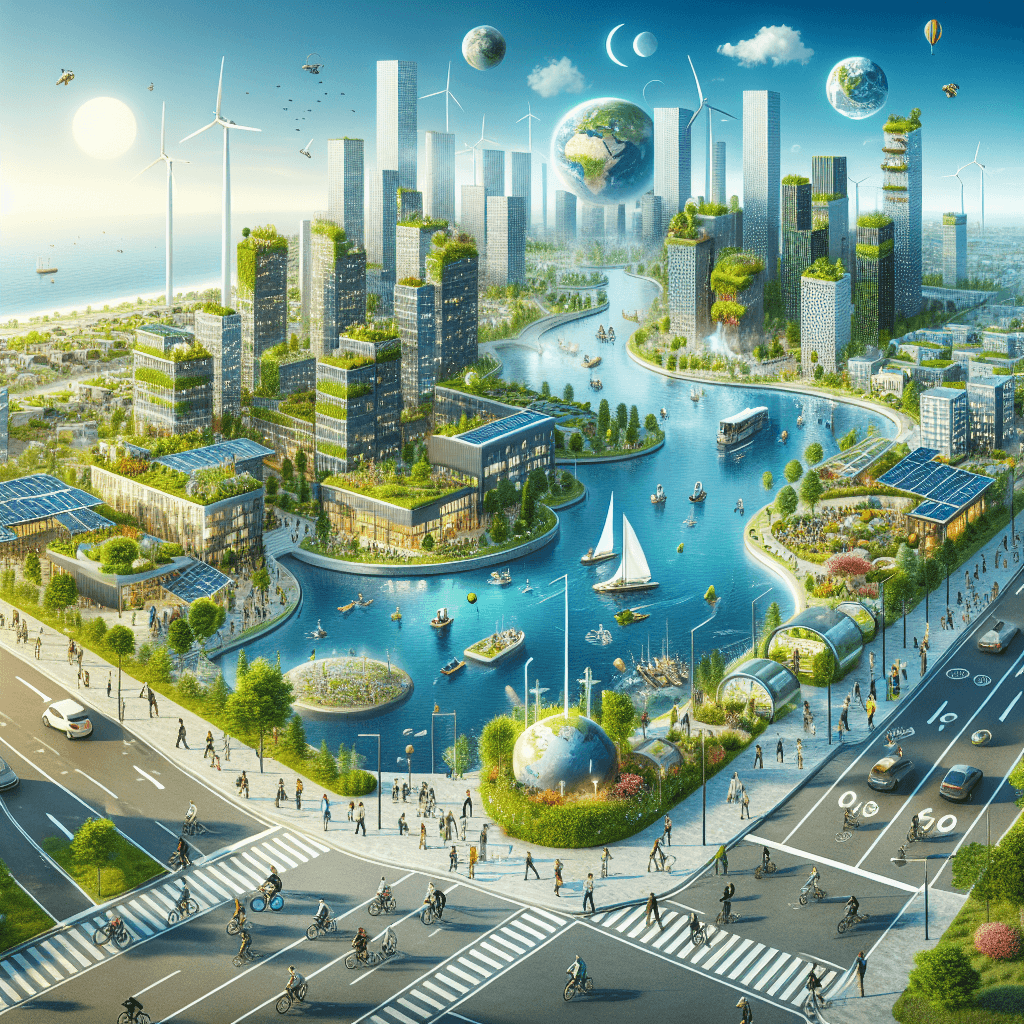
Eco-Tycoon: Building a Sustainable Circular City
Inquiry Framework
Question Framework
Driving Question
The overarching question that guides the entire project.How can we design and code a 'Circular City' tycoon game that uses mathematical modeling and visual data to demonstrate how a transition to a circular economy can balance urban growth with the preservation of biodiversity?Essential Questions
Supporting questions that break down major concepts.- How can we use game mechanics and data-driven algorithms to model a city where economic growth and environmental health exist in harmony?
- In what ways does the transition from a 'linear' economy to a 'circular' economy impact a city's biodiversity and resource management?
- How can we design a user interface and visual assets that effectively communicate complex environmental data to players?
- How do mathematical ratios and percentages help us balance competing variables like budget, waste production, and species preservation in a simulation?
- How can we code game logic to simulate the real-world consequences of human activity on an ecosystem over time?
Standards & Learning Goals
Learning Goals
By the end of this project, students will be able to:- Design and program a functional tycoon-style simulation that models the relationship between urban development, waste management, and biodiversity metrics.
- Analyze and differentiate between linear and circular economic systems by applying their principles to game mechanics.
- Apply proportional reasoning, ratios, and percentages to balance game variables and simulate realistic economic and environmental feedback loops.
- Construct visual data representations and user interface (UI) elements that effectively communicate scientific and mathematical data to players.
- Evaluate the impact of human-designed systems on ecosystems by coding logic that simulates long-term environmental consequences.
Next Generation Science Standards (NGSS)
Common Core State Standards - Mathematics
CSTA K-12 Computer Science Standards
ISTE Standards for Students
Common Core State Standards - Mathematical Practice
Entry Events
Events that will be used to introduce the project to studentsThe 2075 Black Box
Students discover a 'black box' from a future city that collapsed due to resource depletion. Inside are encrypted data files (math problems), 3D artifacts of extinct species, and a desperate audio plea for a new design paradigm to save their timeline.The Billionaire’s Dilemma
A charismatic (simulated) billionaire offers the class $1 billion to design a city, but with a catch: for every 1% growth in GDP, they must prove a 1% increase in local biodiversity. Students must use technology and data to pitch their first 'Green Growth' prototype to stay in the running for the contract.The Workspace Congestion Crisis
Students are given 15 minutes to 'build' a business using blocks, but for every profit milestone, they must add 'waste' blocks that take up floor space. They quickly realize that without a circular system, their growth literally traps them, sparking a debate on how to turn waste into resource.Portfolio Activities
Portfolio Activities
These activities progressively build towards your learning goals, with each submission contributing to the student's final portfolio.The 'Cycle of Life' System Blueprint
Before coding, students must understand the math and science of a circular economy. In this activity, students compare a 'Linear City' (Take-Make-Waste) to a 'Circular City' (Reduce-Reuse-Recycle). They will calculate resource consumption rates and waste generation percentages to create a mathematical 'Resource Flow' diagram that serves as the foundation for their game mechanics.Steps
Here is some basic scaffolding to help students complete the activity.Final Product
What students will submit as the final product of the activityA 'System Blueprint' infographic that includes calculated ratios of waste-to-resource conversion and a visual flow of materials within their proposed city.Alignment
How this activity aligns with the learning objectives & standardsThis activity aligns with CCSS.Math.Content.7.RP.A.3 (using proportional relationships to solve ratio and percent problems) and NGSS MS-ESS3-3 (applying scientific principles to minimize human impact). Students must use math to model the environmental shift from linear to circular systems.Algorithm Architects: Mapping the City Brain
Students will design the 'brain' of their Eco-Tycoon game. They will create logical pathways that determine how the game responds to player choices. For example: 'IF player builds a factory, THEN GDP increases by 5% AND Biodiversity decreases by 2% UNLESS a Carbon Filter is researched.' This scaffolding ensures students understand the cause-and-effect relationships in ecosystem management.Steps
Here is some basic scaffolding to help students complete the activity.Final Product
What students will submit as the final product of the activityA comprehensive 'Logic Flowchart' or pseudocode document that maps out the primary gameplay loop and the environmental feedback systems.Alignment
How this activity aligns with the learning objectives & standardsThis activity aligns with CSTA 2-AP-10 (using flowcharts and pseudocode to address complex problems as algorithms). It requires students to translate environmental interactions into logical sequences for game development.The Data Dashboard & Species Catalog
In this activity, students shift to the visual and user-experience (UX) side of the project. They will design the 'Biodiversity Dashboard'—the part of the game screen that tells the player how healthy their ecosystem is. They will also create 'Species Sprites' that represent the biodiversity metrics in the game, ensuring that the visual art changes based on the data (e.g., plants wilting if waste is high).Steps
Here is some basic scaffolding to help students complete the activity.Final Product
What students will submit as the final product of the activityA 'Digital Asset Portfolio' containing a User Interface (UI) mockup and a set of three evolution states for a local species (Healthy, Threatened, Extinct).Alignment
How this activity aligns with the learning objectives & standardsThis activity aligns with ISTE 1.6.b (creating original works or repurposing digital resources) and NGSS MS-LS2-5 (evaluating design solutions for maintaining biodiversity). It focuses on the visual communication of scientific data.The Eco-Tycoon Engine Build
Students integrate their mathematical models, logical flowcharts, and visual assets into a functional game prototype (using tools like Scratch, MakeCode, or a paper-based simulation). They must demonstrate that their game accurately models the 'Circular City' goals: as the player implements circular strategies, the game's math should show a stabilizing effect on biodiversity despite economic growth.Steps
Here is some basic scaffolding to help students complete the activity.Final Product
What students will submit as the final product of the activityA playable 'Eco-Tycoon' prototype (digital or high-fidelity physical) accompanied by a 'Developer’s Log' explaining the math and science behind the game's balance.Alignment
How this activity aligns with the learning objectives & standardsThis activity aligns with CCSS.Math.Practice.MP.4 (model with mathematics) and NGSS MS-LS2-5 (evaluating design solutions). It serves as the synthesis of all previous work into a functional prototype.Rubric & Reflection
Portfolio Rubric
Grading criteria for assessing the overall project portfolioEco-Tycoon: Circular City Mastery Rubric
Scientific & Mathematical Foundation
Focuses on the integration of environmental science principles and mathematical accuracy in modeling the 'Circular City'.Ecological Systems Design
Evaluates the student's ability to model and justify design solutions that maintain biodiversity while transitioning from a linear to a circular economy.
Exemplary
4 PointsDemonstrates a sophisticated understanding of circular systems; the blueprint includes innovative resource loops (e.g., cross-industry synergy) and provides a comprehensive, evidence-based evaluation of how these solutions preserve biodiversity and ecosystem services.
Proficient
3 PointsDemonstrates a thorough understanding of circular systems; clearly distinguishes between linear and circular models and provides clear evidence of how circular strategies minimize human impact on the environment.
Developing
2 PointsShows an emerging understanding of circular systems; distinguishes between linear and circular models but application to biodiversity preservation is inconsistent or lacks specific scientific detail.
Beginning
1 PointsShows initial understanding of economic systems; struggles to define the difference between linear and circular models or provide a clear method for minimizing human impact.
Mathematical Modeling & Proportional Reasoning
Assesses the student's ability to use proportional relationships, ratios, and percentages to balance game variables such as budget, waste, and population growth.
Exemplary
4 PointsApplies complex mathematical modeling with precise multi-step ratio and percent calculations; the mathematical model accounts for sophisticated feedback loops and accurately predicts game outcomes across various scenarios.
Proficient
3 PointsAccurately uses proportional relationships to solve multi-step ratio and percent problems; mathematical modeling effectively balances budget, waste production, and species preservation within the game mechanics.
Developing
2 PointsApplies proportional reasoning inconsistently; some errors in ratio or percent calculations exist, leading to a basic or slightly imbalanced mathematical model of the city system.
Beginning
1 PointsStruggles with basic ratio and percent calculations; mathematical model is incomplete or fails to realistically simulate the relationship between urban growth and waste.
Computational Thinking & Digital Design
Assesses the technical execution of the game's logic and the clarity of its visual interface for data communication.Algorithmic Logic & Flowcharting
Measures the student's ability to design logical pathways and algorithms that simulate environmental consequences using flowcharts and pseudocode.
Exemplary
4 PointsDesigns sophisticated, branching algorithms using complex 'If-Then' logic and detailed flowcharts that address multiple game states and nuanced environmental feedback loops; logic is highly efficient.
Proficient
3 PointsUses flowcharts and pseudocode effectively to map out the primary gameplay loop; logic clearly demonstrates cause-and-effect relationships between human activity and ecosystem response.
Developing
2 PointsCreates basic flowcharts or pseudocode that show partial logical sequences; cause-and-effect relationships are present but may contain gaps or oversimplifications in the algorithm.
Beginning
1 PointsFlowcharts or pseudocode are incomplete or illogical; struggles to translate environmental interactions into a functional sequence of game events.
Visual Communication & UI Design
Evaluates the creation of original digital assets and a user interface (UI) that effectively communicates complex environmental and mathematical data to the player.
Exemplary
4 PointsCreates professional-quality digital assets and an intuitive HUD; data justification shows an advanced understanding of color theory and semiotics in communicating scientific data to the user.
Proficient
3 PointsProduces clear, original digital assets and a functional UI; use of gauges and icons effectively communicates Biodiversity, Waste, and Budget data to the player.
Developing
2 PointsProduces basic UI elements and assets; visual representation of data is present but may be confusing or lack consistency in how it communicates environmental health.
Beginning
1 PointsVisual assets are incomplete or fail to communicate data; the UI does not provide clear feedback to the player regarding the state of the city's ecosystem.
Synthesis & Portfolio Completion
Focuses on the final integration of the game engine and the student's ability to reflect on their design as a solution to a problem.Iterative Synthesis & Reflection
Assesses the final synthesis of all components into a functional prototype and the reflective justification provided in the Developer's Log.
Exemplary
4 PointsProduces an outstanding prototype that is perfectly balanced and highly engaging; the Developer's Log provides a profound metacognitive analysis of the design's impact on biodiversity and the math behind its success.
Proficient
3 PointsProduces a functional, playable prototype that accurately models circular economy goals; the Developer's Log provides a clear justification for design choices linked to science and math standards.
Developing
2 PointsProduces a partially functional prototype with basic system balance; the Developer's Log is present but lacks deep connection between game mechanics and the underlying academic standards.
Beginning
1 PointsPrototype is non-functional or fails to model the intended concepts; the Developer's Log is missing or does not explain the reasoning behind the game's design.