
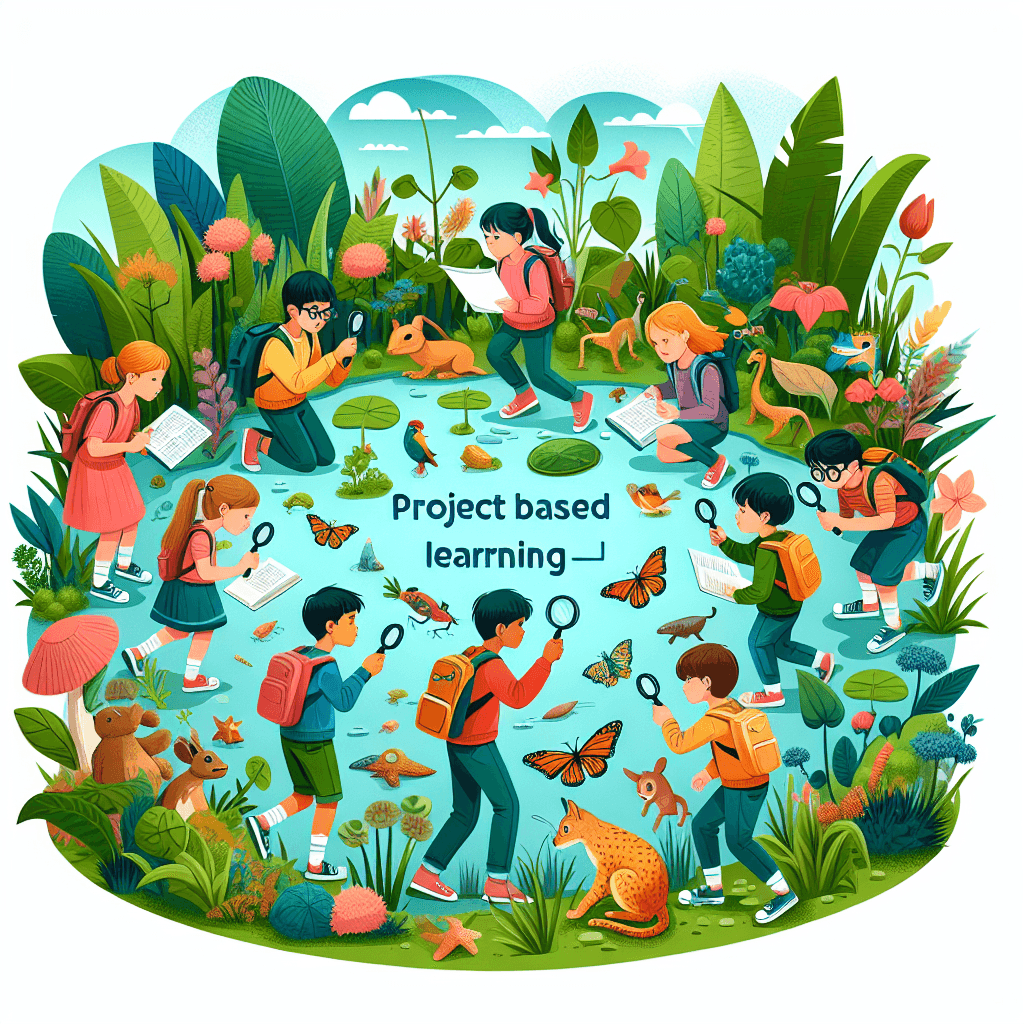
Ecosystem Explorers
Inquiry Framework
Question Framework
Driving Question
The overarching question that guides the entire project.How do the different parts of an ecosystem interact and what roles do they play in helping plants and animals survive?Essential Questions
Supporting questions that break down major concepts.- What are the main parts of an ecosystem?
- How can we tell if something is living or nonliving?
- Why do plants and animals need each other to survive?
- What patterns do we notice in the way living things meet their needs?
- How do living things impact their surroundings?
Standards & Learning Goals
Learning Goals
By the end of this project, students will be able to:- Identify and describe the main components of an ecosystem (plants, animals, nonliving things).
- Differentiate between living and nonliving things using observable characteristics.
- Explain how plants and animals depend on each other for survival in an ecosystem.
- Recognize patterns in the ways living things meet their needs within their environments.
- Conduct simple investigations to observe and document findings on local ecosystems.
NGSS
Entry Events
Events that will be used to introduce the project to studentsEcosystem Adventure Kickoff
Transform the classroom into different mini ecosystems (e.g., forest, desert, ocean) with sounds and visuals. Invite students on an exploratory mission to observe and report the different plants and animals they discover in each ecosystem, fostering initial questions about these environments.Mystery Animal Arrival
Introduce a 'mystery box' with items and clues related to an animal or plant from a local ecosystem. Challenge students to use the clues to infer what living thing it belongs to, promoting curiosity and inquiry about local biodiversity.Nature Walk & Discovery Day
Organize a special walking field trip around the school where students are equipped with magnifying glasses and binoculars to closely observe and document local plant and animal life, sharing discoveries with the class afterward.Portfolio Activities
Portfolio Activities
These activities progressively build towards your learning goals, with each submission contributing to the student's final portfolio.Ecosystem Explorers: Scavenger Hunt
In this introductory activity, students will go on a nature walk around the school to observe and document living and nonliving things. Using magnifying glasses and binoculars, they will explore different habitats and record their findings.Steps
Here is some basic scaffolding to help students complete the activity.Final Product
What students will submit as the final product of the activityA class chart categorizing living and nonliving things observed during the walk and student-created drawings of their favorite discovery.Alignment
How this activity aligns with the learning objectives & standardsAligns with K-LS1-1 by using observations to describe patterns needed for survival and SEP for planning and carrying out investigations.Mystery Box Biodiversity Investigation
Students investigate a mystery box containing clues about a local plant or animal. This activity encourages them to use critical thinking and inquiry skills to make predictions.Steps
Here is some basic scaffolding to help students complete the activity.Final Product
What students will submit as the final product of the activityA class discussion and student journals documenting predictions and the real identity of the mystery living thing.Alignment
How this activity aligns with the learning objectives & standardsSupports CCC: Patterns and SEP by promoting inquiry and pattern recognition in ecosystems.Pattern Detectives: Ecosystem Interactions
Students will learn about how plants and animals interact within ecosystems through observational activities and group discussions. They will identify patterns in these interactions.Steps
Here is some basic scaffolding to help students complete the activity.Final Product
What students will submit as the final product of the activityVisual illustrations showing ecosystem interactions with captions describing the observed patterns.Alignment
How this activity aligns with the learning objectives & standardsAligns with DCI: LS1.C and CCC: Patterns by recognizing patterns and understanding energy flow in ecosystems.Create Your Own Mini Ecosystem
Students will apply their knowledge by creating a mini ecosystem in a jar, demonstrating their understanding of ecosystem components and interactions.Steps
Here is some basic scaffolding to help students complete the activity.Final Product
What students will submit as the final product of the activityA jar-based mini ecosystem with labeled components and observation journal entries.Alignment
How this activity aligns with the learning objectives & standardsFocuses on K-LS1-1 and DCI: LS1.C by using observations to understand how ecosystems support life.Ecosystem Presentation Preparation
In this culminating activity, students will synthesize their learning by preparing a presentation on their findings, including their mini ecosystems.Steps
Here is some basic scaffolding to help students complete the activity.Final Product
What students will submit as the final product of the activityClassroom presentations with visuals and verbal explanations of ecosystem interactions and components.Alignment
How this activity aligns with the learning objectives & standardsEncourages the synthesis of learning goals, aligned with K-LS1-1 and SEP by presenting observations and investigations.Rubric & Reflection
Portfolio Rubric
Grading criteria for assessing the overall project portfolioEcosystem Explorers Assessment Rubric
Observation and Inquiry Skills
Assesses the student's ability to observe, document, and differentiate between living and nonliving components of an ecosystem.Observational Accuracy
Measures how accurately the student documents their observations of living and nonliving things during activities.
Exemplary
4 PointsClearly and accurately documents a wide range of observations with detailed descriptions distinguishing living from nonliving things.
Proficient
3 PointsAccurately documents observations with clear distinctions between living and nonliving things.
Developing
2 PointsDocuments observations with some accuracy but requires support to distinguish certain features of living and nonliving.
Beginning
1 PointsStruggles to accurately document observations, showing minimal distinction between living and nonliving things.
Inquiry Question Engagement
Assesses the student's ability to ask questions and make inferences based on observations and evidence.
Exemplary
4 PointsAsks insightful questions and makes strong inferences, well-connected to observed evidence and ecosystem roles.
Proficient
3 PointsPoses relevant questions and makes reasonable inferences related to observed evidence.
Developing
2 PointsPoses basic questions and makes inferences with moderate connection to observed evidence.
Beginning
1 PointsStruggles to ask relevant questions or make inferences, showing minimal connection to observations.
Communication and Presentation Skills
Assesses the student's ability to communicate their observations and findings effectively through discussions and presentations.Clarity of Communication
Evaluates how clearly the student expresses and communicates their findings and understanding of ecosystem interactions.
Exemplary
4 PointsCommunicates observations and ecosystem insights clearly and confidently, using descriptive language and visual aids effectively.
Proficient
3 PointsCommunicates observations and findings comprehensively with adequate use of visual aids.
Developing
2 PointsCommunicates observations with some clarity; limited use of descriptive language and visuals.
Beginning
1 PointsStruggles to clearly communicate observations and findings, with minimal use of descriptive language or visuals.