
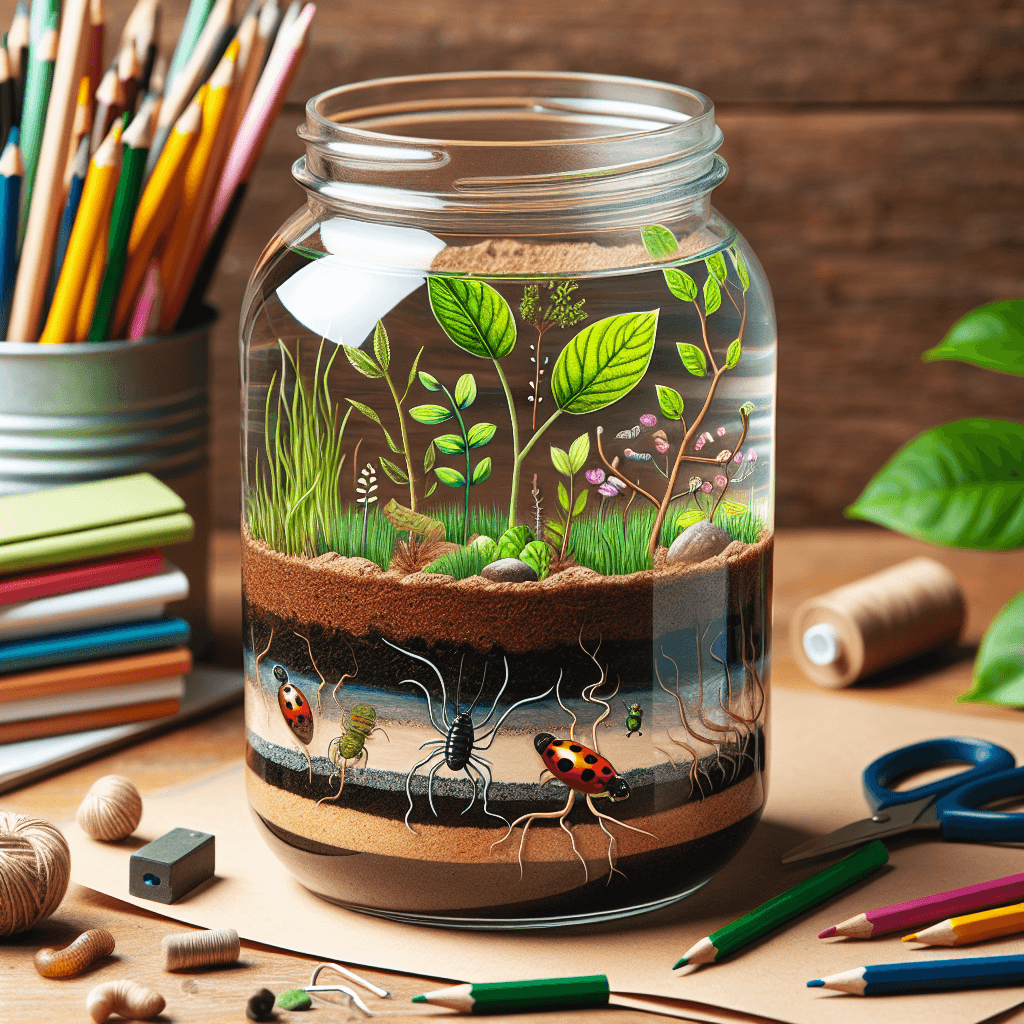
Ecosystem in a Jar: A First Grade Design Challenge
Inquiry Framework
Question Framework
Driving Question
The overarching question that guides the entire project.How can we design a balanced ecosystem in a jar where plants and animals depend on each other to survive using sun, water, and air?Essential Questions
Supporting questions that break down major concepts.- How do plants and animals depend on each other in a jar?
- What do plants need to grow in a jar ecosystem?
- What do animals need to survive in a jar ecosystem?
- How does the sun help plants and animals in the jar?
- What is the role of water and air in the jar ecosystem?
- How can we build a balanced ecosystem in a jar?
Standards & Learning Goals
Learning Goals
By the end of this project, students will be able to:- Students will design a balanced ecosystem in a jar.
- Students will identify the interdependence of plants and animals.
- Students will explain the roles of sun, water, and air in an ecosystem.
- Students will investigate the needs of living things for survival.
PA STEELS
WIDA ELD
NGSS
Entry Events
Events that will be used to introduce the project to studentsMystery Jars
A local environmental scientist brings in various sealed jars, some thriving ecosystems and some failing. Students observe, record differences, and brainstorm factors that could cause the different outcomes, connecting it to their upcoming jar ecosystem design.Portfolio Activities
Portfolio Activities
These activities progressively build towards your learning goals, with each submission contributing to the student's final portfolio.Ecosystem Essentials: Design Blueprint
Students will brainstorm and create a list of necessary components (biotic and abiotic) for their jar ecosystem, focusing on the roles of sun, water, and air. They will draw and label each component.Steps
Here is some basic scaffolding to help students complete the activity.Final Product
What students will submit as the final product of the activityA labeled drawing of the jar ecosystem components with brief descriptions of each component's role.Alignment
How this activity aligns with the learning objectives & standardsPA STEEL Standard 3.1.1.A (dependence on sun's energy, water, air); WIDA ELD Standard 4 (INFORM - describing components)Material Mania: Ecosystem Collection
Students will collect materials for their jar ecosystem, ensuring they include elements to represent the sun's energy, water, air, and living space. They will write a short paragraph describing why each item is essential.Steps
Here is some basic scaffolding to help students complete the activity.Final Product
What students will submit as the final product of the activityA collection of ecosystem materials and a paragraph explaining the importance of each item to the survival of organisms in the jar.Alignment
How this activity aligns with the learning objectives & standardsPA STEEL Standard 3.1.1.A (dependence on sun's energy, water, air); WIDA ELD Standard 4 (INFORM - explaining functions)Ecosystem Explorers: Observation Station
Students will construct their jar ecosystems and observe the interactions between the components over time. They will record their observations in a science journal, noting any changes or dependencies they observe.Steps
Here is some basic scaffolding to help students complete the activity.Final Product
What students will submit as the final product of the activityA science journal with daily observations of the jar ecosystem, including drawings and written descriptions of changes and interactions.Alignment
How this activity aligns with the learning objectives & standardsPA STEEL Standard 3.1.1.A (interdependence of organisms); WIDA ELD Standard 4 (EXPLAIN - cause and effect)Ecosystem Exhibition: Presentation Showcase
Students will present their jar ecosystems to the class, explaining the components, their roles, and any observations they have made about the interdependence of organisms. They will discuss how their ecosystem provides living space and shelter.Steps
Here is some basic scaffolding to help students complete the activity.Final Product
What students will submit as the final product of the activityA presentation of the jar ecosystem to the class, including a verbal explanation of the components, their roles, and observations.Alignment
How this activity aligns with the learning objectives & standardsPA STEEL Standard 3.1.1.A (living space, shelter); WIDA ELD Standard 4 (INFORM - presentation of findings)Rubric & Reflection
Portfolio Rubric
Grading criteria for assessing the overall project portfolioEcosystem in a Jar Rubric
Design Blueprint
Focuses on the clarity, accuracy, and completeness of the design blueprint, including the drawing and explanations.Drawing Accuracy and Completeness
Accuracy and completeness of the drawing of the ecosystem components.
Exemplary
4 PointsDrawing is exceptionally detailed, accurate, and includes all necessary components with precise labels and insightful descriptions.
Proficient
3 PointsDrawing is detailed, accurate, and includes most necessary components with clear labels and descriptions.
Developing
2 PointsDrawing includes some components but lacks detail, accuracy, and/or clear labels and descriptions.
Beginning
1 PointsDrawing is incomplete, inaccurate, and lacks necessary components, labels, and descriptions.
Explanation of Component Roles
Clarity and correctness of the sentences explaining the role of each component in the ecosystem.
Exemplary
4 PointsSentences are exceptionally clear, accurate, and demonstrate a deep understanding of each component's role.
Proficient
3 PointsSentences are clear, accurate, and demonstrate a good understanding of each component's role.
Developing
2 PointsSentences are somewhat unclear, contain minor inaccuracies, and/or demonstrate a basic understanding of each component's role.
Beginning
1 PointsSentences are unclear, inaccurate, and/or demonstrate a limited understanding of each component's role.
Material Collection
Focuses on the selection of appropriate materials and the quality of the explanation of their importance.Material Variety and Appropriateness
Variety and appropriateness of materials collected for the ecosystem.
Exemplary
4 PointsMaterials collected are highly diverse, appropriate, and demonstrate an exceptional understanding of the needs of the ecosystem.
Proficient
3 PointsMaterials collected are diverse, appropriate, and demonstrate a good understanding of the needs of the ecosystem.
Developing
2 PointsMaterials collected are somewhat limited, and/or their appropriateness is questionable, demonstrating a basic understanding of the ecosystem's needs.
Beginning
1 PointsMaterials collected are very limited, inappropriate, and/or demonstrate a limited understanding of the ecosystem's needs.
Explanation of Material Importance
Clarity and accuracy of the paragraph describing the importance of each material.
Exemplary
4 PointsParagraphs are exceptionally clear, accurate, and demonstrate a deep understanding of each material's importance to the ecosystem's survival.
Proficient
3 PointsParagraphs are clear, accurate, and demonstrate a good understanding of each material's importance to the ecosystem's survival.
Developing
2 PointsParagraphs are somewhat unclear, contain minor inaccuracies, and/or demonstrate a basic understanding of each material's importance.
Beginning
1 PointsParagraphs are unclear, inaccurate, and/or demonstrate a limited understanding of each material's importance.
Ecosystem Observation
Focuses on the quality and consistency of the student's observations and recordings in their science journal.Observation Consistency and Detail
Consistency and detail of daily observations recorded in the science journal.
Exemplary
4 PointsObservations are consistently recorded with exceptional detail, insightful reflections, and demonstrate a deep understanding of the ecosystem's dynamics.
Proficient
3 PointsObservations are consistently recorded with good detail and demonstrate a good understanding of the ecosystem's dynamics.
Developing
2 PointsObservations are recorded inconsistently, lack detail, and/or demonstrate a basic understanding of the ecosystem's dynamics.
Beginning
1 PointsObservations are rarely recorded, lack detail, and/or demonstrate a limited understanding of the ecosystem's dynamics.
Observation Quality and Accuracy
Quality and accuracy of drawings and written descriptions of changes and interactions in the ecosystem.
Exemplary
4 PointsDrawings and written descriptions are exceptionally detailed, accurate, and insightful, demonstrating a deep understanding of changes and interactions.
Proficient
3 PointsDrawings and written descriptions are detailed, accurate, and demonstrate a good understanding of changes and interactions.
Developing
2 PointsDrawings and written descriptions lack detail, contain minor inaccuracies, and/or demonstrate a basic understanding of changes and interactions.
Beginning
1 PointsDrawings and written descriptions are incomplete, inaccurate, and/or demonstrate a limited understanding of changes and interactions.
Ecosystem Presentation
Focuses on the clarity, completeness, and insightfulness of the student's presentation about their ecosystem.Explanation Clarity and Completeness
Clarity and completeness of the explanation of ecosystem components and their roles.
Exemplary
4 PointsExplanation is exceptionally clear, complete, and demonstrates a deep understanding of the ecosystem components and their intricate roles.
Proficient
3 PointsExplanation is clear, complete, and demonstrates a good understanding of the ecosystem components and their roles.
Developing
2 PointsExplanation is somewhat unclear, incomplete, and/or demonstrates a basic understanding of the ecosystem components and their roles.
Beginning
1 PointsExplanation is unclear, incomplete, and/or demonstrates a limited understanding of the ecosystem components and their roles.
Observation Insightfulness
Insightfulness of observations shared about the interactions between the components.
Exemplary
4 PointsObservations shared are exceptionally insightful, demonstrating a deep understanding of the interdependence of organisms and their environment.
Proficient
3 PointsObservations shared are insightful and demonstrate a good understanding of the interdependence of organisms and their environment.
Developing
2 PointsObservations shared are somewhat superficial and/or demonstrate a basic understanding of the interdependence of organisms and their environment.
Beginning
1 PointsObservations shared are minimal and/or demonstrate a limited understanding of the interdependence of organisms and their environment.
Discussion of Living Space and Shelter
Effectiveness in discussing how the ecosystem provides living space and shelter.
Exemplary
4 PointsDiscussion is exceptionally effective, demonstrating a deep understanding of how the ecosystem fulfills the needs for living space and shelter.
Proficient
3 PointsDiscussion is effective and demonstrates a good understanding of how the ecosystem fulfills the needs for living space and shelter.
Developing
2 PointsDiscussion is somewhat superficial and/or demonstrates a basic understanding of how the ecosystem fulfills the needs for living space and shelter.
Beginning
1 PointsDiscussion is minimal and/or demonstrates a limited understanding of how the ecosystem fulfills the needs for living space and shelter.