
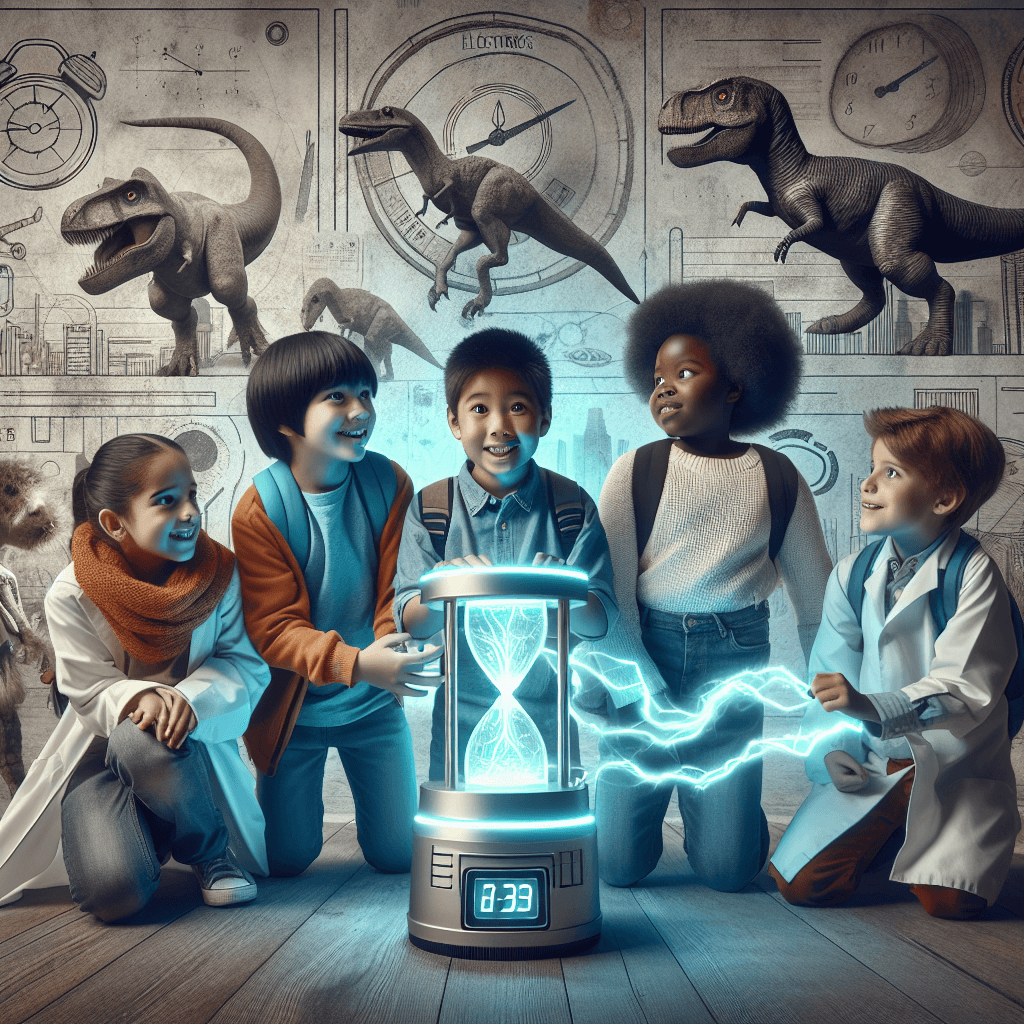
Electricity Time Travelers
Inquiry Framework
Question Framework
Driving Question
The overarching question that guides the entire project.How can designing a time machine help us understand the historical evolution and the impact of electricity on modern life and future innovations?Essential Questions
Supporting questions that break down major concepts.- How has electricity changed the way we live over time?
- What are the key discoveries and inventions in the history of electricity?
- How does electricity work, and why is it important in our daily lives?
- What were some of the challenges and obstacles faced by early inventors in harnessing electricity?
- How can understanding the history of electricity help us innovate future technologies?
- What role did famous scientists, like Benjamin Franklin and Thomas Edison, play in the development of electricity?
- How does exploring the history of electricity enhance our understanding of science and technology today?
Standards & Learning Goals
Learning Goals
By the end of this project, students will be able to:- Understand and describe the historical development and impact of electricity on society.
- Identify key figures and events in the history of electricity, including their contributions.
- Design a model time machine that demonstrates the principles of electricity and historical advancements.
- Conduct and apply research to inform the design process, emphasizing scientific understanding.
- Enhance communication skills through project presentations that integrate historical and scientific contexts.
Next Generation Science Standards
Common Core State Standards for English Language Arts
Entry Events
Events that will be used to introduce the project to studentsMystery Time Capsule
A mysterious time capsule from the future appears in the classroom, filled with artifacts from various eras highlighting key moments in the development of electricity. Students are tasked with identifying the time and significance of each artifact, sparking interest in the historical journey they will explore throughout the project. The intrigue of unlocking a 'future' time capsule connects directly to the concept of time travel and advances in electricity.Virtual Reality Voyage
Students don VR headsets for a thrilling journey through time, witnessing firsthand the groundbreaking moments in electrical history as if they were actually there. This tech-savvy entry venture marries students' interest in virtual reality with the science of electricity, pivoting their curiosity toward the past and its relevance to the modern world.Electricity Storybook Quest
Introduce students to a captivating storybook that articulates the epic narrative of electricity's invention and development through different epochs. Each chapter presents a problem-solving challenge, encouraging students to think critically about how electricity shaped those time periods. Storytelling taps into student interests in narratives while establishing a foundational understanding of the project.Portfolio Activities
Portfolio Activities
These activities progressively build towards your learning goals, with each submission contributing to the student's final portfolio.Artifact Investigation
Students will act as detectives to investigate artifacts from the past, each representing a key moment in the history of electricity. They will learn how to contextualize these artifacts in terms of their historical significance and the evolution of electricity. This activity serves to ground students in historical inquiry and sets the foundation for understanding electricity's development over time.Steps
Here is some basic scaffolding to help students complete the activity.Final Product
What students will submit as the final product of the activityAn annotated timeline that maps the historical progression of key discoveries in electricity.Alignment
How this activity aligns with the learning objectives & standardsAligns with NGSS.4-PS3-2 by providing evidence of energy transfer over time and CCSS.ELA-LITERACY.W.4.7 through research conducted to build historical knowledge.Timeline Engineers
Students will engineer a visual timeline that not only maps the historical advancements of electricity but also reflects on how each discovery or invention contributed to societal changes. This is an opportunity for creative expression, and students will use multimedia tools to make their timelines interactive and engaging.Steps
Here is some basic scaffolding to help students complete the activity.Final Product
What students will submit as the final product of the activityAn interactive, multimedia timeline that demonstrates the historical evolution of electricity and its impact on society.Alignment
How this activity aligns with the learning objectives & standardsConnects to NGSS.4-PS3-4 by designing a tool that conveys scientific advancement and CCSS.ELA-LITERACY.SL.4.4 for effectively communicating information.Inventor's Insight
Students will delve into the lives of famous scientists, such as Benjamin Franklin and Thomas Edison, to understand their contributions to electricity. By creating biographical sketches, students will explore the obstacles these inventors faced and how their breakthroughs shaped our world.Steps
Here is some basic scaffolding to help students complete the activity.Final Product
What students will submit as the final product of the activityA biographical sketch that provides insight into the lives and contributions of historical figures in electricity.Alignment
How this activity aligns with the learning objectives & standardsSupports CCSS.ELA-LITERACY.W.4.7 by conducting a research project and enhances understanding of NGSS.4-PS3-2 through contextual exploration of energy pioneers.Time Machine Blueprint
In this culminating activity, students will design and conceptualize a 'Time Machine' that showcases the history of electricity. They will brainstorm engineering principles to apply and describe how their machine illustrates electricity's evolution.Steps
Here is some basic scaffolding to help students complete the activity.Final Product
What students will submit as the final product of the activityA detailed blueprint and narrative for a time machine that visually and contextually represents the history of electricity.Alignment
How this activity aligns with the learning objectives & standardsDirectly aligns with NGSS.4-PS3-4 through the design and conceptualization of a model and engages CCSS.ELA-LITERACY.SL.4.4 in narrating and presenting their designs.Rubric & Reflection
Portfolio Rubric
Grading criteria for assessing the overall project portfolioElectricity Time Travelers Assessment Rubric
Historical Understanding
Assesses the depth of understanding and representation of historical events and figures in the context of electricity.Historical Accuracy
Evaluates the correctness of historical details related to key events and figures in the development of electricity.
Exemplary
4 PointsDemonstrates sophisticated understanding with accurate and insightful historical representations, integrating multiple sources.
Proficient
3 PointsPresents accurate historical details with logical interpretations and source integration.
Developing
2 PointsShows emerging understanding with some inaccuracies or occasional lack of detail.
Beginning
1 PointsDemonstrates minimal accuracy in the representation of historical facts and lack of detail.
Key Historical Figures
Measures the depth of understanding and portrayal of key figures’ contributions and challenges in electricity's history.
Exemplary
4 PointsProvides a comprehensive account of key figures, detailing significant contributions and challenges, using creative narratives.
Proficient
3 PointsAccurately describes key figures and their contributions with coherent presentation.
Developing
2 PointsPresents basic understanding with limited detail or clarity.
Beginning
1 PointsProvides minimal information about historical figures and lacks clarity.
Scientific and Creative Innovation
Evaluates the integration of scientific principles with creative design in project deliverables.Creative Design and Functionality
Assesses the originality and effectiveness of the project's design elements and their practical representations.
Exemplary
4 PointsDesigns are exceptionally creative and effectively demonstrate scientific concepts related to electrical evolution.
Proficient
3 PointsDesigns are creative and functionally demonstrate the relevant scientific concepts.
Developing
2 PointsDemonstrates some creativity but with limited functionality or scientific accuracy.
Beginning
1 PointsDesigns lack creativity and do not adequately represent scientific concepts.
Scientific Understanding
Measures the understanding and application of scientific principles concerning electricity.
Exemplary
4 PointsExhibits advanced understanding and application of scientific concepts through accurate and innovative presentations.
Proficient
3 PointsShows solid understanding and appropriate application of scientific concepts.
Developing
2 PointsDemonstrates basic understanding with some application inaccuracies.
Beginning
1 PointsShows minimal understanding or application of the scientific concepts.
Communication and Presentation
Assesses clarity, coherence, and creativity in the presentation of ideas and findings.Oral and Written Communication
Evaluates the clarity, organization, and creativity of both oral and written presentations.
Exemplary
4 PointsDemonstrates exceptional clarity and organization with compelling storytelling and creative presentation methods.
Proficient
3 PointsCommunicates clearly and organizes ideas well using appropriate storytelling techniques.
Developing
2 PointsDisplays some clarity with episodes of disorganization and basic storytelling.
Beginning
1 PointsLacks clarity and organization; storytelling is unclear.