
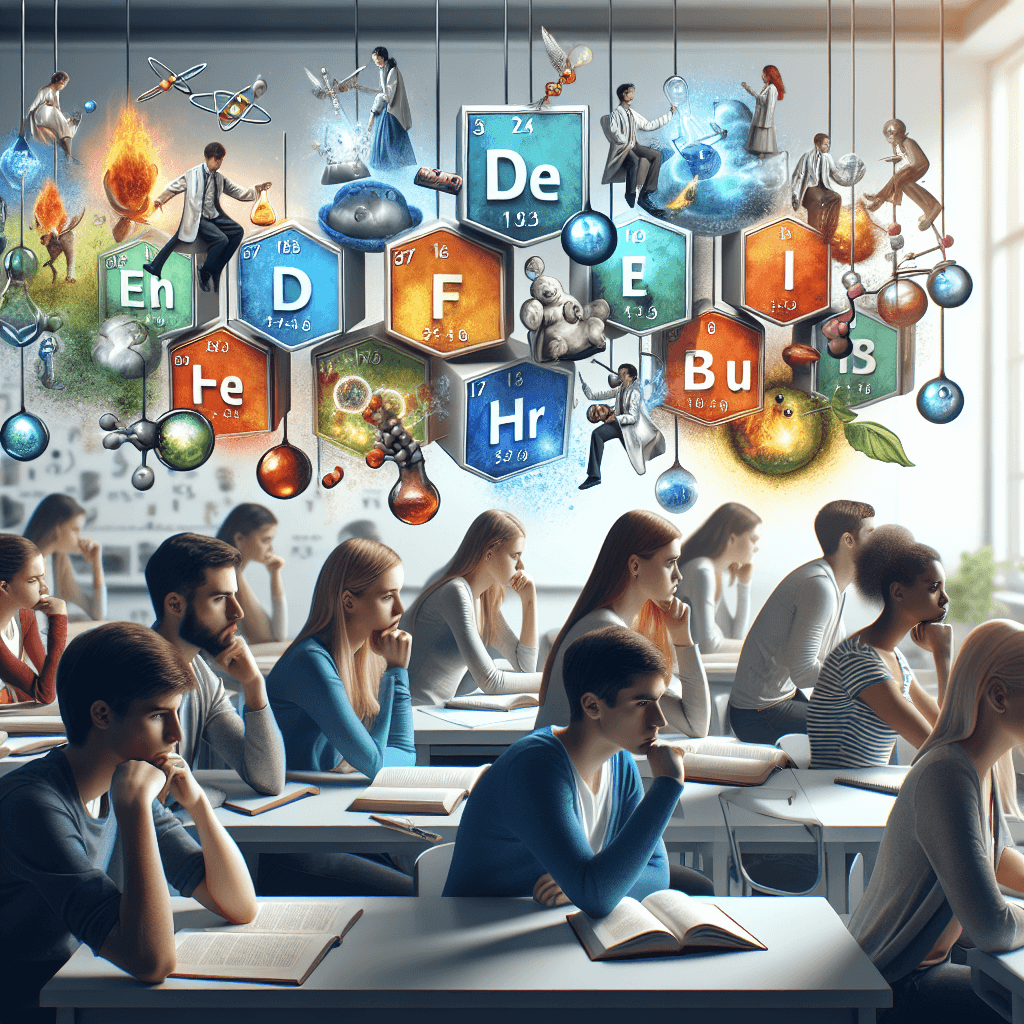
Elemental Storytelling: Periodic Tales
Inquiry Framework
Question Framework
Driving Question
The overarching question that guides the entire project.How can we creatively integrate the properties of elements into an original story written in a foreign language to both entertain and educate others about the periodic table?Essential Questions
Supporting questions that break down major concepts.- How can the properties of elements be used to create compelling characters and narratives?
- How can storytelling be used to explain the properties and interactions of elements in an engaging way?
- How can we use figurative language to describe the characteristics and behaviors of different elements?
- In what ways does understanding the periodic table enhance our creative writing?
- How can we develop our communication skills in a foreign language through creative storytelling about elements?
Standards & Learning Goals
Learning Goals
By the end of this project, students will be able to:- Understand and explain the properties of elements.
- Develop creative writing skills by crafting fictional narratives.
- Use a foreign language to describe and present the periodic table of elements.
- Integrate scientific concepts with storytelling techniques.
- Improve communication skills in a foreign language.
Entry Events
Events that will be used to introduce the project to studentsElemental Disaster Simulation
A simulated news report details a catastrophic event caused by a chemical reaction involving common elements. Students, acting as experts, must explain the reaction in a foreign language, its causes, and propose solutions to prevent future disasters, connecting science to real-world consequences.The Periodic Table's Got Talent
Each student (or group) picks an element and creates a 'talent show' act in a foreign language that showcases its unique properties in a creative way - a song, a skit, a dance, a commercial. This fosters both understanding and creative expression.Portfolio Activities
Portfolio Activities
These activities progressively build towards your learning goals, with each submission contributing to the student's final portfolio.Elemental Character Profiles
Students will begin by selecting three elements from the periodic table. For each element, they will create a detailed character profile, outlining its properties (atomic number, symbol, reactivity, etc.) and translating these properties into personality traits and physical characteristics suitable for a fictional character. These profiles will be written in the target foreign language.Steps
Here is some basic scaffolding to help students complete the activity.Final Product
What students will submit as the final product of the activityThree detailed character profiles, each representing a different element, written in the target foreign language, accompanied by a visual representation.Alignment
How this activity aligns with the learning objectives & standardsAddresses the learning goals of understanding the properties of elements, using a foreign language to describe the periodic table, and developing creative writing skills. It aligns with the standard of using English as a foreign language to present the periodic table of elements by requiring students to articulate and translate the properties and behaviors of elements.World-Building with Elements
Using the three elemental characters developed in the previous activity, students will now create a world where these elements interact. This could be a planet, a city, or even a microscopic environment. The environment's rules and conditions will be based on the chemical properties of the chosen elements. Students will describe this world in the target foreign language, focusing on how the elements' properties shape the environment and the interactions within it.Steps
Here is some basic scaffolding to help students complete the activity.Final Product
What students will submit as the final product of the activityA detailed description of an elemental world, written in the target foreign language, explaining how the properties of the elements shape the environment and interactions within it, along with an illustration.Alignment
How this activity aligns with the learning objectives & standardsThis activity builds on the previous one by further integrating scientific concepts with storytelling techniques. It continues to address the learning goals of understanding and explaining the properties of elements in a foreign language and fostering creative writing skills. It also promotes the development of communication skills in a foreign language.Elemental Conflict & Resolution
Students will devise a plot involving their three elemental characters and the world they inhabit. The plot should center around a conflict that arises due to the elements' properties and interactions. The resolution should be scientifically plausible, given the elements' characteristics. The story will be written in the target foreign language, emphasizing creative language use and scientific accuracy.Steps
Here is some basic scaffolding to help students complete the activity.Final Product
What students will submit as the final product of the activityA complete fictional narrative in the target foreign language, featuring elemental characters, a conflict rooted in their properties, and a scientifically plausible resolution.Alignment
How this activity aligns with the learning objectives & standardsThis activity culminates the project by requiring students to fully integrate their understanding of element properties, creative writing skills, and foreign language proficiency. It directly addresses all learning goals and meets the standard by presenting the periodic table of elements in a compelling and educational format.Rubric & Reflection
Portfolio Rubric
Grading criteria for assessing the overall project portfolioElemental Storytelling Assessment Rubric
Conceptual Understanding of Element Properties
Evaluates the student's ability to understand and explain the chemical properties of elements accurately in a foreign language.Accuracy of Element Properties
Assesses how accurately the student presents the chemical properties of the chosen elements in their narrative.
Exemplary
4 PointsChemical properties are described with precision and exemplary accuracy, reflecting a deep understanding of each element.
Proficient
3 PointsChemical properties are accurately described with minor errors that do not significantly affect understanding.
Developing
2 PointsSome chemical properties are inaccurately described, though the majority are correctly presented.
Beginning
1 PointsMany chemical properties are inaccurately or vaguely described, reflecting limited understanding.
Application of Element Properties to Characters
Evaluates how well the student translates element properties into character traits and backstories in the narrative.
Exemplary
4 PointsElement properties are creatively and consistently translated into unique, well-developed characters with a rich backstory.
Proficient
3 PointsElement properties are effectively translated into diverse characters with clear backstories.
Developing
2 PointsElement properties are inconsistently applied to character traits resulting in less cohesive backstories.
Beginning
1 PointsMinimal application of element properties to characters, leading to flat or undeveloped personas.
Creative Writing and Storytelling
Assesses the student's creative writing skills, focusing on the use of a foreign language, plot development, and narrative creativity.Language Use in Narrative
Evaluates the use of foreign language in narrative writing, focusing on fluency, vocabulary, and grammatical accuracy.
Exemplary
4 PointsDemonstrates fluent and sophisticated use of foreign language, with a wide range of vocabulary and grammatical precision.
Proficient
3 PointsShows proficient use of foreign language, with minor errors in vocabulary and grammar.
Developing
2 PointsDemonstrates basic language skills, with noticeable errors affecting clarity and engagement.
Beginning
1 PointsLimited foreign language use, with frequent errors that impede understanding.
Plot and Conflict Development
Assesses the originality and coherence of the plot, as well as the scientifically plausible resolution of the story's conflict.
Exemplary
4 PointsCrafts a highly original and coherent plot with a scientifically accurate and imaginative resolution to conflict.
Proficient
3 PointsDevelops an original plot with a logical and mostly scientifically accurate resolution.
Developing
2 PointsCreates a plot with some original elements and a basic resolution, lacking scientific depth.
Beginning
1 PointsPresents a basic plot with limited original elements and a vague resolution.
Visual Representation and Integration
Evaluates the effectiveness and creativity of integrating visuals into the narrative to enhance understanding of element properties.Creativity and Relevance of Visuals
Assesses how creatively and effectively visuals represent element properties and enhance the narrative.
Exemplary
4 PointsVisuals are highly creative and closely related to the narrative, significantly enhancing understanding of element properties.
Proficient
3 PointsVisuals are effectively used and relevant to the narrative, enhancing understanding of element properties.
Developing
2 PointsVisuals show some creativity but have a limited connection to the narrative, offering minimal enhancement.
Beginning
1 PointsVisuals are basic and poorly integrated into the narrative, offering little added value.