
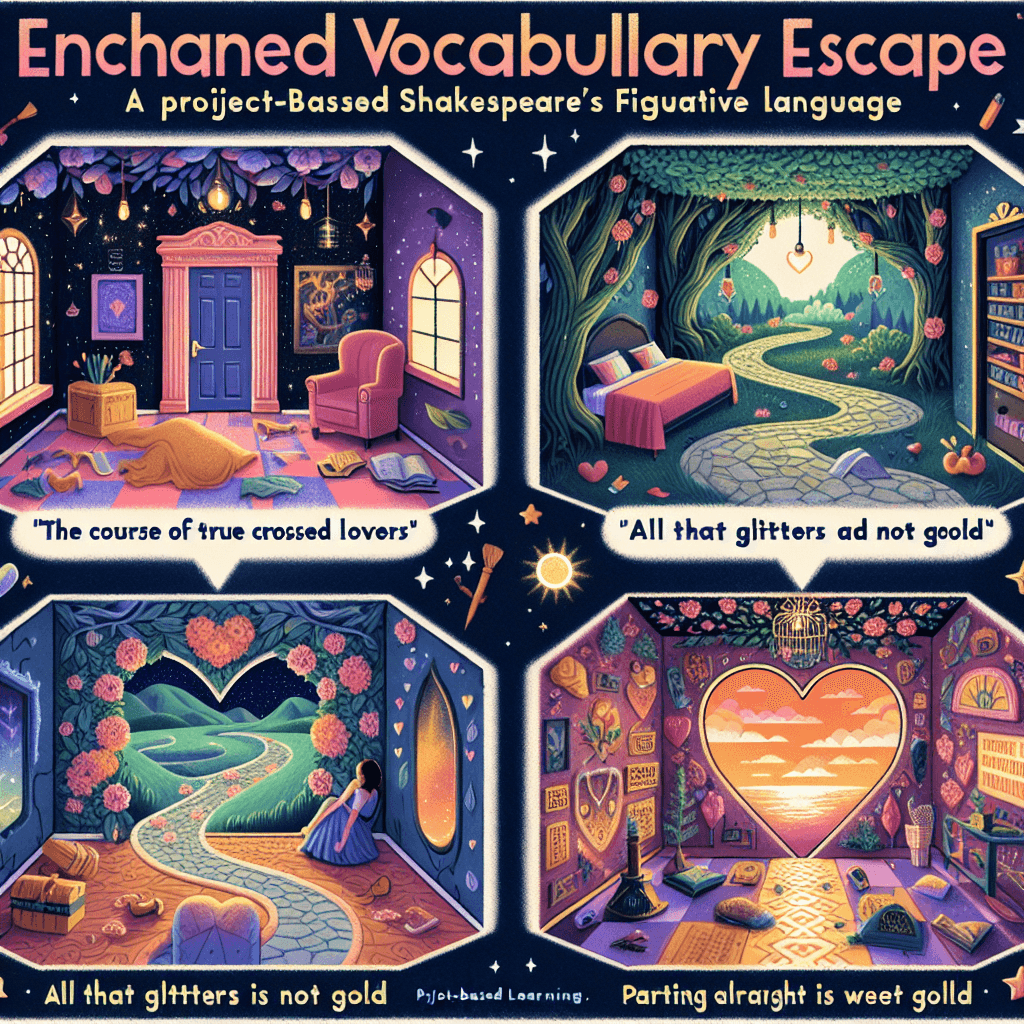
Enchanted Vocabulary Escape: Shakespeare's Figurative Language
Inquiry Framework
Question Framework
Driving Question
The overarching question that guides the entire project.How can we use figurative language to enhance meaning and express character motives in Shakespeare's 'A Midsummer Night's Dream' through an enchanted escape room experience?Essential Questions
Supporting questions that break down major concepts.- What is figurative language and how does it enhance the meaning of a text?
- How do Shakespeare's characters in 'A Midsummer Night's Dream' use language to express their personalities and motives?
- How can understanding figurative language improve our interpretation of Shakespeare's plays?
Standards & Learning Goals
Learning Goals
By the end of this project, students will be able to:- Students will be able to identify and interpret figurative language in Act 1 of 'A Midsummer Night’s Dream'.
- Students will analyze characters’ language to understand their motives and development.
- Students will collaborate effectively to solve puzzles, demonstrating comprehension of the play’s figurative language and character development.
Common Core Standards
Entry Events
Events that will be used to introduce the project to studentsMystical Character Portal
Kick off the project by transforming the classroom into a mystical forest from 'A Midsummer Night's Dream', complete with props and ambient sounds. Students receive a mysterious letter from a Shakespearean character seeking their help with deciphering enchanted figurative language scattered across the forest to unlock the hidden secrets of Act 1. This immersive setup connects students directly to the play and sets the stage for engaging with the text's language creatively.Portfolio Activities
Portfolio Activities
These activities progressively build towards your learning goals, with each submission contributing to the student's final portfolio.Figurative Language Scavenger Hunt
Students will navigate through 'A Midsummer Night's Dream' Act 1, identifying and interpreting figurative language devices such as metaphors, similes, and personifications. They will uncover hidden meanings and connect them to the play’s larger themes and characters.Steps
Here is some basic scaffolding to help students complete the activity.Final Product
What students will submit as the final product of the activityA class-generated compilation of figurative language examples and interpretations from Act 1.Alignment
How this activity aligns with the learning objectives & standardsAligns with RL.8.4 by focusing on determining and interpreting figurative language.Character Motive Investigator
In this activity, students delve into the dialogue of 'A Midsummer Night's Dream' Act 1 to analyze character motives and development. By picking apart the characters’ language, students will unearth deeper insights into their personalities and intentions.Steps
Here is some basic scaffolding to help students complete the activity.Final Product
What students will submit as the final product of the activityGroup presentations on character motives and development, supported by text evidence from Act 1.Alignment
How this activity aligns with the learning objectives & standardsAligns with RL.8.3 by analyzing dialogue to reveal character aspects and motives.Escape Room Challenge Design
Students will work collaboratively to design escape room challenges using their knowledge of figurative language and character analysis from previous activities. These challenges will form an engaging escape room experience inspired by Act 1.Steps
Here is some basic scaffolding to help students complete the activity.Final Product
What students will submit as the final product of the activityAn immersive escape room experience with challenges based on figurative language and character analysis.Alignment
How this activity aligns with the learning objectives & standardsAligns with SL.8.1 as students engage in collaborative discussion and implementation.Rubric & Reflection
Portfolio Rubric
Grading criteria for assessing the overall project portfolioEnchanted Escape Room Rubric
Figurative Language Analysis
Evaluates students' ability to identify and interpret figurative language in the text, understanding its impact on meaning and tone.Identification of Figurative Devices
Measures the student's ability to accurately identify and catalog figurative language from the text.
Exemplary
4 PointsIdentifies all major figurative devices accurately and comprehensively with a keen understanding of nuance.
Proficient
3 PointsIdentifies most figurative devices accurately, showing a good understanding of their presence.
Developing
2 PointsIdentifies some figurative devices but with several inaccuracies or omissions.
Beginning
1 PointsStruggles to identify figurative devices, showing limited understanding.
Interpretation and Impact
Assesses how well the student explains the effects of figurative language on meaning and tone.
Exemplary
4 PointsProvides deep, insightful interpretations that explore multiple levels of meaning and tone impacts.
Proficient
3 PointsOffers clear and accurate interpretations with a solid understanding of meaning and tone influences.
Developing
2 PointsGives basic interpretations with limited exploration of impacts on meaning and tone.
Beginning
1 PointsStruggles to interpret or understand tone and meaning impacts of figurative language.
Character Analysis and Presentation
Assesses the ability to analyze character motives and deliver effective presentations.Character Analysis
Evaluates the student’s ability to analyze character motives and development.
Exemplary
4 PointsAnalyzes characters with deep insight, providing strong, text-based evidence that reveals complex motives.
Proficient
3 PointsAnalyzes characters clearly, providing good quality evidence of basic motives.
Developing
2 PointsOffers limited analysis with basic evidence and surface-level understanding of motives.
Beginning
1 PointsStruggles to provide a coherent analysis of character motives.
Presentation Skills
Assesses how effectively students present their character analysis findings.
Exemplary
4 PointsDelivers a highly engaging, well-structured presentation with clear articulation of ideas.
Proficient
3 PointsDelivers a clear and structured presentation, effectively articulating ideas.
Developing
2 PointsPresentation lacks clarity and structure, impacting the communication of ideas.
Beginning
1 PointsStruggles significantly with delivering a coherent presentation.
Collaborative Escape Room Design
Evaluates teamwork and the application of learned concepts to create escape room challenges.Collaboration and Teamwork
Measures the students’ ability to work effectively within a group setting.
Exemplary
4 PointsDemonstrates excellent collaborative skills, often leading discussions and contributing substantial ideas.
Proficient
3 PointsContributes positively to group discussions and effectively shares ideas.
Developing
2 PointsParticipates in group work but with limited contributions or inconsistent involvement.
Beginning
1 PointsStruggles to engage in group activities, barely contributing to the process.
Application of Figurative Language and Character Analysis in Design
Assesses the integration of figurative language and character analysis into escape room puzzles.
Exemplary
4 PointsExpertly integrates figurative language and character insights into original and challenging puzzles.
Proficient
3 PointsEffectively uses learned concepts to create engaging and appropriate puzzles.
Developing
2 PointsAttempts to apply concepts in puzzle design with limited success.
Beginning
1 PointsShows difficulty applying concepts to puzzle design, resulting in underdeveloped puzzles.