
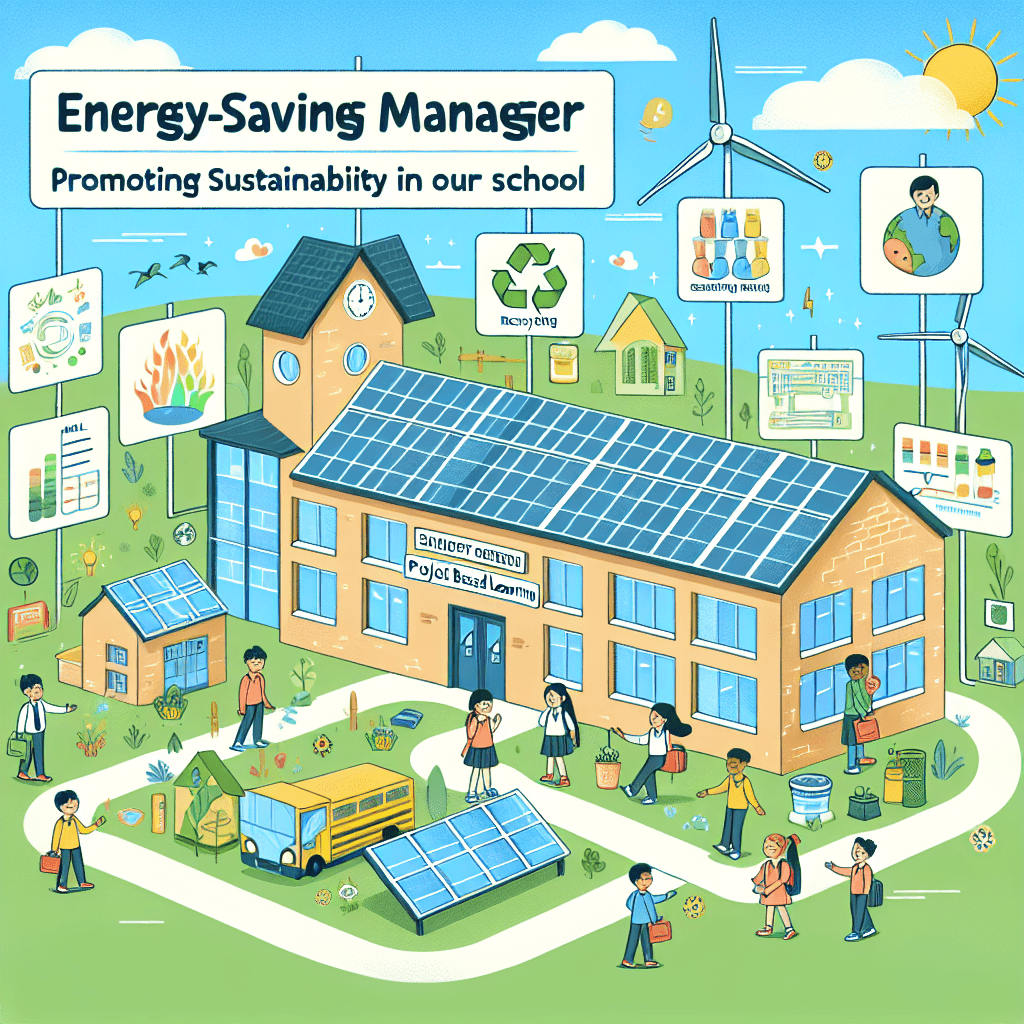
Energiespar-Manager: Nachhaltigkeit an unserer Schule fördern
Inquiry Framework
Question Framework
Driving Question
The overarching question that guides the entire project.How can students, acting as energy managers, effectively implement and support the 'fifty-fifty-aktiv' program to promote sustainability and align with specific Sustainable Development Goals (SDGs), all while overcoming potential challenges?Essential Questions
Supporting questions that break down major concepts.- What role do energy managers play in promoting sustainability and energy efficiency in schools?
- How can participation in programs like 'fifty-fifty-aktiv' contribute to energy conservation and financial savings for schools?
- What are some simple daily actions students and staff can take to reduce energy consumption and support sustainability initiatives at school?
- How does the 'fifty-fifty-aktiv' program align with the goals of the Sustainable Development Goals (SDGs), particularly SDG 7, 12, and 13?
- What challenges might the school encounter in implementing these energy-saving strategies, and how can they be addressed effectively?
- In what ways can students act as change agents in their schools and communities to promote energy conservation and sustainability?
Standards & Learning Goals
Learning Goals
By the end of this project, students will be able to:- Students will understand and participate in the 'fifty-fifty-aktiv' program, learning how energy savings can lead to financial and environmental benefits.
- Students will develop skills to monitor and report on energy use within their school, encouraging accountability and transparency.
- Participants will gain a clear understanding of at least 5 of the 17 Sustainable Development Goals (SDGs), with a deeper focus on SDG 7, 12, and 13.
- Students will apply critical thinking and problem-solving skills to identify challenges and propose effective solutions for implementing energy-saving measures at school.
- Participants will be able to articulate the relationship between local actions and global sustainability efforts, particularly in the context of energy management.
- Students will communicate their experiences and learning outcomes through reports and presentations, enhancing their ability to convey complex information effectively.
German Sustainability Education Standards
United Nations Sustainable Development Goals
Entry Events
Events that will be used to introduce the project to studentsSustainable Development Jeopardy
Modeled after the popular game show, students engage in a fast-paced quiz competition where questions tie to real-world energy challenges, the 'fifty-fifty-aktiv' initiative, and relevant SDGs. This event helps build foundational knowledge while sparking their competitive spirit and interest in sustainable practices.Energy Audit Challenge
In this event, students conduct a 'surprise' energy audit of their school, armed with devices to measure electricity consumption and a checklist based on the SDGs. Their mission is to uncover wasteful practices and propose actionable plans to the school board to enhance energy efficiency.Virtual Reality School Tour
Students participate in an immersive virtual reality tour of their school, where they witness the impact of energy mismanagement versus efficient energy use. This experience encourages them to brainstorm innovative solutions to improve their school's energy efficiency and sustainability practices.Sustainability Mystery Game
Students receive a mysterious letter stating that their school will face serious energy consumption consequences if they don't act. Through clues and problem-solving challenges linked to the SDGs and 'fifty-fifty-aktiv' program, they unravel the mystery and suggest sustainable practices to prevent the predicted outcomes.Role Play Simulation: City Council Meeting
Students assume roles as school representatives at a simulated city council meeting, discussing grant allocations from energy savings achieved through responsible practices. They must advocate for their school's participation in the 'fifty-fifty-aktiv' program by presenting potential energy-saving strategies and their impacts on the SDGs.Portfolio Activities
Portfolio Activities
These activities progressively build towards your learning goals, with each submission contributing to the student's final portfolio.Energy Efficient Practices Journal
Students will observe and document daily energy usage within their classroom to identify wasteful practices and implement small changes that lead to efficient energy use.Steps
Here is some basic scaffolding to help students complete the activity.Final Product
What students will submit as the final product of the activityA journal of observations and reflections on energy usage, identifying patterns and proposing small-scale interventions.Alignment
How this activity aligns with the learning objectives & standardsSupports SDG-07 and SDG-12 by encouraging sustainable energy consumption practices and responsible behavior.SDG Exploration Workshop
In groups, students will research different SDGs and their implications on both local and global scales. Presentations will cover how each goal can be applied to improve school practices relating to the 'fifty-fifty-aktiv' program.Steps
Here is some basic scaffolding to help students complete the activity.Final Product
What students will submit as the final product of the activityGroup presentations that demonstrate how various SDGs can be implemented at school, with a focus on energy efficiency.Alignment
How this activity aligns with the learning objectives & standardsAligns with DE-11-SD-01, as students explore and communicate their understanding of SDGs and their applications.Intermediate Report Compilation
Students will create interim reports evaluating their progress in energy management, offering insights and recommendations for future improvement in line with 'fifty-fifty-aktiv'.Steps
Here is some basic scaffolding to help students complete the activity.Final Product
What students will submit as the final product of the activityAn intermediate report summarizing the evaluation of current energy-saving practices and offering recommendations.Alignment
How this activity aligns with the learning objectives & standardsSupports DE-11-SD-01, SDG-07, and SDG-12 by fostering accountability and transparency in sustainability initiatives.Final Reflection and Presentation
Students reflect on their experiences managing energy resources at school and present their findings and recommendations to a broader audience.Steps
Here is some basic scaffolding to help students complete the activity.Final Product
What students will submit as the final product of the activityA final presentation and reflection document that encapsulates the project journey and provides future guidance.Alignment
How this activity aligns with the learning objectives & standardsAddresses DE-11-SD-01, SDG-07, SDG-12, and SDG-13 by reflecting on contributions to sustainability and articulating the relationship between local actions and global goals.Rubric & Reflection
Portfolio Rubric
Grading criteria for assessing the overall project portfolioEnergy Management and SDG Integration
Understanding of Energy Management
Evaluates students' grasp of concepts related to energy usage, conservation, and the role of energy managers in schools.Comprehension of Key Concepts
Assesses understanding of energy management principles, including the 'fifty-fifty-aktiv' program and its connection to SDGs.
Exemplary
4 PointsDemonstrates sophisticated understanding of energy management concepts and their application within the 'fifty-fifty-aktiv' program, with a highly insightful connection to SDGs.
Proficient
3 PointsShows thorough understanding of energy management principles and their relevance to the 'fifty-fifty-aktiv' program and SDGs.
Developing
2 PointsExhibits emerging understanding of basic energy management concepts and connection to SDGs, with some alignment to 'fifty-fifty-aktiv'.
Beginning
1 PointsShows initial understanding of energy management concepts, struggling to connect them to SDGs or the 'fifty-fifty-aktiv' program.
Application of Energy Conservation Strategies
Evaluates students' ability to identify and implement practical energy-saving measures within the school environment.
Exemplary
4 PointsInnovatively applies a comprehensive range of practical energy-saving strategies, reflecting significant impact and creativity.
Proficient
3 PointsEffectively applies appropriate energy-saving strategies with noticeable impact.
Developing
2 PointsApplies basic energy-saving measures, though impact and consistency may vary.
Beginning
1 PointsStruggles to apply effective energy-saving practices; minimal implementation.
Engagement with Sustainable Development Goals (SDGs)
Assesses students' exploration, understanding, and application of specific SDGs within the school context.SDG Research and Insight
Measures depth of research and insight into selected SDGs, particularly in relation to energy management and school applications.
Exemplary
4 PointsConducts profound research with exceptional insight into selected SDGs, offering creative and applicable strategies for school implementation.
Proficient
3 PointsPerforms thorough research and develops insightful, applicable strategies for engaging SDGs at school.
Developing
2 PointsConducts basic research on selected SDGs, presenting some applicable strategies for school implementation.
Beginning
1 PointsDemonstrates limited research and understanding of selected SDGs; struggles with the presentation of application strategies.
Articulation of SDG Impact and Integration
Evaluates students' ability to articulate the relevance and impact of SDGs, particularly SDG 7, 12, and 13, in relation to school energy initiatives.
Exemplary
4 PointsArticulates the profound impact and integration of SDGs with exemplary clarity and relevance, demonstrating a sophisticated understanding.
Proficient
3 PointsClearly articulates the relevance and impact of SDG implementation in school energy initiatives, showing thorough understanding.
Developing
2 PointsDescribes basic impacts and relevance of SDGs with some clarity and relevance; understanding may lack depth.
Beginning
1 PointsStruggles to clearly articulate the relevance or impact of SDGs; limited understanding evident.
Reflective and Analytical Skills
Focuses on students' reflective practices and analytical skills regarding their participation in the program and personal growth.Reflective Journal Entries
Evaluates the quality of student reflections in their journals, focusing on depth of thought, self-awareness, and critical analysis.
Exemplary
4 PointsProduces highly reflective, insightful journal entries with advanced self-awareness and critical analysis of energy practices.
Proficient
3 PointsProvides thoughtful and reflective journal entries demonstrating clear self-awareness and critical engagement with energy practices.
Developing
2 PointsOffers basic reflections with emerging self-awareness and some critical thought regarding energy practices.
Beginning
1 PointsGives minimal reflections with little evidence of self-awareness or critical analysis regarding energy practices.
Intermediate and Final Reports Analysis
Assesses the analytical depth and clarity in students' reports, focusing on evaluation of practices and proposed improvements.
Exemplary
4 PointsPresents comprehensive, clear, and highly analytical reports with well-structured evaluations and innovative recommendations.
Proficient
3 PointsCrafts thorough, clear reports with strong evaluation and reasonable recommendations.
Developing
2 PointsProvides basic analysis in reports with some evaluation and consideration of improvements.
Beginning
1 PointsPresents unclear reports lacking depth of analysis or substantial evaluations.