
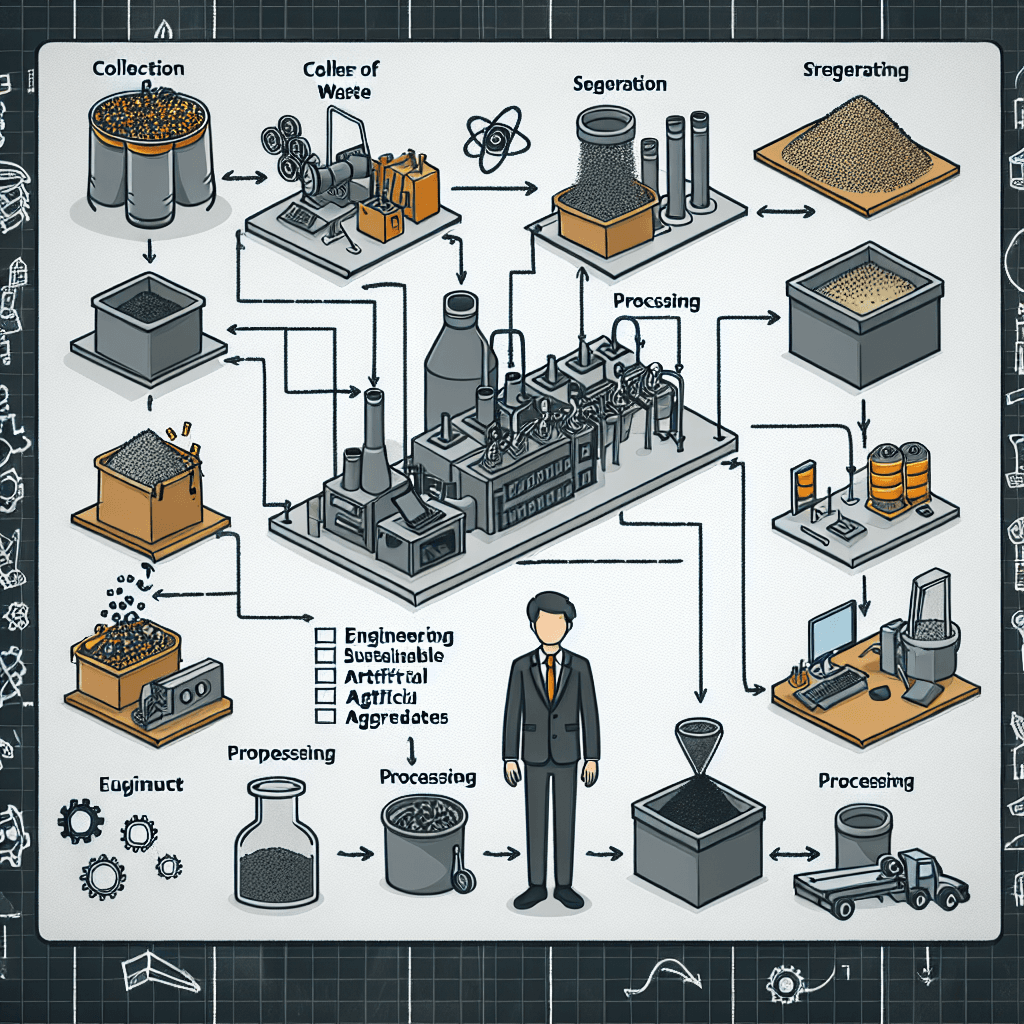
Engineering Sustainable Artificial Aggregates from Industrial Waste Byproducts
Inquiry Framework
Question Framework
Driving Question
The overarching question that guides the entire project.How can we engineer and scale the production of waste-derived artificial aggregates to replace natural minerals in construction, ensuring they are structurally sound, environmentally benign, and economically viable in a global circular economy?Essential Questions
Supporting questions that break down major concepts.- How do the chemical and physical properties of specific industrial byproducts (e.g., fly ash, bottom ash, plastics, or mining tailings) determine their suitability as precursors for artificial aggregates?
- What are the comparative environmental impacts, including carbon footprint and leaching potential, of using waste-derived aggregates versus traditional natural mineral extraction?
- Which manufacturing technologies (such as cold bonding, sintering, or geopolymerization) offer the best balance of energy efficiency and structural performance for high-load construction applications?
- How do artificial aggregates influence the long-term durability and lifecycle of composite materials like concrete when subjected to various environmental stressors?
- To what extent can the implementation of artificial aggregate production address the global scarcity of natural sand and gravel while simultaneously solving local waste management crises?
- What regulatory and economic barriers currently prevent the widespread adoption of waste-based aggregates in the mainstream construction industry, and how can technology bridge these gaps?
Standards & Learning Goals
Learning Goals
By the end of this project, students will be able to:- Analyze the physicochemical properties of diverse industrial waste streams (fly ash, plastics, mining tailings) to determine their viability as precursors for artificial aggregates.
- Design and evaluate manufacturing processes (e.g., geopolymerization, sintering, cold bonding) based on energy efficiency and mechanical performance of the resulting aggregate.
- Conduct a comparative Life Cycle Assessment (LCA) to quantify the environmental footprint and leaching potential of waste-derived aggregates versus traditional mineral extraction.
- Evaluate the long-term structural durability of composite materials containing artificial aggregates when exposed to environmental stressors like freeze-thaw cycles or chemical erosion.
- Synthesize technical, economic, and regulatory data to propose a scalable business model for waste-based aggregates within a global circular economy framework.
ABET Engineering Student Outcomes
United Nations Sustainable Development Goals
Entry Events
Events that will be used to introduce the project to studentsThe 'Sand Wars' Material Briefing
Students are presented with a 'Global Sand Crisis' dossier, highlighting the environmental devastation and geopolitical tensions caused by the illegal mining of natural river sand. They are challenged to act as material engineers tasked by the UN to identify three distinct industrial waste streams that could theoretically replace natural aggregates in high-strength concrete.Portfolio Activities
Portfolio Activities
These activities progressively build towards your learning goals, with each submission contributing to the student's final portfolio.The Waste Stream Prospector
In this foundational activity, students transition from the 'Sand Wars' briefing to active research. They must identify and justify the selection of three specific industrial waste byproducts (e.g., fly ash, ground granulated blast-furnace slag, crushed glass, or plastic waste) that could serve as precursors for artificial aggregates. The focus is on availability, volume, and theoretical suitability for construction.Steps
Here is some basic scaffolding to help students complete the activity.Final Product
What students will submit as the final product of the activityA 'Waste Stream Feasibility Report' including a global availability map, a table of chemical components, and a justification for the chosen materials.Alignment
How this activity aligns with the learning objectives & standardsAligns with ABET-SO-1 (Identifying and formulating complex engineering problems) and UN-SDG-12.5 (Waste reduction through reuse). It directly addresses the learning goal of analyzing the physicochemical potential of waste streams.The Molecular Blueprint
Students perform a deep-dive analysis into the physical and chemical properties of their selected waste materials. This involves understanding particle size distribution, morphology, and reactivity (e.g., pozzolanic activity). This technical profile determines the manufacturing method to be chosen in the next activity.Steps
Here is some basic scaffolding to help students complete the activity.Final Product
What students will submit as the final product of the activityA 'Physicochemical Profile & Material Safety Data Sheet (MSDS)' for each chosen waste precursor.Alignment
How this activity aligns with the learning objectives & standardsAligns with ABET-SO-1 (Applying principles of science and engineering) and the learning goal of analyzing physicochemical properties for viability.The Fusion Architect
Students must now design the 'recipe' and the manufacturing pathway for their artificial aggregate. They choose between Cold Bonding (low energy, longer curing), Sintering (high energy, high strength), or Geopolymerization (chemical bonding). They must justify their choice based on the desired performance and energy constraints.Steps
Here is some basic scaffolding to help students complete the activity.Final Product
What students will submit as the final product of the activityA 'Manufacturing Process Flowsheet' detailing the inputs, energy requirements, and machinery needed for production.Alignment
How this activity aligns with the learning objectives & standardsAligns with ABET-SO-2 (Engineering design to meet specified needs) and UN-SDG-9 (Innovation in infrastructure). It addresses the learning goal of designing manufacturing processes based on energy efficiency.The Stress Chamber
In this phase, students 'produce' their aggregate (either physically in a lab or through a detailed digital simulation/modeling software). They then subject their aggregate to standardized tests to see if it meets the requirements of 'high-strength concrete' aggregates.Steps
Here is some basic scaffolding to help students complete the activity.Final Product
What students will submit as the final product of the activityA 'Technical Performance Data Sheet' comparing the artificial aggregate's properties (crushing value, impact value, water absorption) to natural gravel standards.Alignment
How this activity aligns with the learning objectives & standardsAligns with ABET-SO-2 (Designing solutions with consideration of public health and safety) and the learning goal of evaluating mechanical performance.The Footprint Auditor
Engineering is not just about strength; it is about sustainability. Students conduct a simplified Life Cycle Assessment (LCA) to compare their waste-derived aggregate against traditional quarried sand/gravel. They must also investigate 'leaching'—the risk of heavy metals from the waste entering the groundwater.Steps
Here is some basic scaffolding to help students complete the activity.Final Product
What students will submit as the final product of the activityA 'Comparative Life Cycle Assessment (LCA) Report' featuring a 'Carbon Footprint Scorecard' and 'Leaching Risk Analysis'.Alignment
How this activity aligns with the learning objectives & standardsAligns with ABET-SO-4 (Professional responsibility and environmental context) and UN-SDG-12.5 (Waste reduction). It meets the learning goal of conducting a comparative Life Cycle Assessment (LCA).The Circular Economy Manifesto
In the final phase, students move from the lab to the market. They must address the 'Driving Question' by proposing how this technology can be scaled. They will identify regulatory hurdles (building codes) and economic incentives (carbon credits) that would allow their artificial aggregate to compete with cheap natural sand.Steps
Here is some basic scaffolding to help students complete the activity.Final Product
What students will submit as the final product of the activityA 'Sustainable Material Business Case & Implementation Roadmap' presented as a pitch to a hypothetical UN commission or private investment group.Alignment
How this activity aligns with the learning objectives & standardsAligns with ABET-SO-4 (Informed judgments in global/economic contexts) and UN-SDG-9 (Resilient infrastructure). It addresses the goal of synthesizing technical and economic data into a business model.Rubric & Reflection
Portfolio Rubric
Grading criteria for assessing the overall project portfolioEngineering Circular Aggregates: Global Sustainability Rubric
Material Identification & Research (ABET-SO-1)
Assessment of foundational research and material selection.Material Prospecting & Chemical Feasibility
Evaluating the student's ability to identify diverse waste streams and justify their selection based on chemical composition and local availability.
Exemplary
4 PointsIdentifies 5+ waste streams with exhaustive chemical analysis (SiO2, Al2O3, etc.) compared to natural sand. Selection demonstrates sophisticated understanding of local availability (within 500 miles) and global abundance. Feasibility argument is compelling and scientifically grounded.
Proficient
3 PointsIdentifies 5 waste streams with clear chemical analysis compared to natural sand. Selection considers local availability and global abundance. Feasibility argument is well-reasoned and supported by data.
Developing
2 PointsIdentifies 3-4 waste streams with basic chemical data. Consideration of local availability is inconsistent. Feasibility argument is present but lacks deep scientific justification.
Beginning
1 PointsIdentifies fewer than 3 waste streams or provides incomplete chemical data. Local availability is not addressed. Feasibility argument is weak or missing.
Technical Profiling (ABET-SO-1)
Assessment of scientific depth in material characterization.Physicochemical Analysis
Measuring the technical depth of material analysis, including surface morphology, particle size distribution, and reactivity.
Exemplary
4 PointsProvides a masterly analysis of Particle Size Distribution (PSD) and Scanning Electron Microscopy (SEM) images. MSDS are comprehensive, and ranking of precursors shows a sophisticated grasp of pozzolanic activity and chemical stability.
Proficient
3 PointsProvides a clear analysis of PSD and SEM data. MSDS are complete and accurate. Ranking of precursors is logical and based on physicochemical properties.
Developing
2 PointsProvides basic PSD or SEM analysis. MSDS are partially complete. Ranking of materials lacks clear technical justification or shows emerging understanding.
Beginning
1 PointsAnalysis of physical properties is superficial or missing. MSDS are incomplete. Ranking is arbitrary or absent.
Process Engineering (ABET-SO-2)
Assessment of engineering design and process optimization.Manufacturing Design & Energy Logic
Evaluating the design of the manufacturing pathway, including energy efficiency, mixing ratios, and process flow.
Exemplary
4 PointsInnovative design of mixing ratios and binders. Process Flow Diagram (PFD) is professional grade. Justification for bonding method (e.g., geopolymerization vs sintering) shows an exceptional balance of energy efficiency and performance.
Proficient
3 PointsEffective design of mixing ratios and PFD. Choice of manufacturing method (cold bonding/sintering/geopolymerization) is well-justified based on energy constraints and desired outcome.
Developing
2 PointsMix ratios and PFD are functional but lack optimization. Justification for the manufacturing method is basic or shows inconsistent logic regarding energy efficiency.
Beginning
1 PointsMix ratios are incomplete or illogical. PFD is missing key steps. Choice of manufacturing method is not justified.
Mechanical Performance (ABET-SO-2)
Assessment of material performance and safety compliance.Structural Validation
Assessing the ability to validate the aggregate against international structural standards (ASTM) and mechanical stress tests.
Exemplary
4 PointsComprehensive evaluation of ACV, AIV, and Water Absorption. Data interpretation shows advanced understanding of specific gravity and density. Demonstrates clear alignment with (or innovative deviation from) ASTM C33 standards.
Proficient
3 PointsThorough evaluation of ACV, AIV, and Water Absorption. Correctly identifies if the aggregate meets ASTM C33 standards for structural concrete. Data is clear and accurate.
Developing
2 PointsMechanical tests are performed but interpretation is incomplete. Basic understanding of ASTM standards is evident but lacks specific gravity or density nuance.
Beginning
1 PointsMechanical testing data is missing or inaccurately reported. Fails to compare findings against international standards.
Environmental Impact (ABET-SO-4 / SDG-12.5)
Assessment of sustainability and environmental ethics.LCA & Leaching Analysis
Evaluating the depth of the Life Cycle Assessment, carbon footprint analysis, and safety regarding chemical leaching.
Exemplary
4 PointsConducts a sophisticated LCA with precise CO2 calculations and Environmental Payback graphs. Leaching analysis (TCLP) is comprehensive, ensuring safety and environmental ethics are prioritized. Strategy for encapsulation is innovative.
Proficient
3 PointsConducts a clear LCA comparing waste-derived vs. natural aggregates. Provides accurate CO2 estimates and a valid leaching risk analysis. Environmental payback period is logically calculated.
Developing
2 PointsLCA is basic or lacks comparative depth. CO2 or leaching analysis shows emerging understanding but contains minor errors or omissions.
Beginning
1 PointsEnvironmental analysis is superficial. Fails to address leaching risks or carbon footprint accurately.
Circular Economy Synthesis (ABET-SO-4 / SDG-9)
Assessment of synthesis, scalability, and global context.Economic & Regulatory Strategy
Evaluating the synthesis of technical data into a scalable, economically viable business model within the circular economy.
Exemplary
4 PointsPitch presents a brilliant circular economy loop. Cost-benefit analysis (CBA) is detailed. Proactively addresses complex regulatory/code barriers and provides a realistic, high-impact 5-year scaling roadmap.
Proficient
3 PointsPitch provides a sound business case with a logical CBA. Identifies key regulatory barriers and proposes a clear 5-year roadmap for adoption in the construction industry.
Developing
2 PointsBusiness case is present but lacks financial or regulatory depth. Scaling roadmap is vague or shows partial understanding of circular economy principles.
Beginning
1 PointsFails to provide a coherent business case or CBA. Regulatory barriers and scaling are not addressed.