
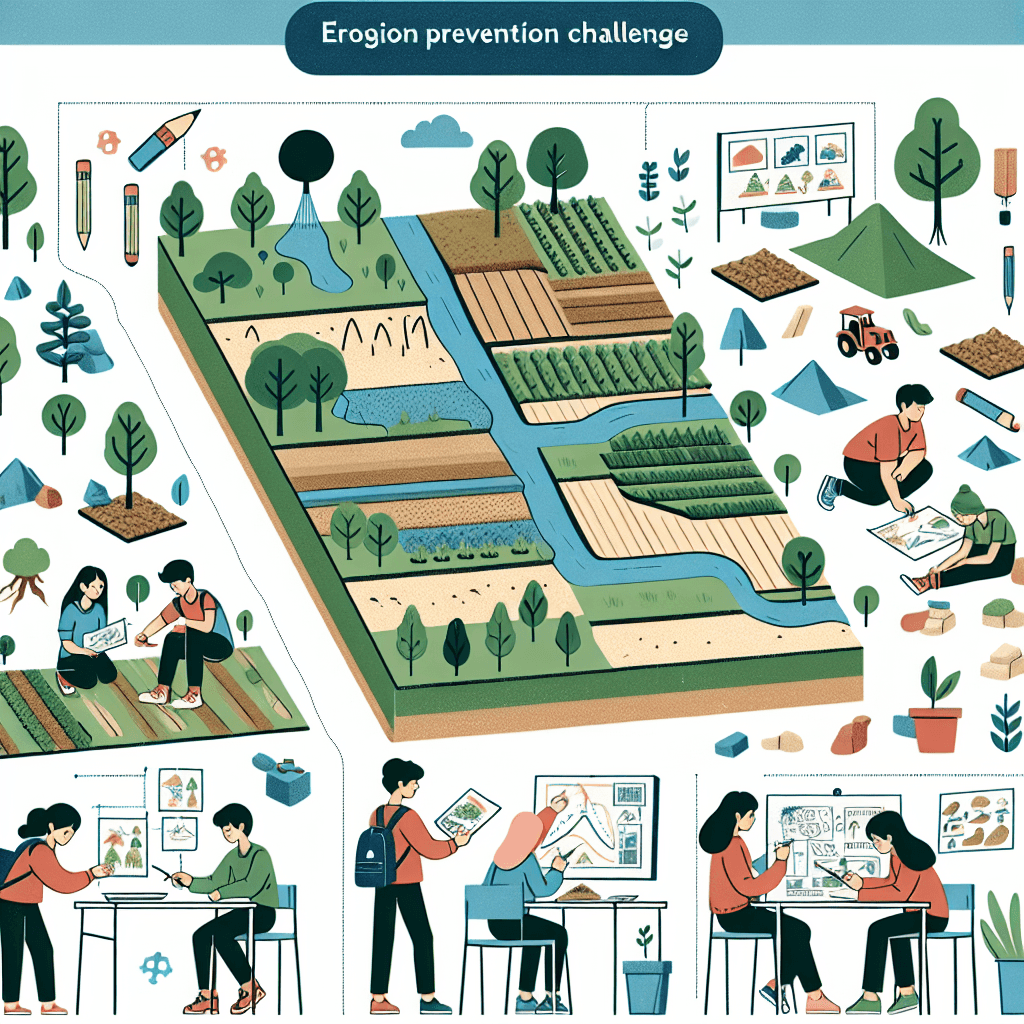
Erosion Prevention Challenge: Design Solutions to Protect Our Land
Inquiry Framework
Question Framework
Driving Question
The overarching question that guides the entire project.How can we design and build a landscape model that effectively prevents soil erosion from water runoff, considering different materials and design strategies?Essential Questions
Supporting questions that break down major concepts.- How does water change the shape of the land?
- What are some ways to slow down or stop water from eroding soil?
- What materials work best to prevent erosion?
- How can we design a landscape to resist erosion?
Standards & Learning Goals
Learning Goals
By the end of this project, students will be able to:- Understand the causes and effects of soil erosion.
- Design and test different methods to prevent soil erosion on a model landscape.
- Evaluate the effectiveness of various materials in preventing soil erosion.
- Collaborate to build a landscape model that minimizes soil erosion from water runoff.
NGSS
Entry Events
Events that will be used to introduce the project to studentsTime-Lapse Trouble
Show a sped-up time-lapse video of a landscape rapidly eroding. Challenge students to identify the problem and brainstorm solutions to 'rewind' the damage.Portfolio Activities
Portfolio Activities
These activities progressively build towards your learning goals, with each submission contributing to the student's final portfolio.Erosion Observation Expedition
Students observe different environments (schoolyard, local park) to identify signs of erosion and its effects.Steps
Here is some basic scaffolding to help students complete the activity.Final Product
What students will submit as the final product of the activityA visual journal with photos/sketches and descriptions of observed erosion, including location and possible causes.Alignment
How this activity aligns with the learning objectives & standardsAddresses 2-ESS1-1 by providing evidence of Earth events (erosion) occurring at varying rates (rapid after rain, slow over time).Material Matters: Erosion Resistance Challenge
Students investigate different materials to determine their effectiveness in preventing soil erosion.Steps
Here is some basic scaffolding to help students complete the activity.Final Product
What students will submit as the final product of the activityA data table ranking materials based on their erosion resistance, with a written explanation of the results.Alignment
How this activity aligns with the learning objectives & standardsAddresses 2-ESS2-1 by comparing multiple solutions (different materials) designed to slow or prevent water from changing the shape of the land.The Great Water Test: Erosion Challenge
Students test their landscape models by simulating rainfall and observing the amount of erosion that occurs.Steps
Here is some basic scaffolding to help students complete the activity.Final Product
What students will submit as the final product of the activityA data table with measurements of soil erosion on their landscape model, along with a written analysis of the model's effectiveness.Alignment
How this activity aligns with the learning objectives & standardsAddresses 2-ESS1-1 and 2-ESS2-1 by providing evidence of Earth events (erosion) and comparing solutions designed to prevent it.Rubric & Reflection
Portfolio Rubric
Grading criteria for assessing the overall project portfolioErosion Prevention Challenge Rubric
Scientific Understanding
Assesses understanding of the causes and effects of erosion and knowledge of materials that can prevent it.Understanding Erosion Concepts
Evaluates the student's comprehension of how erosion occurs and its impact on the environment.
Exemplary
4 PointsDemonstrates a thorough understanding of erosion, including multiple causes and effects, and connects understanding to real-world scenarios.
Proficient
3 PointsShows a good understanding of erosion and its effects, with some connection to real-world examples.
Developing
2 PointsShows basic understanding of erosion, but with limited explanation of causes and effects.
Beginning
1 PointsDemonstrates minimal understanding of erosion, with incorrect or incomplete explanations.
Materials Knowledge
Measures understanding of different materials' effectiveness in preventing soil erosion.
Exemplary
4 PointsDemonstrates detailed knowledge of a wide range of materials and effectively explains how they prevent erosion.
Proficient
3 PointsShows solid knowledge of various materials and explains their effectiveness in preventing erosion.
Developing
2 PointsShows partial knowledge of materials, with inconsistent reasoning for their effectiveness.
Beginning
1 PointsDemonstrates limited knowledge of materials, with incorrect or incomplete explanations.
Scientific Investigation
Evaluates the design and execution of experiments to test erosion prevention methods.Experiment Design and Execution
Assesses the ability to design, set up, and conduct experiments to test erosion prevention strategies.
Exemplary
4 PointsDesigns and conducts experiments with clear, innovative strategies that effectively test erosion prevention methods.
Proficient
3 PointsDesigns and conducts experiments effectively, with minor issues in setup or execution.
Developing
2 PointsDesigns simple experiments but with noticeable issues in execution and strategy.
Beginning
1 PointsStruggles to design and execute experiments, with major issues in strategy and execution.
Data Collection and Analysis
Measures the ability to accurately collect and analyze data from experiments.
Exemplary
4 PointsCollects comprehensive data accurately and analyzes it to draw insightful conclusions.
Proficient
3 PointsCollects accurate data and provides a reasonable analysis with logical conclusions.
Developing
2 PointsCollects some accurate data but struggles to analyze or draw clear conclusions.
Beginning
1 PointsHas difficulty collecting data correctly or analyzing it meaningfully.
Collaboration and Communication
Assesses teamwork and the ability to communicate findings effectively.Team Collaboration
Evaluates participation and contribution to group activities and discussions.
Exemplary
4 PointsLeads collaborative efforts, encourages participation, and respects group dynamics.
Proficient
3 PointsActively participates in group efforts and communicates well with team members.
Developing
2 PointsParticipates in group activities, but with limited communication or contribution.
Beginning
1 PointsSeldom participates in group activities and does not effectively communicate with peers.
Presentation of Findings
Evaluates the clarity and effectiveness of presenting the final product and conclusions.
Exemplary
4 PointsPresents findings clearly and persuasively, with detailed explanations and strong argumentation.
Proficient
3 PointsPresents findings clearly with appropriate details and understandable explanations.
Developing
2 PointsPresents general findings but lacks clarity or sufficient detail.
Beginning
1 PointsStruggles to present findings clearly or coherently, with little detail or explanation.