
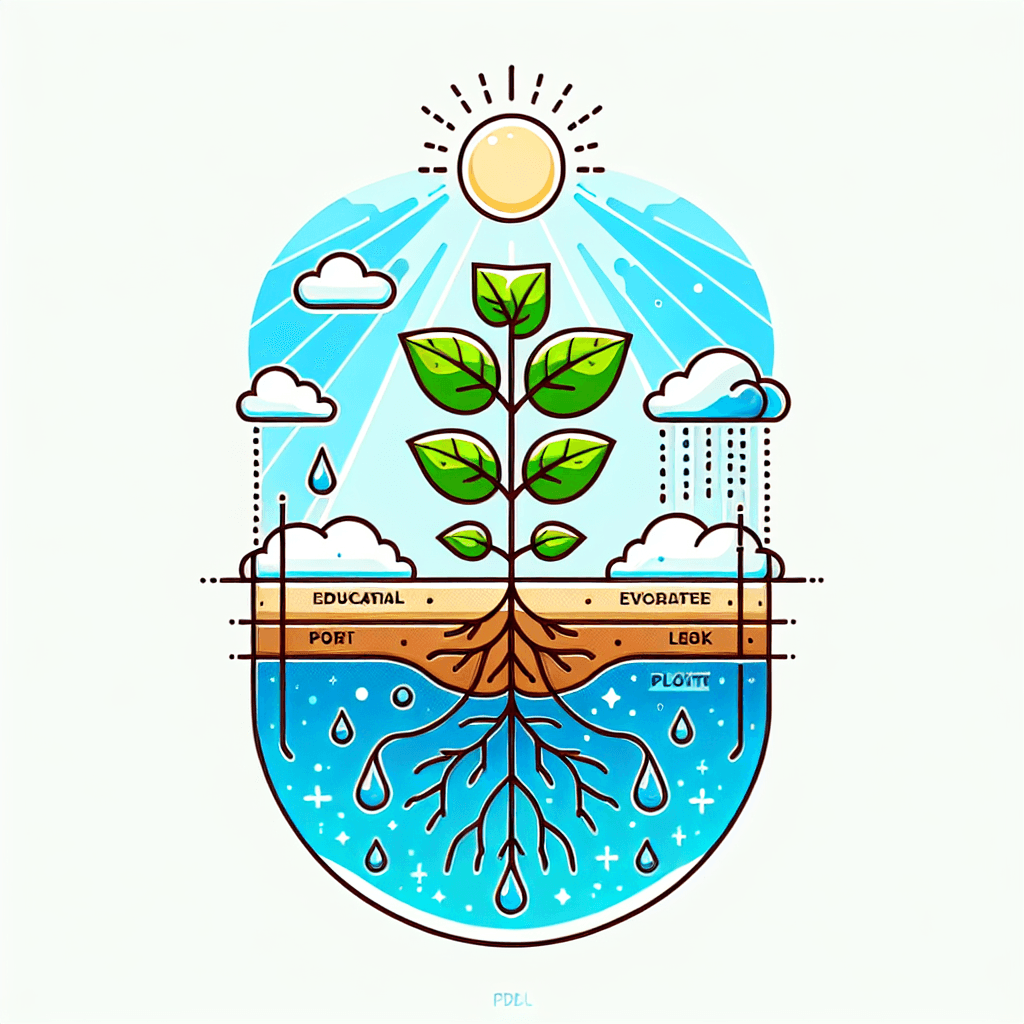
Evapotranspiration Model: Analyzing Plant Water Loss
Inquiry Framework
Question Framework
Driving Question
The overarching question that guides the entire project.How can we develop an effective model to analyze the factors influencing evapotranspiration and water use efficiency in rice plants within Kerala's humid tropical climate, and how does plant physiology impact these processes?Essential Questions
Supporting questions that break down major concepts.- What factors affect evapotranspiration in plants, specifically in rice cultivated in Kerala's humid tropical climate?
- How can we model and measure plant water loss effectively in different environmental conditions?
- What is the role of plant physiology in influencing water use efficiency in humid environments?
Standards & Learning Goals
Learning Goals
By the end of this project, students will be able to:- Understand the process of evapotranspiration and its influencing factors on rice plants in a humid tropical climate.
- Develop a model to measure and analyze plant water loss effectively in varying environmental conditions.
- Analyze the role of plant physiology in determining water use efficiency in humid tropical environments.
Next Generation Science Standards
Common Core Standards
Entry Events
Events that will be used to introduce the project to studentsPlant Detective: A Day in the Life of a Water Molecule
Kick off with an immersive, interactive role-play where students become water molecules traveling through a rice plant in Kerala’s humid climate. They will explore how water molecules journey from the roots to the leaves and into the atmosphere, paving multiple pathways for inquiry on how different factors may affect this journey in terms of evapotranspiration.Rice Field Rescue Mission: Optimize Water Sustainability
Launch with a challenge scenario where students are tasked with managing a rice field experiencing severe water shortages. Present them with current research data and ask them to develop innovative models to predict and optimize plant water use, directly connecting with real-world problem solving in agriculture.Augmented Reality: Inside Evapotranspiration
Provide students an augmented reality experience that visually shows the microscopic processes of evapotranspiration within a rice plant under various conditions. With this technology, they can manipulate variables like humidity and temperature, involving them directly in the scientific inquiry process of plant physiology.Future Farming: Designing Climate-Resilient Crops
Engage students with a scenario set in 2050, where traditional rice farming has changed significantly due to climate change impacts on evapotranspiration rates. Invite them to envision and model possible future farming techniques and rice plant varieties that could thrive under these new conditions.Mysterious Disappearance: Where Does the Water Go?
Begin with a captivating time-lapse video of a rice field in Kerala, showing its lush growth waning as the water levels decrease. Accompanying this, present findings of unexplained fluctuations in water use during different trial periods, sparking curiosity and challenging students to uncover the science behind these mysterious changes using their knowledge of evapotranspiration.Portfolio Activities
Portfolio Activities
These activities progressively build towards your learning goals, with each submission contributing to the student's final portfolio.Evapotranspiration Exploration
Students will dive into the basic principles of evapotranspiration, focusing on the climate of Kerala. They will explore key biological and environmental factors that affect water loss in plants, which is fundamental for proceeding with more complex modeling tasks.Steps
Here is some basic scaffolding to help students complete the activity.Final Product
What students will submit as the final product of the activityA research report summarizing the climate factors of Kerala and biological factors in rice plants affecting evapotranspiration.Alignment
How this activity aligns with the learning objectives & standardsAligns with NGSS.ESS2.D as students analyze how weather and climate influence evapotranspiration.Modeling Plant Water Loss
This activity guides students in applying mathematical modeling techniques to quantify plant water loss. They will develop models based on real environmental data, improving their theoretical understanding using hands-on applications.Steps
Here is some basic scaffolding to help students complete the activity.Final Product
What students will submit as the final product of the activityA mathematical model that predicts plant water loss under various conditions.Alignment
How this activity aligns with the learning objectives & standardsSupports CCSS.MATH.MODEL by requiring students to apply mathematical concepts to real-world problems.Physiology Insights: Plant Adaptations
Students will delve into plant physiology, focusing on how certain adaptations in rice plants affect their water use efficiency. They will examine plant anatomy and explore how these features impact evapotranspiration.Steps
Here is some basic scaffolding to help students complete the activity.Final Product
What students will submit as the final product of the activityAn analytical report on physiological traits in rice plants that affect water use efficiency.Alignment
How this activity aligns with the learning objectives & standardsAligns with NGSS.LS1.C by linking plant physiological adaptations to matter and energy flow.Ecosystem Interactions & Water Use
In this activity, students will examine the interrelationships within the ecosystem that affect plant water use. They will consider how changes in one part of the environment can influence overall plant water loss.Steps
Here is some basic scaffolding to help students complete the activity.Final Product
What students will submit as the final product of the activityA series of hypotheses on ecosystem management strategies for optimizing plant water use.Alignment
How this activity aligns with the learning objectives & standardsConnects with NGSS.LS2.A through understanding ecosystem interdependencies and their role in plant water loss.Predictive Modeling Workshop
Combining knowledge from previous activities, students will design comprehensive predictive models that integrate climate data, plant physiology, and ecosystem interactions to manage water use sustainably.Steps
Here is some basic scaffolding to help students complete the activity.Final Product
What students will submit as the final product of the activityA comprehensive predictive model that addresses sustainable water use in future climatic conditions.Alignment
How this activity aligns with the learning objectives & standardsEncompasses NGSS.ESS2.D, NGSS.LS1.C, NGSS.LS2.A, and CCSS.MATH.MODEL by integrating climate, physiology, and mathematical modeling into a cohesive analysis.Rubric & Reflection
Portfolio Rubric
Grading criteria for assessing the overall project portfolioEvapotranspiration and Water Use Efficiency Comprehensive Assessment
Scientific Understanding
Evaluates the depth of understanding of evapotranspiration, climatic factors, plant physiology, and ecosystem interactions.Climatic Influences
Understanding of how climatic factors such as temperature and humidity impact evapotranspiration in rice plants.
Exemplary
4 PointsDemonstrates a sophisticated understanding of climate factors and integrates them seamlessly into explanations of evapotranspiration processes.
Proficient
3 PointsDisplays a thorough understanding of primary climate factors affecting evapotranspiration, with clear examples.
Developing
2 PointsShows emerging understanding of some climate factors affecting evapotranspiration, with uneven accuracy.
Beginning
1 PointsShows initial understanding of climate factors with minimal linkage to evapotranspiration.
Plant Physiology
Understanding of the biological and physiological factors influencing water use efficiency in rice plants.
Exemplary
4 PointsExhibits exceptional insight into plant physiological adaptations affecting water use, with innovative application strategies.
Proficient
3 PointsDemonstrates clear understanding of major physiological mechanisms affecting water use in rice plants.
Developing
2 PointsShows partial understanding of physiological adaptations related to water use, with some misconceptions.
Beginning
1 PointsShows limited understanding of plant physiological factors or misidentifies key processes.
Ecosystem Interactions
Understanding of the ecosystem components and their interactions affecting plant water use.
Exemplary
4 PointsArticulates complex relationships within the ecosystem and their impact on water use with originality.
Proficient
3 PointsClearly describes key ecosystem interactions that influence plant water use with accurate examples.
Developing
2 PointsShows basic understanding of some ecosystem interactions, but lacks insight into their full impact.
Beginning
1 PointsShows limited understanding of ecosystem components and interactions with missing elements.
Mathematical Modeling
Assesses the ability to apply mathematical principles to develop predictive models for plant water loss.Data Collection and Analysis
Skill in gathering, analyzing, and integrating data to inform model development.
Exemplary
4 PointsCollects and analyzes data with precision, integrating diverse sources to enhance model reliability.
Proficient
3 PointsAccurately collects and analyzes relevant data, supporting effective model construction.
Developing
2 PointsCollects data with some inaccuracies; analysis lacks depth or application to model development.
Beginning
1 PointsStruggles with data collection accuracy and depth, affecting model design.
Model Development
Creation of a model to predict plant water loss considering various environmental and biological factors.
Exemplary
4 PointsDevelops innovative models integrating complex variables, with comprehensive predictive capabilities.
Proficient
3 PointsCreates functional models accurately predicting plant water loss under standard conditions.
Developing
2 PointsCreates basic models with some predictive elements, but lacks comprehensive variable integration.
Beginning
1 PointsDevelops incomplete models that fail to predict plant water loss effectively.
Communication and Collaboration
Assesses the capability to articulate ideas, engage in constructive review, and work collaboratively.Communication Clarity
Articulation of scientific findings and model insights with coherence and professionalism.
Exemplary
4 PointsPresents ideas with clarity and sophistication, engaging audience effectively with advanced communication techniques.
Proficient
3 PointsCommunicates findings clearly and professionally with logical organization.
Developing
2 PointsCommunicates basic ideas with some clarity issues, affecting understanding.
Beginning
1 PointsStruggles to present ideas clearly, impacting audience understanding significantly.
Collaborative Engagement
Effectiveness in contributing to team tasks and engaging in peer review processes.
Exemplary
4 PointsLeads with initiative and supports peers, fostering a collaborative and innovative team environment.
Proficient
3 PointsCollaborates well with peers, contributing positively to team dynamics and task completion.
Developing
2 PointsParticipates in team tasks with occasional assistance, showing basic collaboration skills.
Beginning
1 PointsRequires support to participate in team settings, providing minimal input.