
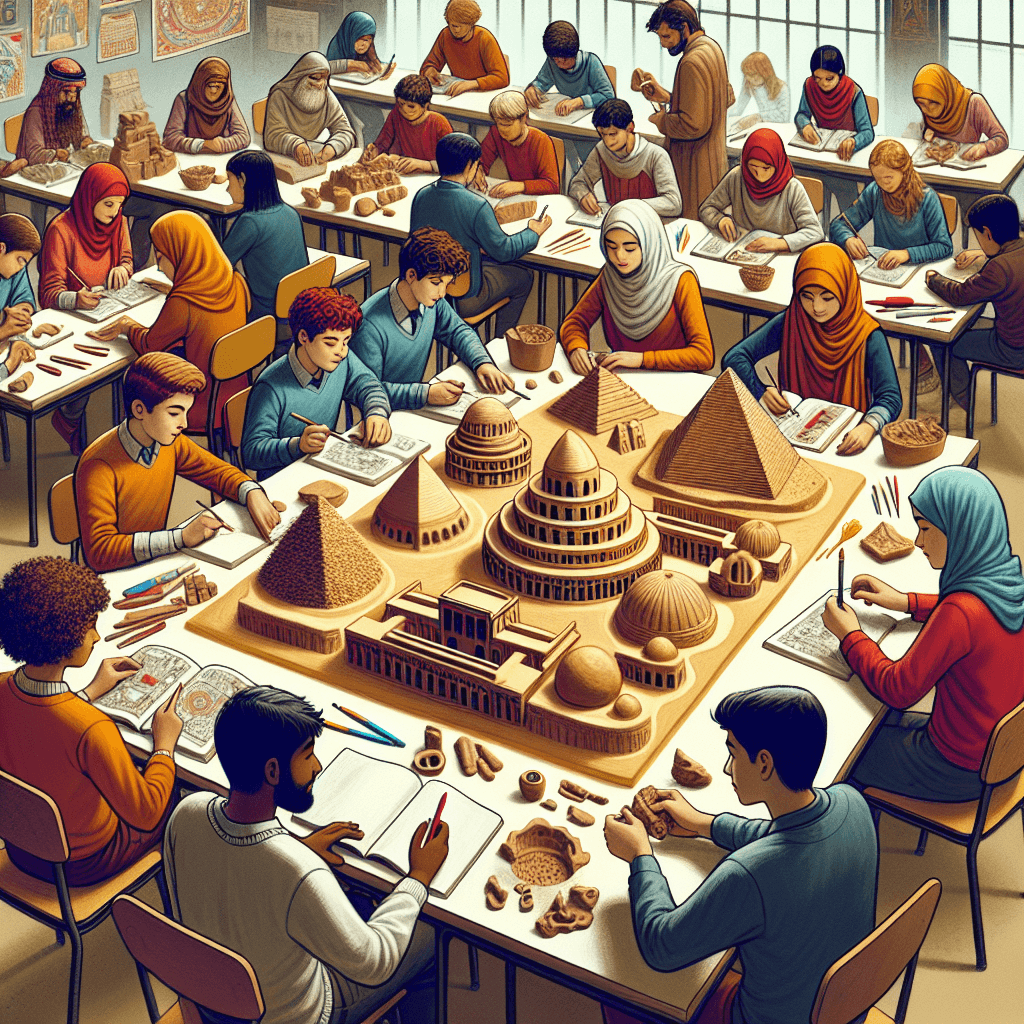
Exploring Archaeological Wonders with Writing and Modeling
Inquiry Framework
Question Framework
Driving Question
The overarching question that guides the entire project.How can we as student archaeologists, uncover, understand, and effectively communicate the significance of archaeological wonders from around the world, considering their historical, cultural, and geographical contexts?Essential Questions
Supporting questions that break down major concepts.- What are some of the most significant archaeological wonders of the world, and why are they considered wonders?
- How do archaeological discoveries impact our understanding of history, culture, and human development?
- What are the cultural and historical significances of the artifacts found at archaeological sites?
- How can we effectively communicate the historical importance and context of archaeological wonders through writing and model creation?
- In what ways do geographical location and environment influence the architecture and preservation of archaeological wonders?
Standards & Learning Goals
Learning Goals
By the end of this project, students will be able to:- Students will be able to research and identify significant archaeological wonders and explain their historical and cultural significance.
- Students will be able to create an informative text that clearly communicates the complex ideas and historical contexts related to an archaeological site.
- Students will be able to develop a scale model of an archaeological wonder, demonstrating understanding of its architecture and geographical setting.
- Students will be able to analyze how geographical and environmental factors influence archaeological sites.
- Students will be able to revise and strengthen their writing to effectively convey their knowledge and research findings.
Common Core Standards
C3 Framework for Social Studies
Entry Events
Events that will be used to introduce the project to studentsGlobal Treasure Hunt
Launch the project with a digital global treasure hunt where students decode clues leading them to discover significant archaeological sites around the world, incorporating geographical and historical research.Artifact Escape Room
Create an escape room scenario where each puzzle leads students to learn about a different archaeological wonder. Harness their competitive spirit and problem-solving skills to "escape" while learning.Portfolio Activities
Portfolio Activities
These activities progressively build towards your learning goals, with each submission contributing to the student's final portfolio.Wonder Exploration Initial Research
Students begin by selecting an archaeological wonder to investigate further. This activity involves gathering preliminary information to set the foundation for deeper inquiry and understanding of its significance.Steps
Here is some basic scaffolding to help students complete the activity.Final Product
What students will submit as the final product of the activityA research outline highlighting essential information about a chosen archaeological wonder.Alignment
How this activity aligns with the learning objectives & standardsAligns with CCSS.ELA-LITERACY.W.9-10.2 and D2.His.1.9-12 by engaging students in conveying complex ideas through research and understanding historical contexts.Artifact Deep Dive Report
Students will dive deeper into their chosen archaeological wonder and write an informative report that includes detailed analysis and synthesis of new research findings.Steps
Here is some basic scaffolding to help students complete the activity.Final Product
What students will submit as the final product of the activityA comprehensive report that presents an in-depth analysis of the chosen archaeological wonder.Alignment
How this activity aligns with the learning objectives & standardsAligns with CCSS.ELA-LITERACY.W.9-10.7 by requiring students to conduct extensive research and synthesize information into a clear text.Model Blueprint Design
Students will create a blueprint for a scale model of their chosen archaeological wonder by applying their research on its architectural features and geographical context.Steps
Here is some basic scaffolding to help students complete the activity.Final Product
What students will submit as the final product of the activityA detailed annotated blueprint for constructing a scale model of the archaeological wonder.Alignment
How this activity aligns with the learning objectives & standardsSupports CCSS.ELA-LITERACY.W.9-10.2 and D2.Geo.6.9-12 by linking research with geographical analysis and visual representation.Scale Model Construction
Students will build a physical scale model of their chosen archaeological wonder using their blueprints as a guide. This activity emphasizes practical application of research and design skills.Steps
Here is some basic scaffolding to help students complete the activity.Final Product
What students will submit as the final product of the activityA completed scale model representing accurate architectural and geographical features of the archaeological wonder.Alignment
How this activity aligns with the learning objectives & standardsFulfills D2.Geo.6.9-12 by applying geographical and environmental understanding in a tangible creation.Historical Context Essay Revision
Students will refine their written reports and essays on the archaeological wonders to ensure clarity, coherence, and polished presentation of their research.Steps
Here is some basic scaffolding to help students complete the activity.Final Product
What students will submit as the final product of the activityA revised and polished informative essay that effectively communicates the archaeological wonder’s significance.Alignment
How this activity aligns with the learning objectives & standardsAddresses CCSS.ELA-LITERACY.W.9-10.5 by focusing on developing and refining writing through revision and editing.Rubric & Reflection
Portfolio Rubric
Grading criteria for assessing the overall project portfolioArchaeological Wonder Exploration Rubric
Research and Analysis
Assessment of students' ability to conduct thorough research and analyze historical and cultural significance of archaeological wonders.Research Depth
Extent to which students gather and synthesize information from diverse sources.
Exemplary
4 PointsDemonstrates sophisticated research with synthesis from multiple, diverse sources and insightful analysis of historical and cultural significance.
Proficient
3 PointsConducts thorough research using diverse sources, showing clear understanding and analysis of historical and cultural aspects.
Developing
2 PointsResearch is emerging, with use of a few sources and basic analysis of historical and cultural significance.
Beginning
1 PointsLimited research from few sources with minimal analysis of historical and cultural aspects.
Historical and Cultural Analysis
Ability to evaluate the historical context and cultural significance of the chosen archaeological wonder.
Exemplary
4 PointsProvides a nuanced evaluation of historical context with deep cultural insights and connections.
Proficient
3 PointsOffers a clear and comprehensive analysis of historical and cultural significance.
Developing
2 PointsPresents a basic analysis with some understanding of historical context or cultural significance.
Beginning
1 PointsAnalysis is limited, with minimal historical or cultural understanding.
Writing and Communication
Evaluation of students' ability to articulate ideas in writing with clarity and coherence.Clarity and Coherence
Effectiveness of structuring writing to communicate complex ideas clearly and cohesively.
Exemplary
4 PointsWrites with exceptional clarity and coherence, structuring content seamlessly to convey complex ideas.
Proficient
3 PointsMaintains clarity and coherence with clear structure and effective communication of ideas.
Developing
2 PointsWriting is partially clear with some coherence in communicating ideas.
Beginning
1 PointsWriting lacks clarity and coherent structure, hindering communication.
Revision and Editing
Process and efforts taken to improve writing through planning, revising, and editing.
Exemplary
4 PointsDemonstrates exemplary revision, with significant improvements and polished final text.
Proficient
3 PointsShows clear improvements through revision with a well-edited final result.
Developing
2 PointsSome revisions made with limited impact on clarity and quality.
Beginning
1 PointsLimited revisions with minimal impact on the overall quality of work.
Model Creation and Design
Assessment of students' ability to create and design a scale model based on research and blueprint accuracy.Blueprint Accuracy
Accuracy and detail in designing a blueprint that reflects architectural features and geographical context.
Exemplary
4 PointsBlueprint is highly accurate, detailed, and reflects comprehensive understanding of architectural and geographical aspects.
Proficient
3 PointsBlueprint is accurate and detailed, showcasing understanding of key features and context.
Developing
2 PointsBlueprint shows emerging accuracy with basic detail and understanding of context.
Beginning
1 PointsBlueprint lacks accuracy and significant details related to the architectural and geographical context.
Model Construction
Skill in constructing a scale model using blueprint guidance and incorporating contextual elements.
Exemplary
4 PointsConstructs a sophisticated model with exceptional accuracy and contextual detail.
Proficient
3 PointsBuilds an accurate model with clear attention to detail and context.
Developing
2 PointsModel construction is basic with some attention to detail and context.
Beginning
1 PointsModel is incomplete or inaccurately constructed with limited context.