
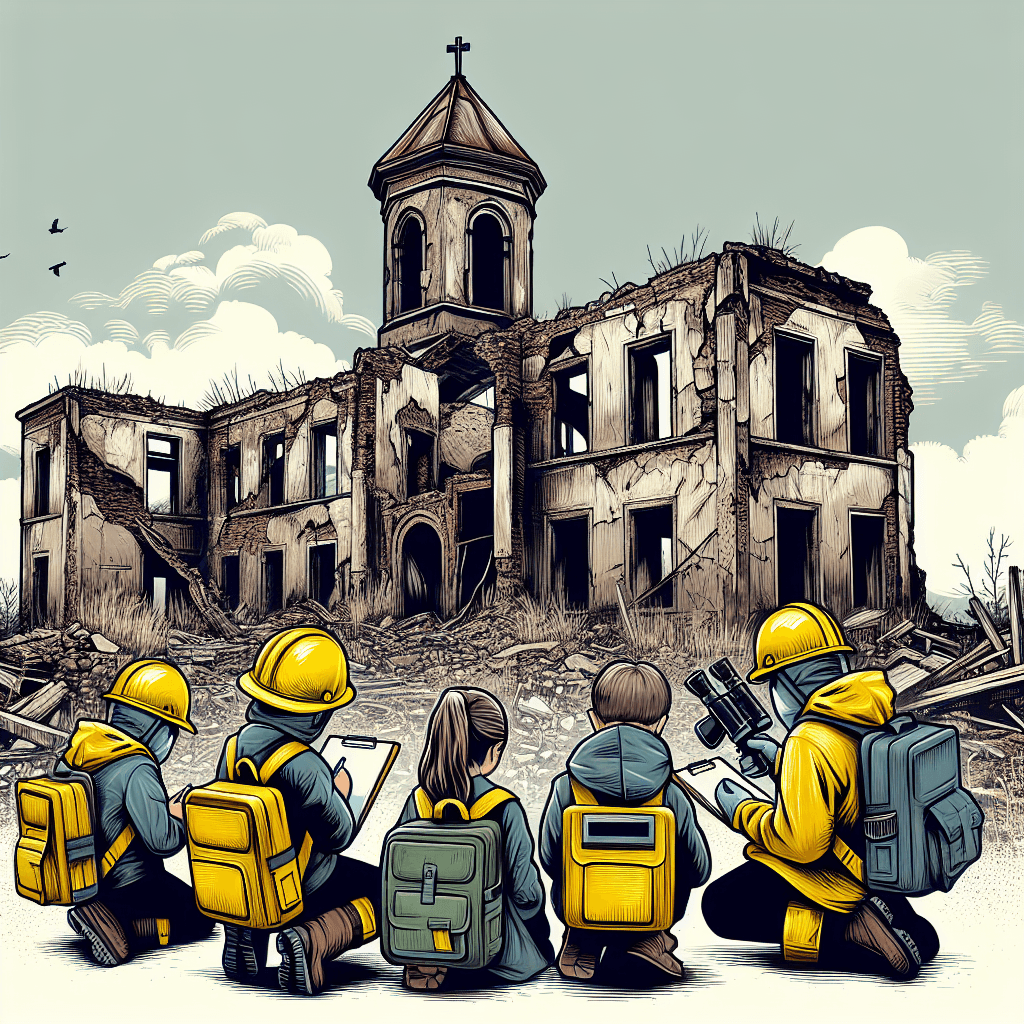
Exploring Chernobyl: CCSS Aligned PSSA Style Questions
Inquiry Framework
Question Framework
Driving Question
The overarching question that guides the entire project.How can we analyze and interpret different types of texts to understand the varied perspectives on the immediate and long-lasting impacts of the Chernobyl disaster on people and the environment, and use these insights to evaluate the role of nuclear energy in our world today?Essential Questions
Supporting questions that break down major concepts.- What happened during the Chernobyl disaster, and what were its immediate effects on the environment and people?
- How can analyzing different types of texts about Chernobyl help us understand the perspectives and biases present in media and historical accounts?
- What are the long-term impacts of the Chernobyl disaster on human health and the environment, and how are these impacts recorded over time?
- How do authors use evidence from texts to develop and support a central idea or theme related to the Chernobyl disaster?
- What role does nuclear energy play in modern society and what can we learn from historical events like Chernobyl to inform future energy policies?
Standards & Learning Goals
Learning Goals
By the end of this project, students will be able to:- Analyze various texts about the Chernobyl disaster to understand and interpret different perspectives.
- Cite textual evidence to support analyses of texts discussing the Chernobyl incident.
- Determine central ideas in texts related to Chernobyl and provide objective summaries.
- Compare how different authors present information on Chernobyl, focusing on evidence and interpretation.
- Write arguments regarding nuclear energy policies informed by lessons from the Chernobyl disaster.
- Engage in discussions to explore and express ideas related to the impact of Chernobyl on society and environment.
Common Core Standards
Entry Events
Events that will be used to introduce the project to studentsChernobyl Live Simulation
Students are invited into a dimly-lit classroom, transformed into an emergency response center from 1986. Sirens and radio broadcasts play in the background as the scenario of a nuclear power plant incident unfolds. This immersive experience sets the stage for understanding the historical context and the impact of language in emergency communications.Portfolio Activities
Portfolio Activities
These activities progressively build towards your learning goals, with each submission contributing to the student's final portfolio.Historical Context Explorers
Students dive into the historical and environmental context of the Chernobyl disaster by observing a simulation and engaging with introductory articles.Steps
Here is some basic scaffolding to help students complete the activity.Final Product
What students will submit as the final product of the activityA reflective journal entry capturing initial thoughts on the Chernobyl disaster's immediate and long-lasting impacts.Alignment
How this activity aligns with the learning objectives & standardsAligns with CCSS.ELA-LITERACY.SL.7.1 by setting the foundation for effective discussions through initial reflections.Textual Evidence Detectives
Students investigate various texts to find evidence that supports the analysis of the Chernobyl disaster’s impact.Steps
Here is some basic scaffolding to help students complete the activity.Final Product
What students will submit as the final product of the activityA comprehensive graphic organizer with cited textual evidence from multiple sources.Alignment
How this activity aligns with the learning objectives & standardsSupports CCSS.ELA-LITERACY.RI.7.1 by requiring the citation of textual evidence for explicit and inferred content.Central Idea Investigators
Students identify and analyze central ideas within texts discussing the Chernobyl disaster and its broader implications on nuclear energy.Steps
Here is some basic scaffolding to help students complete the activity.Final Product
What students will submit as the final product of the activityAn objective summary for each text, emphasizing the central ideas and their development.Alignment
How this activity aligns with the learning objectives & standardsMeets CCSS.ELA-LITERACY.RI.7.2 by focusing on determining and summarizing central ideas.Authors’ Angle Analysts
Students compare how different authors present information on the Chernobyl disaster.Steps
Here is some basic scaffolding to help students complete the activity.Final Product
What students will submit as the final product of the activityA comparative analysis document highlighting differences in author perspectives and evidence usage.Alignment
How this activity aligns with the learning objectives & standardsAligns with CCSS.ELA-LITERACY.RI.7.9 by focusing on comparing authors’ approaches.Debate and Defend: Nuclear Energy Edition
Students write and present arguments about the role of nuclear energy, considering lessons from Chernobyl.Steps
Here is some basic scaffolding to help students complete the activity.Final Product
What students will submit as the final product of the activityA written argumentative essay and participation in a class debate on nuclear energy.Alignment
How this activity aligns with the learning objectives & standardsSupports CCSS.ELA-LITERACY.W.7.1 by focusing on writing arguments with clear reasons and evidence, and CCSS.ELA-LITERACY.SL.7.1 by engaging in structured debates.Rubric & Reflection
Portfolio Rubric
Grading criteria for assessing the overall project portfolioChernobyl Disaster Inquiry Rubric
Understanding Historical Context
Assesses students' grasp of the Chernobyl disaster's historical and environmental context through initial reflections and engagement with simulations and texts.Engagement with Simulation
Measures students' ability to immerse in and reflect on the simulation of Chernobyl as a means to understand historical context.
Exemplary
4 PointsDemonstrates a thorough engagement with the simulation, providing insightful reflections that deepen understanding of Chernobyl's historical context.
Proficient
3 PointsActively engages with the simulation, providing thoughtful reflections that show a solid understanding of Chernobyl's historical context.
Developing
2 PointsParticipates in the simulation with some engagement, offering reflections that show a basic understanding of Chernobyl's context.
Beginning
1 PointsShows minimal engagement with the simulation and provides limited reflections on the historical context of Chernobyl.
Reflective Journal Entry
Evaluates the ability to capture initial thoughts on the Chernobyl disaster's impacts in a reflective journal entry.
Exemplary
4 PointsJournal entry presents a well-organized, insightful reflection with comprehensive thoughts on the disaster's immediate and long-lasting impacts.
Proficient
3 PointsJournal entry is coherently organized with thoughtful insights on the disaster's impacts.
Developing
2 PointsJournal entry offers some organization and basic insights into the impacts of the Chernobyl disaster.
Beginning
1 PointsJournal entry is disorganized with minimal insights on the disaster's effects.
Citing Textual Evidence
Evaluates students' ability to gather and organize textual evidence from multiple sources on the Chernobyl disaster.Textual Evidence Gathering
Assesses the process of collecting and documenting text-based evidence to support analysis.
Exemplary
4 PointsEfficiently gathers diverse, relevant textual evidence that convincingly supports analyses of explicit and inferred content.
Proficient
3 PointsGathers relevant textual evidence that supports analyses of explicit and inferred content.
Developing
2 PointsCollects some relevant evidence, but may not fully support analyses or misses inferences.
Beginning
1 PointsStruggles to gather relevant textual evidence, with limited support for analysis.
Graphic Organizer Completion
Measures the completeness and coherence of the graphic organizer used to present evidence.
Exemplary
4 PointsCompletes a detailed and coherent graphic organizer that clearly outlines strong evidence and logical inferences.
Proficient
3 PointsCompletes the graphic organizer effectively, highlighting main evidence and logical inferences.
Developing
2 PointsPartially completes the graphic organizer with basic evidence and inferences, lacking clarity.
Beginning
1 PointsStruggles to complete the graphic organizer, with unclear presentation of evidence and inferences.
Central Idea Analysis
Assesses students' ability to determine and summarize central ideas within texts on the Chernobyl disaster.Identification of Central Ideas
Evaluates the ability to identify major ideas presented in multiple texts.
Exemplary
4 PointsPrecisely identifies two or more central ideas across texts, showing insightful connections and development.
Proficient
3 PointsAccurately identifies two or more central ideas across texts, with some connections showing development.
Developing
2 PointsIdentifies central ideas with limited connections or partial development of ideas.
Beginning
1 PointsStruggles to identify central ideas, with minimal connections or development.
Summary Writing
Assesses the ability to write objective summaries that reflect text central ideas and their development over time.
Exemplary
4 PointsWrites comprehensive summaries that objectively cover central ideas and their development, demonstrating depth over time.
Proficient
3 PointsWrites clear summaries that cover central ideas and their development.
Developing
2 PointsWrites basic summaries with limited coverage of central ideas and their development.
Beginning
1 PointsStruggles to provide objective summaries, with minimal coverage of central ideas.
Comparative Author Analysis
Evaluates students' ability to compare how different authors present information on the Chernobyl disaster.Comparison of Author Approaches
Measures the ability to identify and analyze different authors' approaches based on evidence and interpretations.
Exemplary
4 PointsInsightfully compares multiple authors, highlighting nuanced differences in evidence and interpretations with depth.
Proficient
3 PointsEffectively compares authors, with clear notions of differing evidence and interpretations.
Developing
2 PointsAttempts to compare authorial approaches but may miss some critical differences in evidence.
Beginning
1 PointsStruggles to differentiate between authors beyond superficial observations.
Comparative Analysis Document
Evaluates the quality of written comparative analysis in organizing and presenting author differences.
Exemplary
4 PointsPresents a well-structured analysis featuring comprehensive comparisons and coherent argumentation across authors.
Proficient
3 PointsProvides a structured analysis that accurately compares authors, with a clear flow of ideas.
Developing
2 PointsOffers a basic comparative analysis with limited depth and clarity across authors.
Beginning
1 PointsStruggles to produce a coherent comparative analysis, lacking in depth and clarity.
Argumentative Writing and Speaking
Assesses students’ ability to construct and articulate arguments regarding nuclear energy using historical examples such as Chernobyl.Argument Construction
Evaluates the construction of a coherent and well-supported argumentative essay.
Exemplary
4 PointsDevelops a compelling argument with robust reasoning and well-integrated evidence from historical examples, with exceptional clarity and logic.
Proficient
3 PointsConstructs a well-reasoned argument supported by relevant evidence from historical examples.
Developing
2 PointsAttempts to construct a basic argument, with some evidence integration yet lacking clarity and logic.
Beginning
1 PointsStruggles to construct a coherent argument, with limited evidence and reasoning supporting claims.
Debate Participation
Assesses the quality of participation and articulation in debating nuclear energy topics.
Exemplary
4 PointsEngages smoothly in debates, presenting arguments confidently and articulately, with strong responsiveness to others' points.
Proficient
3 PointsParticipates actively in debates, presenting arguments clearly and responding to others’ ideas effectively.
Developing
2 PointsParticipates in debates with basic argument presentation and response to others’ points.
Beginning
1 PointsShows minimal participation in debates, with struggle to articulate arguments and respond to others.