
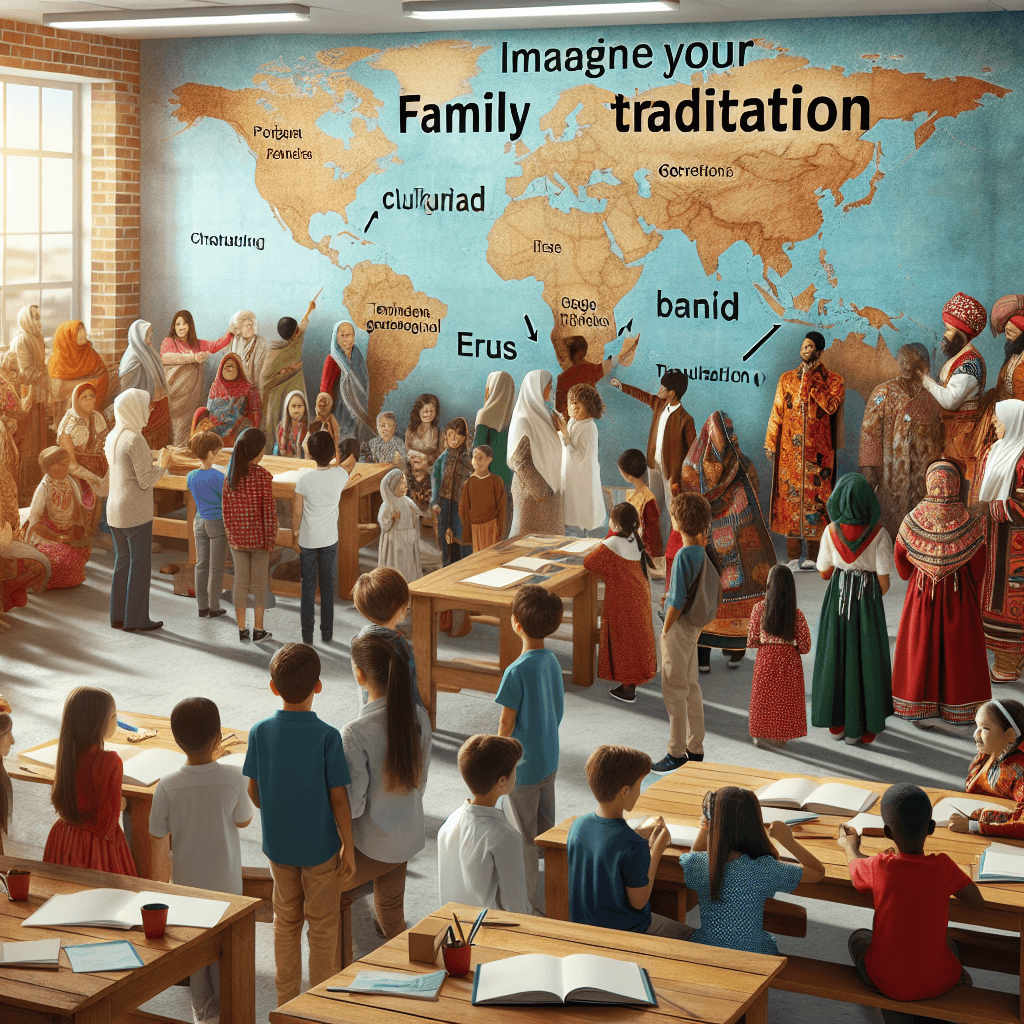
Exploring Family Traditions and Histories
Inquiry Framework
Question Framework
Driving Question
The overarching question that guides the entire project.How can we use storytelling and art to explore and express our personal and cultural identities while learning to appreciate and respect the diverse backgrounds in our community?Essential Questions
Supporting questions that break down major concepts.- What is cultural identity and how does it shape who we are?
- How do family traditions reflect our cultural heritage?
- In what ways can storytelling help us learn about our family history?
- How can we express our identity through art and creative projects?
- Why is it important to understand and respect diverse cultural backgrounds within our community and classroom?
Standards & Learning Goals
Learning Goals
By the end of this project, students will be able to:- Students will be able to articulate their understanding of personal and cultural identity through storytelling and art.
- Students will learn to appreciate and respect diverse cultural backgrounds in their community and classroom.
- Students will develop skills to investigate and recount their own family traditions and histories.
- Students will compare past and present cultural practices related to family traditions.
- Students will creatively express their personal and cultural identity using various art forms.
Common Core State Standards
C3 Framework for Social Studies
National Core Arts Standards
Entry Events
Events that will be used to introduce the project to studentsCultural Show-and-Tell
Begin the project with a 'Cultural Show-and-Tell' day where students bring an item or story from their family tradition to share with the class. This could be a piece of clothing, a special dish, or a photo. This event immediately connects to the core project by encouraging students to share and learn about personal and cultural histories in a tactile way.Family History Interview Introduction
Students are introduced to the project by interviewing a family member about their cultural traditions and histories using a provided questionnaire. Class discussion follows where students share interview highlights, opening avenues for deeper inquiry into personal and cultural identities.Interactive Heritage Map
Kick off the project with an activity where students place pins on a world map representing their family's countries of origin. They can share one interesting fact or a family tradition from their heritage. This visually engaging entry event sets a global context for further exploration and understanding of diverse identities.Family Recipe Swap
Organize a 'Family Recipe Swap' where students bring a simple recipe from their family traditions. This culinary journey not only introduces students to diverse cultural practices but also encourages them to explore and share the stories behind these recipes, making connections to personal and cultural identities.Portfolio Activities
Portfolio Activities
These activities progressively build towards your learning goals, with each submission contributing to the student's final portfolio.Cultural Connection Collage
In this introductory activity, students create a visual collage to represent their family traditions and cultural background. They will gather photos, magazine cutouts, or illustrations that resonate with their family history to make a collage that tells their cultural story visually.Steps
Here is some basic scaffolding to help students complete the activity.Final Product
What students will submit as the final product of the activityA cultural collage representing family traditions and cultural identity, accompanied by a brief presentation explaining its elements.Alignment
How this activity aligns with the learning objectives & standardsAligns with CCSS.ELA-LITERACY.SL.2.4 by encouraging storytelling through visual elements and speaking coherently about the collage.Family Traditions Podcast
Students will work to create a podcast episode where they interview a family member about cultural stories and traditions. This activity involves planning, scripting, recording, and editing a podcast episode.Steps
Here is some basic scaffolding to help students complete the activity.Final Product
What students will submit as the final product of the activityA recorded podcast episode sharing an interview about family traditions and cultural stories.Alignment
How this activity aligns with the learning objectives & standardsAligns with CCSS.ELA-LITERACY.SL.2.4 by offering opportunities to tell a story and share details in a creative audio format.Heritage Timeline Storybook
In this activity, students research their family history and produce a storybook that outlines significant family traditions and cultural shifts over generations.Steps
Here is some basic scaffolding to help students complete the activity.Final Product
What students will submit as the final product of the activityA timeline storybook that depicts family traditions and cultural shifts, accompanied by illustrations and narratives.Alignment
How this activity aligns with the learning objectives & standardsAligns with CCSS.ELA-LITERACY.W.2.7 by engaging in shared research and writing projects, and with D2.His.2.K-2 by comparing past and present cultural practices.Identity Expression Art
Through this art project, students express their personal and cultural identity by creating an art piece that incorporates elements they connect with their cultural heritage and personal experiences.Steps
Here is some basic scaffolding to help students complete the activity.Final Product
What students will submit as the final product of the activityAn art piece that creatively represents the student’s personal and cultural identity, showcased in a class exhibition.Alignment
How this activity aligns with the learning objectives & standardsSupports Anchor Standard #1 by helping students generate and conceptualize artistic ideas and work.Community Culture Celebration
Conclude the project with a classroom event celebrating the diverse cultural backgrounds of the students. They will plan and participate in a celebration showcasing their learning and creative projects.Steps
Here is some basic scaffolding to help students complete the activity.Final Product
What students will submit as the final product of the activityA classroom event showcasing student projects, fostering an environment of appreciation and respect for diversity.Alignment
How this activity aligns with the learning objectives & standardsConnects with D2.Civ.8.K-2 by identifying and explaining community interaction and respect, using collaboration and expression.Rubric & Reflection
Portfolio Rubric
Grading criteria for assessing the overall project portfolioCultural Identity Exploration Rubric
Understanding of Cultural Identity
Assesses the student's comprehension and articulation of their cultural identity through various media.Articulation of Identity
Measures how well the student can describe and explain their understanding of cultural identity.
Exemplary
4 PointsStudent articulates their cultural identity with depth, using specific examples and connecting personal experiences meaningfully.
Proficient
3 PointsStudent describes their cultural identity clearly, using some examples and relevant personal experiences.
Developing
2 PointsStudent gives a basic description of their cultural identity with limited examples or personal connections.
Beginning
1 PointsStudent struggles to describe their cultural identity, providing minimal examples or unclear connections.
Depth of Cultural Exploration
Evaluates the thoroughness in exploring cultural traditions and histories.
Exemplary
4 PointsStudent demonstrates extensive exploration into family traditions and history, offering detailed accounts and multiple perspectives.
Proficient
3 PointsStudent explores family traditions and history well, providing detailed information with some diversity of perspectives.
Developing
2 PointsStudent shows limited exploration of family traditions and history, providing some general information.
Beginning
1 PointsStudent shows minimal exploration, providing insufficient or unrelated information on family traditions and history.
Creative Expression
Assesses the originality and creativity in students' use of storytelling, art, and presentation.Originality in Art
Measures the creativity and uniqueness of art or creative projects expressing personal and cultural identity.
Exemplary
4 PointsStudent creates highly original and visually engaging art, incorporating unique symbols and inventive artistic techniques.
Proficient
3 PointsStudent creates creative and appealing art using appropriate symbols and techniques.
Developing
2 PointsStudent shows some creativity in art, though originality and engagement are limited.
Beginning
1 PointsStudent displays limited creativity, using few symbols and simple techniques.
Storytelling Innovation
Evaluates the innovation in narrative techniques used in storytelling activities, such as podcasts or presentations.
Exemplary
4 PointsStudent uses innovative storytelling techniques, presenting narratives in an engaging and fluent manner with clear thematic connections.
Proficient
3 PointsStudent uses appropriate storytelling techniques, presenting narratives clearly with thematic ties.
Developing
2 PointsStudent shows basic use of storytelling techniques, with some narrative clarity.
Beginning
1 PointsStudent struggles to use effective storytelling techniques, resulting in unclear narratives.
Presentation and Communication
Evaluates the effectiveness and fluency in presentation and peer communication.Presentation Clarity
How clearly the student presents their ideas and findings through various formats (orally, visually, etc.).
Exemplary
4 PointsStudent presents ideas with extreme clarity, confidence, and engagement across all formats.
Proficient
3 PointsStudent presents clearly and confidently in most formats.
Developing
2 PointsStudent presents ideas with occasional clarity and confidence.
Beginning
1 PointsStudent struggles with clear presentation and confidence.