
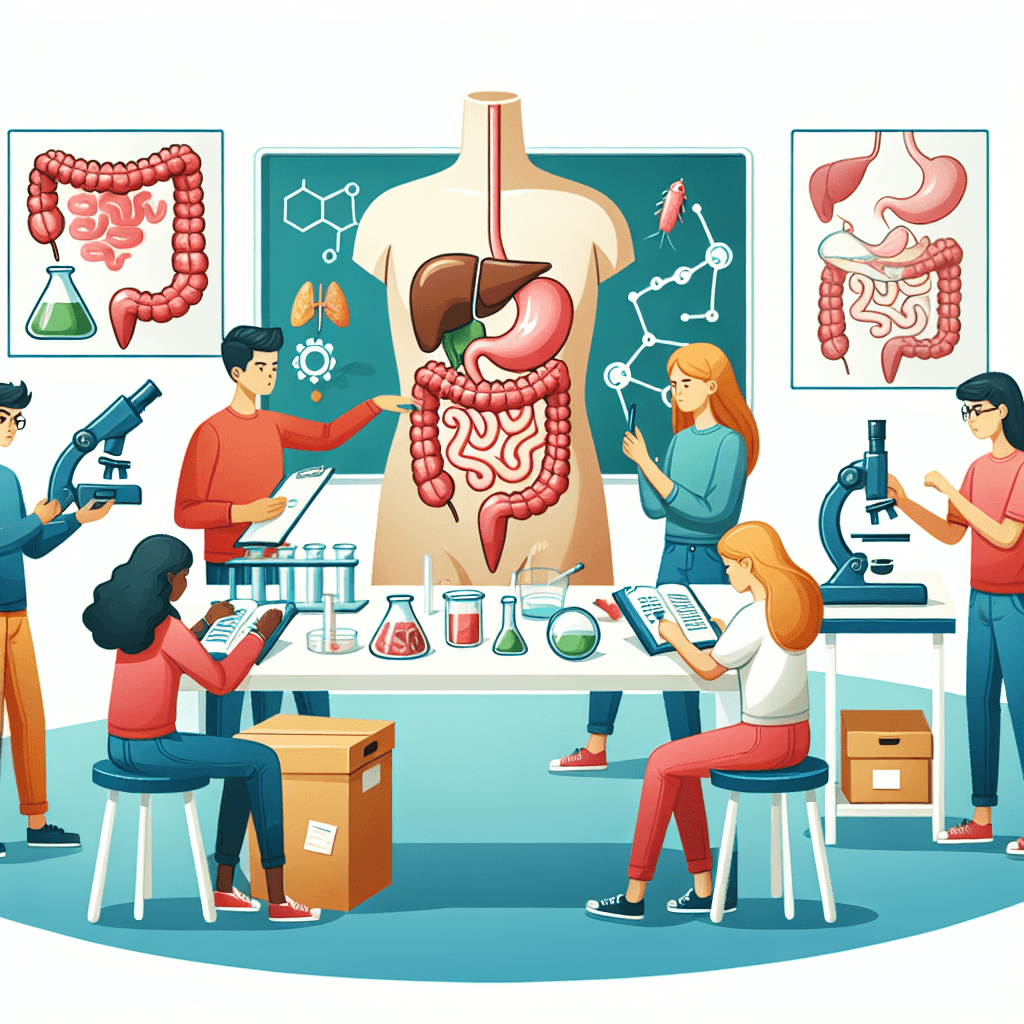
Exploring Human Digestion: Interactive Lab Activities
Inquiry Framework
Question Framework
Driving Question
The overarching question that guides the entire project.How can we design and conduct lab experiments to explore the intricate processes of the human digestive system, including organ functions, enzyme roles, disorders, and the influence of diet?Essential Questions
Supporting questions that break down major concepts.- How does the human digestive system function as a whole?
- What are the roles of different organs in the digestive system?
- How do enzymes and digestive juices aid in the digestion of food?
- What are the common disorders of the digestive system and how do they affect digestion?
- How does the structure of each part of the digestive system relate to its function?
- What impact do diet and nutrition have on the functioning of the digestive system?
Standards & Learning Goals
Learning Goals
By the end of this project, students will be able to:- Understand the overall function of the human digestive system and the specific roles of individual organs involved.
- Design and conduct lab experiments to investigate the role of enzymes and digestive juices in the digestive process.
- Analyze the impact of common digestive disorders on the system's function and relate them to disruptions in normal processes.
- Evaluate how diet and nutrition can influence digestive health and organ function.
- Synthesize knowledge from lab experiments to create models demonstrating the interaction and interdependence of digestive system components.
Next Generation Science Standards
Common Core Standards
Entry Events
Events that will be used to introduce the project to studentsDigestive Detective
Students are presented with a real-life case study of someone with a mysterious digestive issue to solve. They must apply their knowledge of the digestive system to diagnose the problem, offering solutions and dietary recommendations.Culinary Chemistry Challenge
Students take on the role of 'digestive chefs', tasked with designing a meal plan that optimizes nutrient absorption, while explaining the biochemical processes that aid digestion.Portfolio Activities
Portfolio Activities
These activities progressively build towards your learning goals, with each submission contributing to the student's final portfolio.Organs & Functions Map Quest
Students create a detailed map and explanation of the human digestive system, focusing on organ functions and interactions.Steps
Here is some basic scaffolding to help students complete the activity.Final Product
What students will submit as the final product of the activityA labeled map of the digestive system with accompanying descriptions of each organ's function and interactions.Alignment
How this activity aligns with the learning objectives & standardsAligns with HS-LS1-2, focusing on the organization of interacting systems.Enzyme Action Exploration
Engage in hands-on lab activities to investigate how enzymes work in digestion.Steps
Here is some basic scaffolding to help students complete the activity.Final Product
What students will submit as the final product of the activityA complete lab report with data analysis on enzyme activity in digestion.Alignment
How this activity aligns with the learning objectives & standardsLinks to HS-LS1-3, planning and conducting investigations on enzyme regulation.Dietary Impact Investigation
Conduct experiments to evaluate how different diets affect the digestive system's efficiency and health.Steps
Here is some basic scaffolding to help students complete the activity.Final Product
What students will submit as the final product of the activityA presentation with experimental data on the impact of diet on digestion.Alignment
How this activity aligns with the learning objectives & standardsAddresses HS-LS1-7 by linking diet through digestion to energy release.Digestive Disorders Case Study
Explore common digestive disorders and their effects on the digestive system through case studies.Steps
Here is some basic scaffolding to help students complete the activity.Final Product
What students will submit as the final product of the activityA detailed case study on a digestive disorder, highlighting its impact and management strategies.Alignment
How this activity aligns with the learning objectives & standardsCovers HS-LS1-2 through exploring disruptions in the digestive system's hierarchy.Interactive Digestive Simulation Design
Develop a model illustrating the complex interactions within the digestive system, showing how various factors influence function.Steps
Here is some basic scaffolding to help students complete the activity.Final Product
What students will submit as the final product of the activityAn interactive simulation or model of the digestive system showing interconnections and influences.Alignment
How this activity aligns with the learning objectives & standardsSupports HS-LS1-7 and CCSS.ELA-LITERACY.W.11-12.7 by using models to illustrate digestive processes and synthesize investigations.Rubric & Reflection
Portfolio Rubric
Grading criteria for assessing the overall project portfolioDigestive System Exploration Rubric
Scientific Inquiry and Experimentation
Evaluates students' ability to design, conduct, and analyze scientific experiments related to digestion.Experimental Design
Assesses the ability to plan and set up a valid and reliable experiment.
Exemplary
4 PointsDesigns an innovative and thoroughly detailed experiment that addresses the research question comprehensively.
Proficient
3 PointsDesigns a clear and effective experiment that appropriately addresses the research question.
Developing
2 PointsDesigns an experiment that partially addresses the research question with some logistical issues.
Beginning
1 PointsShows struggle with designing an experiment that addresses the research question.
Data Collection and Analysis
Evaluates the precision and depth of data collection and analysis.
Exemplary
4 PointsCollects accurate data systematically and interprets results with advanced analytical skills.
Proficient
3 PointsCollects data accurately and analyzes results effectively to draw logical conclusions.
Developing
2 PointsCollects some relevant data but analysis lacks depth, resulting in basic conclusions.
Beginning
1 PointsStruggles to collect relevant data or analyze it meaningfully.
Content Understanding and Application
Measures knowledge of digestive system processes and ability to apply this understanding in lab activities.Conceptual Understanding
Assesses understanding of human digestive system organ functions and interactions.
Exemplary
4 PointsDemonstrates comprehensive understanding of digestive processes and articulates intricate organ interdependencies.
Proficient
3 PointsShows thorough understanding of essential digestive processes with clear explanation of organ functions.
Developing
2 PointsExhibits partial understanding with basic explanations of organ functions and interactions.
Beginning
1 PointsDisplays minimal understanding of organ functions and how they relate to the entire digestive system.
Communication and Presentation
Focuses on the ability to effectively communicate findings and ideas through written and oral presentations.Clarity and Organization
Assesses the ability to present complex ideas clearly and systematically.
Exemplary
4 PointsPresents information in a highly organized, clear manner, with exceptional articulation of ideas.
Proficient
3 PointsPresents information clearly and systematically, with a logical flow of ideas.
Developing
2 PointsPresents information with some logical sequence but ideas occasionally lack clarity.
Beginning
1 PointsStruggles to present information clearly or organize ideas systematically.
Collaboration and Reflective Thinking
Assesses the ability to participate in teamwork and reflect on learning experiences.Teamwork and Contribution
Evaluates active participation and contribution to group activities.
Exemplary
4 PointsLeads group work with proactive ideas and solutions, fostering a collaborative learning environment.
Proficient
3 PointsContributes effectively with constructive input, promoting collaborative work.
Developing
2 PointsParticipates in group tasks with occasional contributions to discussions.
Beginning
1 PointsShows minimal participation in group activities and requires encouragement.