
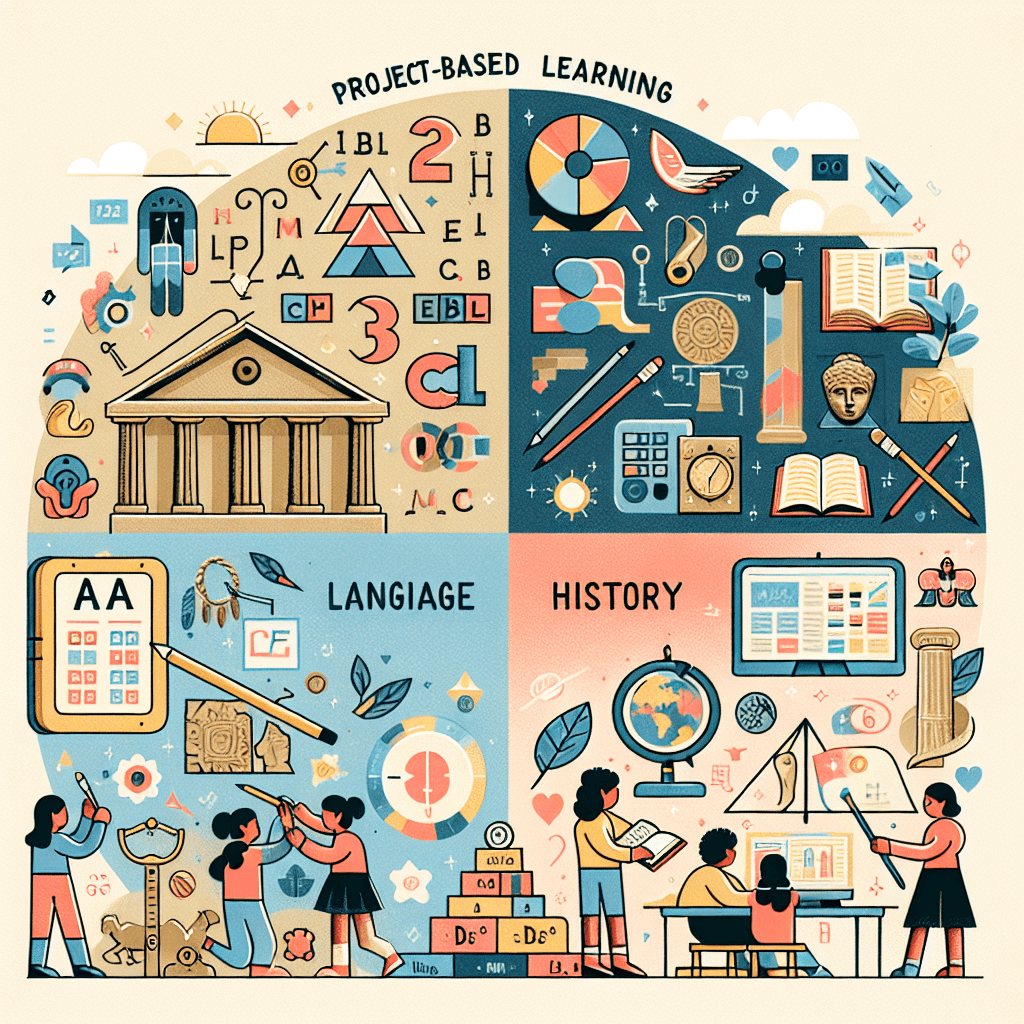
Exploring Innovators: Math, Language, History Adventures
Inquiry Framework
Question Framework
Driving Question
The overarching question that guides the entire project.How have the contributions of significant inventors and explorers shaped history, and what methods can students use to understand their impact through mathematical, historical, and linguistic lenses?Essential Questions
Supporting questions that break down major concepts.- Who are some of the most significant inventors and explorers, and what impact have they had on history?
- How can we sequence historical events and figures accurately, and what tools or language should we use to do so?
- What are the key characteristics and features of the periods and societies that have contributed to the development of civilization?
- How do we measure and convert between different units of measurement, and why is this important in understanding historical studies?
- In what ways do mathematical concepts like geometry and measurement help us understand the world of inventors and explorers?
- How can understanding angles and shapes aid in solving real-world problems that inventors and explorers may have faced?
- What are the skills needed to communicate effectively about historical figures and their contributions in multiple languages?
- How can we analyze and evaluate the impact of inventors and explorers on a specific society, such as China?
- What methods can we use to share our understanding of historical inventors and explorers through speeches, presentations, and written reports?
- How can researching diverse views and incorporating them into our conclusions improve our understanding of historical contributions?
Standards & Learning Goals
Learning Goals
By the end of this project, students will be able to:- Students will be able to identify and discuss significant inventors and explorers and their contributions to history.
- Students will demonstrate the ability to sequence historical events related to inventors and explorers accurately.
- Students will connect characteristics and features of specific periods to the contributions of inventors and explorers.
- Students will use mathematical concepts to interpret historical data and artifacts related to inventors and explorers.
- Students will improve skills in communicating about historical figures and their contributions in English and a foreign language.
- Students will analyze and evaluate the impact of inventors and explorers on different societies, focusing particularly on China.
- Students will develop and present speeches, presentations, and written reports on historical inventors and explorers.
- Students will enhance their research skills by incorporating diverse viewpoints into their understanding of historical contributions.
Social Studies
Math
English
Foreign Language
Entry Events
Events that will be used to introduce the project to studentsInventor's Shark Tank
Students simulate a 'Shark Tank' episode where they pitch modern adaptations of historic inventions to a panel of 'investors'. By researching and creatively presenting how inventions from the past can be updated for today's world, students develop critical thinking and persuasive skills.Portfolio Activities
Portfolio Activities
These activities progressively build towards your learning goals, with each submission contributing to the student's final portfolio.Timelines of Change
Students create detailed timelines representing significant events in the lives and contributions of famous inventors and explorers. This activity will cultivate students' skills in sequencing historical events using proper academic terminology.Steps
Here is some basic scaffolding to help students complete the activity.Final Product
What students will submit as the final product of the activityA completed visual timeline of an inventor or explorer, showcasing significant life events in chronological order.Alignment
How this activity aligns with the learning objectives & standardsAligns with 6PP101 by focusing on sequencing events, people, and changes in chronological order.Historical Context Chronicles
In this activity, students delve into the eras of their chosen inventors or explorers, investigating the characteristics and features of the societies during those times. By connecting historical context with individual contributions, students will deepen their understanding of how societies develop.Steps
Here is some basic scaffolding to help students complete the activity.Final Product
What students will submit as the final product of the activityA written report and class presentation connecting historical characteristics with individual achievements.Alignment
How this activity aligns with the learning objectives & standardsSupports 6PP102 by connecting characteristics and features of the periods and societies studied.Chinese Contributions Evaluation
Focuses on the contributions of inventors and explorers specifically to Chinese society. Students will analyze texts and resources to evaluate the historical impact of these individuals and formulate evidence-based conclusions.Steps
Here is some basic scaffolding to help students complete the activity.Final Product
What students will submit as the final product of the activityA comprehensive evaluation essay regarding contributions to Chinese society.Alignment
How this activity aligns with the learning objectives & standardsTargets 6PP103 by analyzing and evaluating the contributions to the development of Chinese society.Measurement Mastery Adventure
Students engage in hands-on activities to understand mathematical concepts within a historical context, such as measuring historical artifacts or tools. They'll focus on various measurement conversions and understand how these metrics apply to interpreting historical data.Steps
Here is some basic scaffolding to help students complete the activity.Final Product
What students will submit as the final product of the activityA chart displaying accurate conversions between different units for historical measurements.Alignment
How this activity aligns with the learning objectives & standardsCovers 6MMMC2 by focusing on the selection and conversion of standard metric and imperial units.Persuasive Pitch Performance
Leveraging the 'Inventor's Shark Tank' entry event, students create and refine pitches for updating historical inventions. They'll apply English skills in writing and oral presentations to persuade a panel of 'investors' of the viability and importance of their ideas.Steps
Here is some basic scaffolding to help students complete the activity.Final Product
What students will submit as the final product of the activityA well-structured oral presentation persuading the audience of a modern adaptation of a historical invention.Alignment
How this activity aligns with the learning objectives & standardsAligns with ESA15 by encouraging speeches and presentations, as well as enhancing skills in using technical vocabulary (EWD03).Rubric & Reflection
Portfolio Rubric
Grading criteria for assessing the overall project portfolioInventors and Explorers Comprehensive Evaluation Rubric
Historical Understanding and Chronological Sequencing
Evaluates student's ability to research, sequence, and narrate events, focusing on significant inventors and explorers.Research and Gathering Information
Assess the thoroughness and accuracy of the background research on inventors and explorers.
Exemplary
4 PointsDemonstrates comprehensive and accurate research with a deep understanding of the inventor's or explorer's contributions and historical context.
Proficient
3 PointsDemonstrates accurate research with a good understanding of the inventor's or explorer's contributions.
Developing
2 PointsShows basic research with some understanding of contributions, but may lack depth or accuracy.
Beginning
1 PointsShows limited research with minimal understanding of the inventor's or explorer's contributions.
Chronological Sequencing
Evaluates the ability to sequence key historical events accurately and clearly.
Exemplary
4 PointsSequences all events accurately with clear labels and academic terminology, demonstrating sophisticated understanding.
Proficient
3 PointsAccurately sequences most events with clear understanding and use of proper terminology.
Developing
2 PointsAttempts to sequence events but may have some inaccuracies or lack of clarity.
Beginning
1 PointsStruggles to sequence events accurately and clearly.
Connection to Historical Context
Assesses the ability to connect historical inventors' contributions to the socio-political, and technological contexts of their times.Contextual Analysis
Evaluates the student’s capability to relate inventors' contributions to the characteristics of their societal period.
Exemplary
4 PointsProvides insightful analysis with clear connections to multiple societal features and impacts.
Proficient
3 PointsEffectively connects contributions to societal features, demonstrating good analysis.
Developing
2 PointsShows basic connections but lacks depth in understanding societal features or impacts.
Beginning
1 PointsMinimal connection between contributions and societal features; lacks coherence.
Influence of Historical Periods
Evaluates how well students understand the influence of different historical periods on inventors' contributions.
Exemplary
4 PointsDemonstrates deep understanding of how historical periods influenced inventions, with insightful examples.
Proficient
3 PointsShows good understanding with clear examples of influence though might lack depth.
Developing
2 PointsUnderstands basic influences but provides limited examples or insights.
Beginning
1 PointsLimited understanding of influences; lacks supporting examples and clarity.
Mathematical Interpretation and Application
Evaluates the ability to use mathematical concepts to interpret historical data effectively.Measurement and Conversion Skills
Assesses accuracy and understanding of converting between metric and imperial units used in historical contexts.
Exemplary
4 PointsDemonstrates precise and thorough conversion skills, applying them innovatively to historical contexts.
Proficient
3 PointsAccurately uses conversion skills in historical contexts with minimal error.
Developing
2 PointsShows developing conversion skills with occasional inaccuracies.
Beginning
1 PointsStruggles with basic conversion skills; multiple inaccuracies noted.
Mathematical Problem Solving
Evaluates student's ability to use geometric and mathematic principles to solve historical problems.
Exemplary
4 PointsExhibits advanced problem-solving skills using math to solve complex historical issues.
Proficient
3 PointsSolves historical problems well using mathematical principles, though lacks complexity.
Developing
2 PointsShows basic problem-solving attempts with mathematical principles; incomplete solutions.
Beginning
1 PointsMinimal problem-solving demonstrated; inability to apply mathematics effectively.
Communicative Skills and Presentation
Assesses the students’ ability to effectively present findings in both written and oral formats with clarity and persuasion.Oral Presentation Skills
Evaluates the ability to convey ideas and arguments effectively in an oral format.
Exemplary
4 PointsPresents in a highly engaging, clear, and persuasive manner, integrating advanced communication techniques.
Proficient
3 PointsConveys ideas clearly and persuasively, with effective communication.
Developing
2 PointsCommunicates basic ideas inconsistently; lacks persuasive clarity.
Beginning
1 PointsStruggles to communicate ideas effectively or persuasively.
Writing and Vocabulary Precision
Assesses the use of appropriate academic vocabulary and clear structuring in written reports.
Exemplary
4 PointsUses sophisticated vocabulary and structured arguments effectively, demonstrating depth and clarity in writing.
Proficient
3 PointsUses appropriate vocabulary with well-structured arguments, though may lack depth.
Developing
2 PointsUses basic vocabulary and somewhat structured writing but lacks sophistication.
Beginning
1 PointsMinimal vocabulary use; lacks clear, structured arguments.
Analytical and Critical Thinking
Reviews the student’s ability to evaluate diverse viewpoints and integrate them into their analyses of historical contributions.Critical Analysis of Contributions
Assesses the depth of analysis regarding the contributions of inventors and explorers to society.
Exemplary
4 PointsDelivers comprehensive evaluations with deep analytical insights into historical contributions.
Proficient
3 PointsProvides solid analysis of contributions, demonstrating essential analytical skills.
Developing
2 PointsShows emerging analytical skills with limited depth in evaluations.
Beginning
1 PointsStruggles to analyze contributions deeply; lack of critical insights.
Integration of Diverse Viewpoints
Evaluates how well students incorporate multiple perspectives into their historical analyses.
Exemplary
4 PointsIntegrates diverse perspectives with clarity, enhancing the depth of analysis significantly.
Proficient
3 PointsEffectively includes multiple viewpoints, strengthening analysis moderately.
Developing
2 PointsAttempts to include diverse views, but integration is limited or lacking impact.
Beginning
1 PointsMinimal or no incorporation of differing views in analysis.