
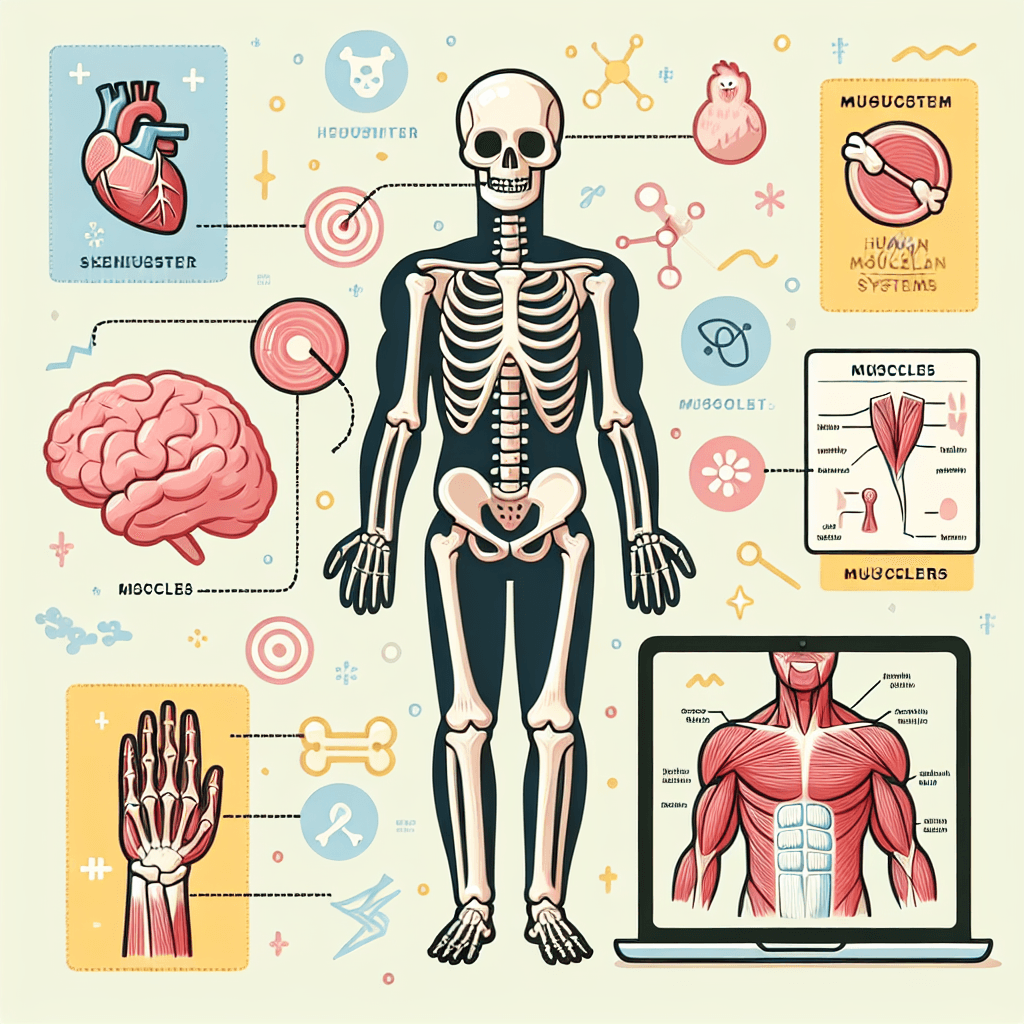
Exploring the Human Skeletal and Muscular Systems
Inquiry Framework
Question Framework
Driving Question
The overarching question that guides the entire project.How can we create detailed presentations on specific parts of the human body, such as the arm, leg, or core, to demonstrate the functions and interconnections of their skeletal and muscular systems and promote awareness on maintaining their health and preventing common injuries?Essential Questions
Supporting questions that break down major concepts.- What are the main functions of the skeletal and muscular systems in a specific body part (e.g., arm, leg, core)?
- How do the skeletal and muscular systems in a specific body part work together to enable movement and support?
- Why is it important to maintain the health of specific bones and muscles in the body?
- What are some common injuries or disorders affecting specific body parts, and how can these be prevented or treated?
Standards & Learning Goals
Learning Goals
By the end of this project, students will be able to:- Students will understand and illustrate the main functions of the human skeletal and muscular systems through mini posters.
- Students will articulate how the skeletal and muscular systems work together to support movement, using researched evidence.
- Students will explore and discuss strategies for maintaining skeletal and muscular health and preventing common injuries.
- Students will develop research and information synthesis skills by accessing, evaluating, and using various resources effectively.
Next Generation Science Standards
Common Core Standards
Entry Events
Events that will be used to introduce the project to studentsThe Mystery of the Missing Bone
Students enter the classroom to find a mysterious note and a set of bones hidden around the room. They're tasked with locating and identifying each bone to help 'rebuild' a missing skeleton, engaging them immediately in an anatomical treasure hunt that ties directly to the skeletal system.Portfolio Activities
Portfolio Activities
These activities progressively build towards your learning goals, with each submission contributing to the student's final portfolio.Anatomical Treasure Hunt
Students engage in a classroom treasure hunt where they locate and identify hidden bones, immediately immersing them in the basics of the skeletal system and engaging critical thinking and observational skills.Steps
Here is some basic scaffolding to help students complete the activity.Final Product
What students will submit as the final product of the activityA list of identified bones with descriptions of their functions.Alignment
How this activity aligns with the learning objectives & standardsAligns with NGSS MS-LS1-3 by initiating an understanding of how bones function as part of the human body's subsystems.Body System Mechanics
Students work in pairs to brainstorm and map out the relationship between specific bones and muscles, understanding their cooperation to facilitate movement.Steps
Here is some basic scaffolding to help students complete the activity.Final Product
What students will submit as the final product of the activityA collaborative mind map showing the interworking of bones and muscles in a chosen body area.Alignment
How this activity aligns with the learning objectives & standardsSupports NGSS MS-LS1-3 by demonstrating how bones and muscles function together as interacting subsystems of the body.Health Awareness Poster
Each student creates a mini poster to educate peers about the importance of maintaining healthy bones and muscles, including common injuries and prevention strategies.Steps
Here is some basic scaffolding to help students complete the activity.Final Product
What students will submit as the final product of the activityAn informative poster on skeletal and muscular health with tips and prevention strategies.Alignment
How this activity aligns with the learning objectives & standardsConnects to CCSS ELA-Literacy.W.6.7 by requiring students to conduct research and synthesize information into a coherent format.Mini Poster Presentation
Students present their mini posters to the class, sharing their findings and insights about their chosen body area, demonstrating both collaborative and individual learning outcomes.Steps
Here is some basic scaffolding to help students complete the activity.Final Product
What students will submit as the final product of the activityA class presentation that highlights each student's research findings on a specific body area and its skeletal and muscular health.Alignment
How this activity aligns with the learning objectives & standardsAddresses CCSS ELA-Literacy.W.6.8 by synthesizing research and presenting findings, fostering speaking and listening skills.Rubric & Reflection
Portfolio Rubric
Grading criteria for assessing the overall project portfolioSkeletal and Muscular Systems Portfolio Rubric
Content Understanding
Assessment of the depth of knowledge and understanding of the skeletal and muscular systems, including their functions and interconnections.Accuracy of Information
Evaluation of the correctness and precision of the information presented regarding the skeletal and muscular systems.
Exemplary
4 PointsInformation is highly accurate, with detailed and precise descriptions of each system and their interconnections, showcasing in-depth research and understanding.
Proficient
3 PointsInformation is mostly accurate, with a clear understanding of the systems and their functions, supported by research.
Developing
2 PointsInformation is somewhat accurate, with basic descriptions that may overlook some key points or interconnections.
Beginning
1 PointsInformation is limited or inaccurate, failing to clearly describe the systems or their interconnections.
Integration of Systems
Assessment of the ability to describe how skeletal and muscular systems work together to enable movement and provide support.
Exemplary
4 PointsStudent effectively and creatively demonstrates the integration of skeletal and muscular systems with clear examples and explanations.
Proficient
3 PointsStudent clearly demonstrates the integration of skeletal and muscular systems with appropriate examples.
Developing
2 PointsStudent provides a basic demonstration of system integration, with limited examples or explanations.
Beginning
1 PointsStudent struggles to demonstrate system integration, offering vague or no examples.
Research and Synthesis
Evaluation of students’ ability to gather, evaluate, and synthesize information effectively for informed presentation and poster creation.Research Quality
Assessment of the ability to conduct thorough research using reliable sources and incorporating varied information into the final product.
Exemplary
4 PointsResearch is comprehensive, utilizing diverse and credible sources to build a strong, evidence-backed presentation or poster.
Proficient
3 PointsResearch is thorough, using several credible sources to support the presentation or poster.
Developing
2 PointsResearch is limited or uses few reliable sources, resulting in incomplete information synthesis.
Beginning
1 PointsResearch is minimal, lacking credible sources or synthesis of information.
Information Synthesis
Evaluation of the ability to organize and present collected information clearly and coherently.
Exemplary
4 PointsInformation is organized and synthesized in an exceptionally clear, logical, and engaging manner through the presentation or poster.
Proficient
3 PointsInformation is organized clearly and logically, with effective use in the presentation or poster.
Developing
2 PointsInformation is partially organized, lacking full coherence or structure in the presentation or poster.
Beginning
1 PointsInformation is poorly organized, lacking clarity and coherence in presentation.
Creativity and Engagement
Assessment of the creativity in presentation and the ability to engage the audience via posters, presentations, or activities.Creativity
Evaluation of originality and inventiveness in designing presentations or creating posters.
Exemplary
4 PointsDemonstrates high originality and creativity, making the presentation or poster particularly engaging and informative.
Proficient
3 PointsShows originality and creativity, effectively engaging the audience through the presentation or poster.
Developing
2 PointsDemonstrates some creativity, but with limited originality or engagement in the presentation or poster.
Beginning
1 PointsLacks creativity, resulting in a presentation or poster that fails to engage the audience.
Audience Engagement
Assessment of the student's ability to engage peers and teachers during presentations and poster displays.
Exemplary
4 PointsConsistently engages the audience, fostering interactive discussion and attention throughout the presentation or display.
Proficient
3 PointsEngages the audience effectively, maintaining attention throughout the presentation or display.
Developing
2 PointsShows some effort to engage the audience, but with limited effectiveness.
Beginning
1 PointsStruggles to engage the audience, with minimal effort to ensure interaction or attention.