
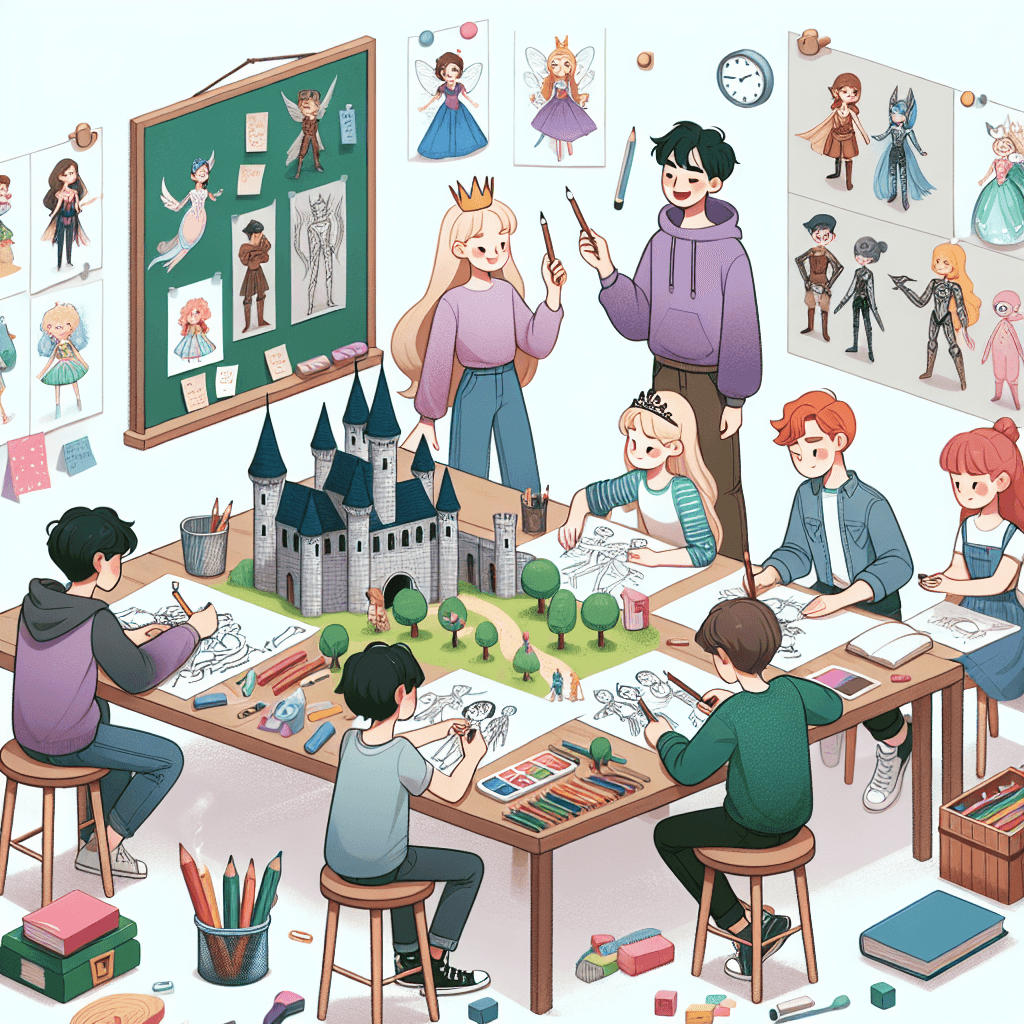
Fairytale Character Creation: A Storytelling Project
Inquiry Framework
Question Framework
Driving Question
The overarching question that guides the entire project.How can we create a memorable fairytale character that helps us tell an engaging story with all the key fairytale elements?Essential Questions
Supporting questions that break down major concepts.- What makes a character memorable?
- How do characters help tell a story?
- What are the key parts of a fairytale?
Standards & Learning Goals
Learning Goals
By the end of this project, students will be able to:- Students will be able to identify and describe the key elements of a fairytale.
- Students will be able to create a unique and memorable fairytale character.
- Students will be able to explain how their character contributes to the plot of a fairytale story.
Entry Events
Events that will be used to introduce the project to studentsFractured Fairytale Rescue
The teacher dramatically reads a fractured fairytale where the main character is missing key traits, leaving the story unresolved. Students are invited to 'repair' the story by inventing a character to complete it.Mystery Character Kit
A mysterious package arrives containing random objects (e.g., a toy sword, a sparkly fabric scrap, a rubber chicken). Students brainstorm what kind of fairytale character would possess these items, fostering curiosity and imaginative thinking.Fairytale Convention
The class participates in a 'Fairytale Character Creation Convention' where they explore different character archetypes (hero, villain, sidekick) and traits through interactive games and role-playing, building a foundation for their own creations.The Lost Ending
Begin reading a popular fairytale but stop at a critical moment, announcing that the original ending is lost. Challenge students to create a new character who can resolve the story's central conflict in a unique and imaginative way.Portfolio Activities
Portfolio Activities
These activities progressively build towards your learning goals, with each submission contributing to the student's final portfolio.Fairytale Element Expedition
Students will explore existing fairytales to identify common elements such as setting, characters, problem, and solution.Steps
Here is some basic scaffolding to help students complete the activity.Final Product
What students will submit as the final product of the activityA fairytale elements chart for three different fairytales.Alignment
How this activity aligns with the learning objectives & standardsLearning Goal: Students will be able to identify and describe the key elements of a fairytale.Character Creation Lab
Students will brainstorm different character traits and develop a profile for their own fairytale character.Steps
Here is some basic scaffolding to help students complete the activity.Final Product
What students will submit as the final product of the activityA character profile including name, appearance, personality, and special abilities.Alignment
How this activity aligns with the learning objectives & standardsLearning Goal: Students will be able to create a unique and memorable fairytale character.Story Spark Blueprint
Students will create a short story outline showing how their character interacts with other fairytale elements to solve a problem.Steps
Here is some basic scaffolding to help students complete the activity.Final Product
What students will submit as the final product of the activityA story outline with a clear problem, a description of how the character intervenes, and the resolution.Alignment
How this activity aligns with the learning objectives & standardsLearning Goal: Students will be able to explain how their character contributes to the plot of a fairytale story.Rubric & Reflection
Portfolio Rubric
Grading criteria for assessing the overall project portfolioFairytale Character Creation Rubric
Fairytale Elements
Assesses students' ability to recognize and describe key components of fairytales.Fairytale Element Identification
Demonstrates understanding of key fairytale elements (setting, characters, problem, solution).
Exemplary
4 PointsIdentifies and accurately describes all key fairytale elements in multiple fairytales with detailed examples.
Proficient
3 PointsIdentifies and describes most fairytale elements accurately, with clear examples from the stories.
Developing
2 PointsIdentifies some fairytale elements but struggles with accurate descriptions or relevant examples.
Beginning
1 PointsStruggles to identify fairytale elements or provide accurate descriptions.
Character Creation
Evaluates the creativity and thoroughness of the student-created fairytale character.Character Originality and Detail
The originality and detail of the created fairytale character.
Exemplary
4 PointsCharacter is exceptionally unique and imaginative, with rich, descriptive details of appearance, personality, and special abilities that enhance the character's appeal and memorability.
Proficient
3 PointsCharacter is creative and well-developed, with clear descriptions of appearance, personality, and special abilities.
Developing
2 PointsCharacter demonstrates some originality but lacks detail in descriptions of appearance, personality, or special abilities.
Beginning
1 PointsCharacter is generic and lacks detail; descriptions of appearance, personality, and abilities are minimal or unclear.
Story Integration
Assesses how well the student integrates their character into a story outline, focusing on problem-solving.Story Integration and Problem Solving
The clarity and effectiveness of the story outline and how the character resolves the central conflict.
Exemplary
4 PointsThe story outline is exceptionally clear and compelling, demonstrating a sophisticated understanding of plot structure; the character's role in resolving the conflict is innovative and highly effective.
Proficient
3 PointsThe story outline is clear and logical, with a well-defined problem, a clear role for the character, and a satisfying resolution.
Developing
2 PointsThe story outline is somewhat unclear or incomplete; the character's role in resolving the conflict is not fully developed.
Beginning
1 PointsThe story outline is confusing or missing key elements; the character's role in the resolution is unclear or absent.