
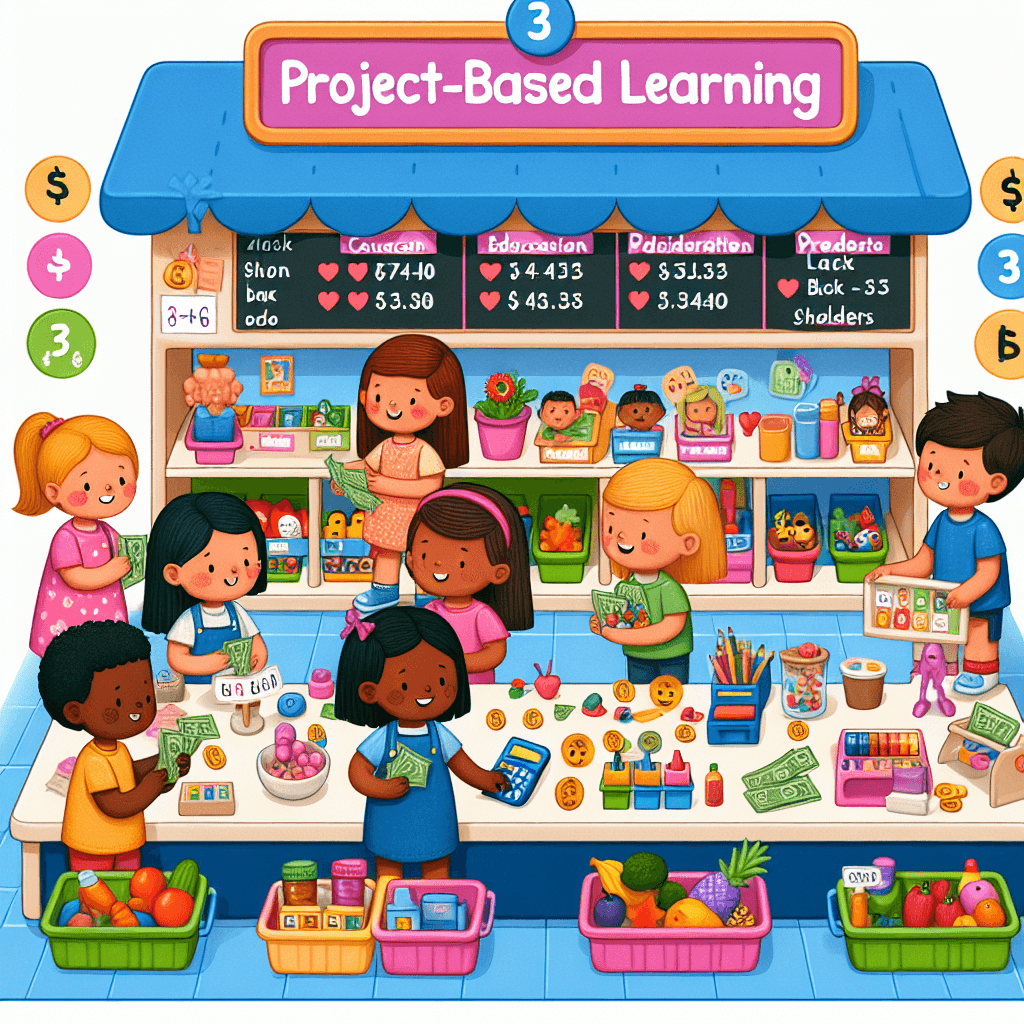
First Grade Store: A Math, Social Studies, and Economics Project
Inquiry Framework
Question Framework
Driving Question
The overarching question that guides the entire project.How can we create a store that meets the needs of our community while using math to manage our resources and make decisions about what to sell?Essential Questions
Supporting questions that break down major concepts.- How do we decide what to sell in our store?
- How can we use math to help run our store?
- How do stores help people in our community?
Standards & Learning Goals
Learning Goals
By the end of this project, students will be able to:- Students will identify community needs to inform product selection.
- Students will use addition and subtraction to manage inventory and sales.
- Students will understand the role of stores in fulfilling community needs.
- Students will apply economic concepts such as supply, demand, and profit in a simplified store model.
- Students will collaborate to design and operate a classroom store.
- Students will make decisions based on data and mathematical analysis.
- Students will communicate their reasoning and choices effectively.
- Students will learn how to manage money
- Students will improve their problem-solving skills
Entry Events
Events that will be used to introduce the project to studentsCommunity Needs Store
"Community Needs Assessment": Begin with a class discussion about problems they face daily or things they wish were more accessible in their community, guiding them to identify potential store concepts that solve real-world issues. This activity emphasizes the role of stores in fulfilling community needs and relates directly to their experiences.Pop-Up Store
The "Pop-Up Store Simulation": Transform the classroom into a temporary marketplace where students bring in items from home to 'sell' or 'trade', allowing them to experience supply, demand, and basic economic principles firsthand. This simulation introduces economic concepts and the practical aspects of running a store in a relatable way.Dream Store
"Design Your Dream Store" Contest: Challenge students to draw or build a model of their ideal store, complete with products, layout, and a catchy name, fostering creativity and allowing them to express their interests while aligning with the project's core goals. This event provides a creative outlet and multiple pathways for inquiry into store design and product selection.Portfolio Activities
Portfolio Activities
These activities progressively build towards your learning goals, with each submission contributing to the student's final portfolio.Needs vs. Wants Brainstorm
Students will brainstorm and create a list of things that people in their community need or want. They will then vote to decide which items would be best to sell in their store.Steps
Here is some basic scaffolding to help students complete the activity.Final Product
What students will submit as the final product of the activityA list of potential products for the store, ranked by student votes.Alignment
How this activity aligns with the learning objectives & standardsLearning Goal: Students will identify community needs to inform product selection.Inventory Math
Students will practice adding and subtracting quantities of items to simulate managing store inventory. They will also role-play selling items and making change.Steps
Here is some basic scaffolding to help students complete the activity.Final Product
What students will submit as the final product of the activityWorksheets showing inventory calculations and records of sales transactions.Alignment
How this activity aligns with the learning objectives & standardsLearning Goal: Students will use addition and subtraction to manage inventory and sales.Community Helper Store
Students will create posters or presentations explaining how their store helps people in the community. They will describe the products they sell and why those products are important.Steps
Here is some basic scaffolding to help students complete the activity.Final Product
What students will submit as the final product of the activityA poster or short presentation explaining the store's role in the community.Alignment
How this activity aligns with the learning objectives & standardsLearning Goal: Students will understand the role of stores in fulfilling community needs.Supply, Demand, Profit Trackers
Students will learn about supply, demand, and profit by tracking which items sell quickly and which do not. They will adjust prices and inventory based on demand.Steps
Here is some basic scaffolding to help students complete the activity.Final Product
What students will submit as the final product of the activityA simple profit and loss statement for the store, tracking sales and costs.Alignment
How this activity aligns with the learning objectives & standardsLearning Goals: Students will apply economic concepts such as supply, demand, and profit in a simplified store model.Rubric & Reflection
Portfolio Rubric
Grading criteria for assessing the overall project portfolioCreating a Store Portfolio Rubric
Needs vs. Wants
This category assesses students' ability to identify community needs and wants, collaborate effectively, and present their ideas clearly.Understanding of Needs vs. Wants
Demonstrates understanding of community needs versus wants in product selection.
Exemplary
4 PointsDemonstrates sophisticated understanding of community needs and wants, innovatively applying this understanding to product selection with detailed justification.
Proficient
3 PointsDemonstrates thorough understanding of community needs and wants, applying this to product selection with clear reasoning.
Developing
2 PointsShows emerging understanding of community needs and wants, applying this inconsistently to product selection.
Beginning
1 PointsShows initial understanding of community needs and wants but struggles with application to product selection.
Collaboration Skills
Effectiveness of collaboration in brainstorming and voting process.
Exemplary
4 PointsShows leadership in collaborative settings, ensuring all voices are heard and integrated into a cohesive list of products.
Proficient
3 PointsContributes effectively to collaboration, participating in brainstorming and voting processes to create a comprehensive product list.
Developing
2 PointsParticipates in collaboration, contributing partially to the brainstorming and voting processes.
Beginning
1 PointsRequires support in collaboration, showing limited participation in the brainstorming and voting processes.
Organization and Clarity
Clarity and organization of the final product list.
Exemplary
4 PointsPresents an outstandingly clear and organized product list, ranked effectively to reflect community needs and wants.
Proficient
3 PointsPresents a clear and organized product list, ranked according to student votes.
Developing
2 PointsPresents a product list with some organization, but clarity could be improved.
Beginning
1 PointsPresents an incomplete or disorganized product list with limited clarity.
Inventory Math
This category assesses the ability to use math skills for inventory management and sales transactions.Mathematical Accuracy
Accuracy in performing addition and subtraction calculations for inventory management.
Exemplary
4 PointsDemonstrates sophisticated accuracy in addition and subtraction, innovatively solving complex inventory problems and explaining reasoning clearly.
Proficient
3 PointsDemonstrates thorough accuracy in addition and subtraction, effectively managing inventory through correct calculations.
Developing
2 PointsShows emerging accuracy in addition and subtraction, with some errors in inventory calculations.
Beginning
1 PointsShows initial accuracy in addition and subtraction but struggles significantly with inventory calculations.
Practical Application
Application of addition and subtraction skills in role-playing scenarios.
Exemplary
4 PointsApplies addition and subtraction skills innovatively during role-play to make advanced financial decisions, demonstrating keen economic sense.
Proficient
3 PointsApplies addition and subtraction skills effectively during role-play to manage sales transactions and make correct change.
Developing
2 PointsApplies addition and subtraction skills inconsistently during role-play, making some errors in managing sales transactions.
Beginning
1 PointsStruggles to apply addition and subtraction skills during role-play, requiring significant support to manage sales transactions.
Record Keeping
Completeness and correctness of inventory worksheets and sales records.
Exemplary
4 PointsProvides exceptionally complete and correct inventory worksheets and sales records, demonstrating meticulous attention to detail and accuracy.
Proficient
3 PointsProvides complete and correct inventory worksheets and sales records, accurately reflecting inventory management and sales transactions.
Developing
2 PointsProvides partially complete inventory worksheets and sales records, with some inaccuracies or missing information.
Beginning
1 PointsProvides incomplete inventory worksheets and sales records, with significant inaccuracies and missing information.
Community Helper
This category assesses the students' ability to explain how their store benefits the community and communicate the value of their products.Community Role
Explanation of the store's role in fulfilling community needs.
Exemplary
4 PointsProvides a sophisticated and insightful explanation of the store's role, innovatively connecting it to broader community issues with compelling evidence.
Proficient
3 PointsProvides a thorough and clear explanation of the store's role in fulfilling community needs, with supporting details.
Developing
2 PointsProvides an emerging explanation of the store's role, but some aspects lack clarity or detail.
Beginning
1 PointsProvides a limited explanation of the store's role, with minimal detail or clarity.
Presentation Quality
Creativity and clarity in poster or presentation design.
Exemplary
4 PointsPresents an exceptionally creative and clear poster/presentation that effectively communicates the store's role with innovative design elements.
Proficient
3 PointsPresents a clear and well-designed poster/presentation that effectively communicates the store's role.
Developing
2 PointsPresents a poster/presentation with some creative elements, but clarity or design could be improved.
Beginning
1 PointsPresents an incomplete or poorly designed poster/presentation with limited clarity.
Product Importance
Effectiveness in communicating the importance of the products sold.
Exemplary
4 PointsCommunicates the importance of the products sold with exceptional effectiveness, making a compelling case for their value in meeting community needs.
Proficient
3 PointsClearly communicates the importance of the products sold and their relevance to community needs.
Developing
2 PointsCommunicates the importance of the products sold with some clarity, but relevance to community needs could be strengthened.
Beginning
1 PointsStruggles to communicate the importance of the products sold or their relevance to community needs.
Supply, Demand, Profit
This category evaluates how well students apply economic concepts to manage their store and track financial performance.Economic Concepts
Understanding and application of supply, demand, and profit concepts.
Exemplary
4 PointsDemonstrates sophisticated understanding of supply, demand, and profit, applying these concepts innovatively to optimize store operations and maximize profit.
Proficient
3 PointsDemonstrates thorough understanding of supply, demand, and profit, applying these concepts effectively to manage inventory and pricing.
Developing
2 PointsShows emerging understanding of supply, demand, and profit, applying these concepts inconsistently to manage inventory and pricing.
Beginning
1 PointsShows initial understanding of supply, demand, and profit but struggles to apply these concepts to inventory and pricing decisions.
Data Tracking
Accuracy in tracking sales data and adjusting inventory/prices.
Exemplary
4 PointsMaintains impeccably accurate sales data, using it with outstanding insight to make optimal adjustments to inventory and pricing strategies.
Proficient
3 PointsAccurately tracks sales data and uses it effectively to adjust inventory and prices based on demand.
Developing
2 PointsTracks sales data with some inaccuracies and makes limited adjustments to inventory and prices.
Beginning
1 PointsStruggles to track sales data accurately and makes minimal adjustments to inventory and prices.
Financial Statement
Completeness and correctness of the profit and loss statement.
Exemplary
4 PointsCreates an exceptionally complete, accurate, and insightful profit and loss statement, demonstrating a deep understanding of financial management.
Proficient
3 PointsCreates a complete and correct profit and loss statement that accurately reflects the store's financial performance.
Developing
2 PointsCreates a partially complete or somewhat inaccurate profit and loss statement.
Beginning
1 PointsCreates an incomplete or inaccurate profit and loss statement.