
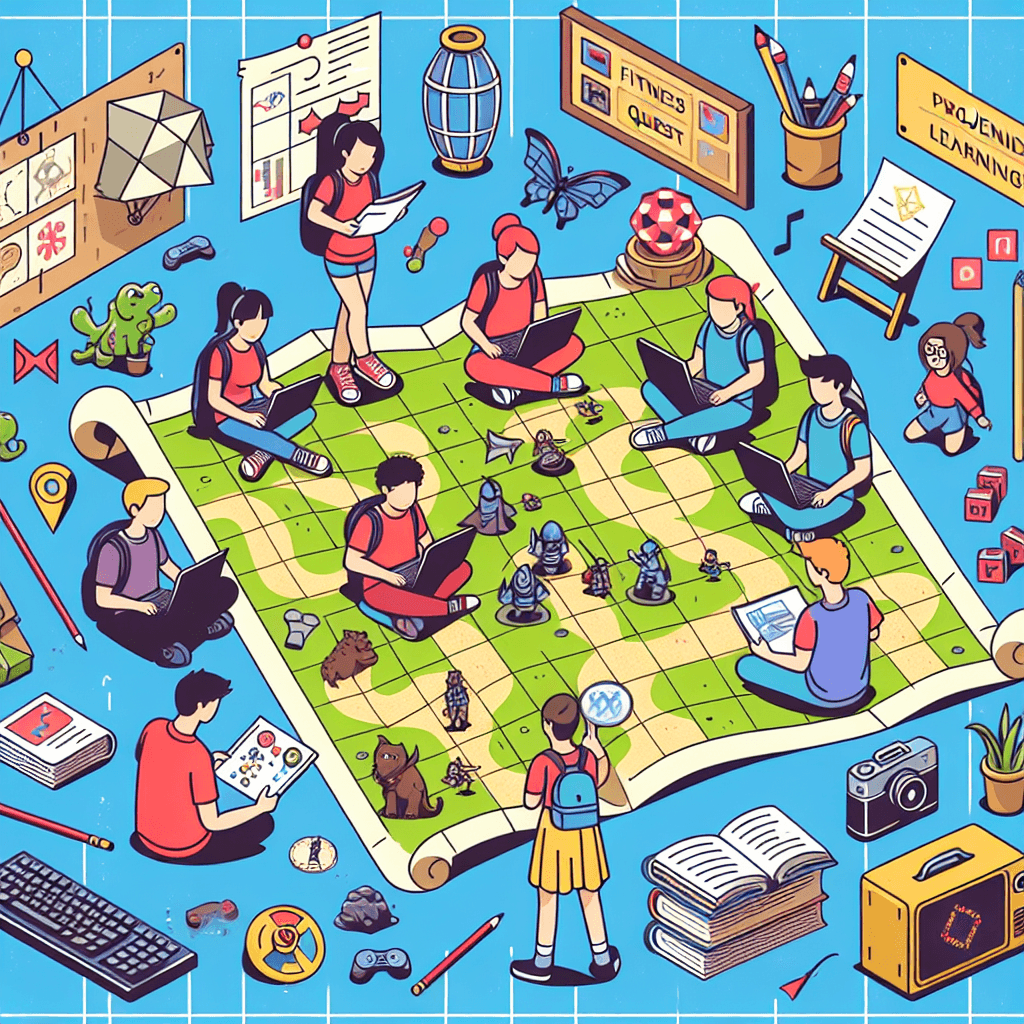
Fitness Quest: A Team RPG Adventure
Inquiry Framework
Question Framework
Driving Question
The overarching question that guides the entire project.How can we, as a legendary adventuring party, use productive collaboration to design and conquer a fitness quest where our collective effort and data unlock the next chapter of our epic story?Essential Questions
Supporting questions that break down major concepts.- How can we work together as a legendary team to achieve fitness goals and conquer an epic live-action adventure?
- What specific roles and behaviors make a person a 'productive collaborator' during a physical challenge?
- How can we design fitness tasks that are inclusive and challenging for every member of our adventuring party?
- How does setting collective goals change the way we approach individual physical effort?
- In what ways does our team's ability to communicate and resolve conflict impact our progress through the story levels?
- How can we track and visualize our fitness data to prove we have 'unlocked' the next stage of our quest?
Standards & Learning Goals
Learning Goals
By the end of this project, students will be able to:- Students will design and execute inclusive fitness challenges that accommodate varying ability levels within their 'adventuring party.'
- Students will demonstrate specific 'productive collaborator' behaviors, such as active listening, conflict resolution, and equitable task distribution, during physical challenges.
- Students will set collective, data-driven fitness goals and monitor progress using tracking tools to determine story progression.
- Students will communicate effectively under physical exertion to coordinate movements and strategy during 'boss battle' fitness scenarios.
- Students will analyze and visualize team fitness data to provide evidence of achieving quest milestones.
SHAPE America National PE Standards
Common Core State Standards (ELA)
Common Core State Standards (Math)
Entry Events
Events that will be used to introduce the project to studentsThe Guild Assembly Trials
Instead of a traditional syllabus, students are handed 'Hero Stat Sheets' and told they must form diverse 'Guilds' where every member's unique physical strength (speed, power, flexibility, or endurance) is vital. They are tasked with navigating a 'fog of war' obstacle course where certain members are blinded or restricted, forcing total reliance on their teammates' communication and physical guidance.Portfolio Activities
Portfolio Activities
These activities progressively build towards your learning goals, with each submission contributing to the student's final portfolio.The Guild Constitution & Hero Stat Mapping
Before embarking on the quest, guilds must understand the unique powers each member brings to the party. Students will create a 'Hero Stat Sheet' that identifies their personal strengths in the five components of health-related fitness (e.g., High Endurance for a Ranger, High Power for a Warrior). They will then draft a 'Guild Charter'—a contract that outlines how they will communicate, resolve conflicts, and ensure every member is included, regardless of their 'stat' levels.Steps
Here is some basic scaffolding to help students complete the activity.Final Product
What students will submit as the final product of the activityA 'Guild Manifesto' including a set of 'Member Profile Cards' and a signed collaboration agreement.Alignment
How this activity aligns with the learning objectives & standardsThis activity aligns with SHAPE.S4.M4.6 (Accepting differences in physical development) by requiring students to recognize and value varied physical 'stats' in their peers. It also meets CCSS.ELA-LITERACY.SL.6.1 by facilitating collaborative discussions to establish group norms.Architects of the Trial: Quest Level Design
Guilds will act as 'Dungeon Masters' to design one stage of the Fitness Quest. They must create a physical challenge that incorporates at least two components of health-related fitness (e.g., a muscular endurance wall-sit challenge that unlocks a cardiorespiratory endurance relay). Crucially, the challenge must be 'inclusive by design,' meaning it must have modifications so that every guild member, regardless of their physical baseline, can contribute to the team’s success.Steps
Here is some basic scaffolding to help students complete the activity.Final Product
What students will submit as the final product of the activityA 'Trial Blueprint' featuring a map of the challenge, equipment list, and a 'Modifications Menu' for inclusivity.Alignment
How this activity aligns with the learning objectives & standardsThis aligns with SHAPE.S3.M7.6 (Identifying components of health-related fitness) as students must apply these concepts to their designs. It also addresses SHAPE.S4.M5.6 by requiring cooperation to ensure the challenge is inclusive.The Data Scroll: Tracking Guild Experience
To progress through the story, guilds must collect 'Experience Points' (XP) based on their actual physical effort. In this activity, students will design a 'Data Scroll' (a tracking spreadsheet or visual chart). They will determine what numerical data they need to collect (e.g., total heart rate points, total repetitions, or seconds held in a plank) to prove they have 'defeated' a level. They will then practice summarizing this data to show their collective progress toward a goal.Steps
Here is some basic scaffolding to help students complete the activity.Final Product
What students will submit as the final product of the activityAn interactive 'Quest Progress Dashboard' (physical or digital) that visualizes the team's fitness data.Alignment
How this activity aligns with the learning objectives & standardsThis aligns with CCSS.MATH.CONTENT.6.SP.B.5 (Summarizing numerical data sets) and SHAPE.S4.M5.6, as students must collaborate to track and interpret their collective physical output.The Grand Boss Battle: Collaboration in Action
This is the final performance of the Quest. Guilds will navigate the challenges they and their peers designed. During this 'Live Action RPG,' students must demonstrate the collaboration skills they've practiced: communicating strategy mid-exercise, offering physical guidance, and using their data scrolls to prove they've 'unlocked' the victory. Teachers will observe for specific collaborator behaviors like 'pivoting strategy when a teammate struggles' and 'equitable distribution of roles.'Steps
Here is some basic scaffolding to help students complete the activity.Final Product
What students will submit as the final product of the activityThe 'After-Action Report' (AAR)—a reflective video or written portfolio entry detailing how the guild's collaboration led to victory (or what they would change for the next 'season').Alignment
How this activity aligns with the learning objectives & standardsThis aligns with SHAPE.S4.M5.6 (Cooperating in adventure activities) and CCSS.ELA-LITERACY.SL.6.1 (Expressing ideas clearly under pressure). It is the culmination of being a 'productive collaborator.'Rubric & Reflection
Portfolio Rubric
Grading criteria for assessing the overall project portfolioFitness Quest: The Live RPG Mastery Rubric
Social-Emotional & Interpersonal Dynamics
This category focuses on the interpersonal skills and ethical design choices required to function as a successful adventuring party.Productive Collaboration & Communication
Assessment of the student's ability to communicate, resolve conflict, and demonstrate 'Guild Laws' during high-exertion physical trials and strategy sessions.
Exemplary
4 PointsDemonstrates proactive leadership by anticipating group needs; uses sophisticated communication to resolve conflicts immediately; consistently applies 'Guild Laws' even under extreme physical exertion.
Proficient
3 PointsCooperates effectively during all adventure activities; uses pre-planned 'Collaborative Callouts' to coordinate strategy; contributes meaningfully to all group discussions and goals.
Developing
2 PointsParticipates in group tasks but communication is inconsistent; requires teacher prompts to use 'Guild Laws' or resolve conflicts; role participation is present but passive.
Beginning
1 PointsStruggles to engage in collaborative discussions; communication is minimal or counterproductive during physical tasks; does not follow established team norms or 'Guild Laws.'
Inclusive Design & Peer Respect
Evaluates how well students recognize diverse physical abilities and design 'Modifications Menus' to ensure all guild members can succeed regardless of their 'Hero Stats.'
Exemplary
4 PointsExhibits exceptional empathy and foresight; designs innovative, challenging modifications that celebrate diverse physical 'Hero Stats' and ensure total group success.
Proficient
3 PointsAccepts differences in classmates' physical development; creates clear, fair modifications that allow every member of the guild to participate in the designed quest levels.
Developing
2 PointsIdentifies differences in physical ability but modifications are basic or do not fully address the needs of all team members; shows emerging respect for diverse peer strengths.
Beginning
1 PointsDesigns challenges that are exclusionary or lack necessary modifications; demonstrates limited understanding of how to adapt physical tasks for varying ability levels.
Academic Integration & Physical Mastery
This category assesses the technical application of physical education concepts and the mathematical integration of fitness data.Health-Related Fitness Application
Measures the accuracy and creativity in applying health-related fitness components (endurance, strength, flexibility, etc.) within the RPG quest design.
Exemplary
4 PointsIntegrates three or more fitness components seamlessly into a complex quest narrative; provides a sophisticated rationale for how each task builds specific physical 'stats.'
Proficient
3 PointsCorrectly identifies and applies at least two components of health-related fitness in the 'Trial Blueprint'; tasks clearly target the intended physical goals.
Developing
2 PointsIdentifies fitness components but the application in the quest design is vague or inconsistent; shows emerging understanding of how tasks impact the body.
Beginning
1 PointsFails to connect quest tasks to specific health-related fitness components; the blueprint lacks clear physical goals or intentional design.
Data Literacy & XP Tracking
Evaluates the ability to collect, summarize (mean, sum), and visualize team XP data to provide evidence of quest progression.
Exemplary
4 PointsProduces a flawless 'Data Scroll' with advanced visualizations; uses data to make real-time strategic adjustments; provides a sophisticated summary of collective performance.
Proficient
3 PointsAccurately tracks individual contributions and calculates the 'Guild Mean' and 'Total Sum'; provides a clear, numerical summary of team progress toward goals.
Developing
2 PointsMaintains a basic tracking system with minor errors in data collection or calculations; data visualization is present but lacks clarity or detail.
Beginning
1 PointsData tracking is incomplete or contains significant mathematical errors; fails to use numerical data to summarize guild performance or 'unlock' levels.
Reflection & Growth Mindset
This category evaluates the student's ability to analyze their learning journey and identify pathways for future development.Metacognitive Reflection (AAR)
Assesses the depth of the student's reflection in the 'After-Action Report,' focusing on growth mindset and future collaborative improvement.
Exemplary
4 PointsProvides a profound metacognitive analysis; identifies specific moments of growth and details a comprehensive strategy for future collaborative improvement.
Proficient
3 PointsReflects clearly on team performance; identifies what led to victory and honestly assesses personal and group collaborative behaviors.
Developing
2 PointsReflection is mostly descriptive and surface-level; focuses on what happened during the quest rather than how the collaboration or data impacted the outcome.
Beginning
1 PointsReflection is incomplete or lacks detail; shows little to no understanding of how personal effort or group dynamics influenced the results.